What Rubber Pulley Lagging Does
Rubber pulley lagging is the rubber layer bonded to the shell of a conveyor pulley to raise friction between the drum and the conveyor belt. On a drive pulley, that friction is what turns belt tension into forward motion without slip. On a tail or bend pulley, lagging mainly protects the shell and helps the belt track more consistently. The product is also called rubber drum lagging or pulley rubber covering, and it is specified by surface pattern, thickness and hardness rather than by a single universal standard.
In a quarry, a coal washing plant or a cement clinker line, a slipping drive pulley quickly becomes a production problem. Correctly chosen lagging keeps the friction coefficient stable in wet, dusty or oily conditions and absorbs some of the shock from lumpy material on the belt.
How the Lagging Is Built
Most rubber pulley lagging is supplied in two forms. Cold-bonded lagging comes as sheets or strips with a pre-applied adhesive system, cut to the shell width and pressed on site. Hot-vulcanized lagging is applied in a workshop and cured under heat and pressure, giving a continuous bond around the drum. Both use a rubber compound selected for abrasion resistance and oil resistance where needed.
The surface form matters as much as the compound:
- Plain or flat rubber for general duty and cleaner belts.
- Diamond lagging to channel water and fines away from the contact patch.
- Herringbone lagging for higher grip on reversing or heavily loaded drives.
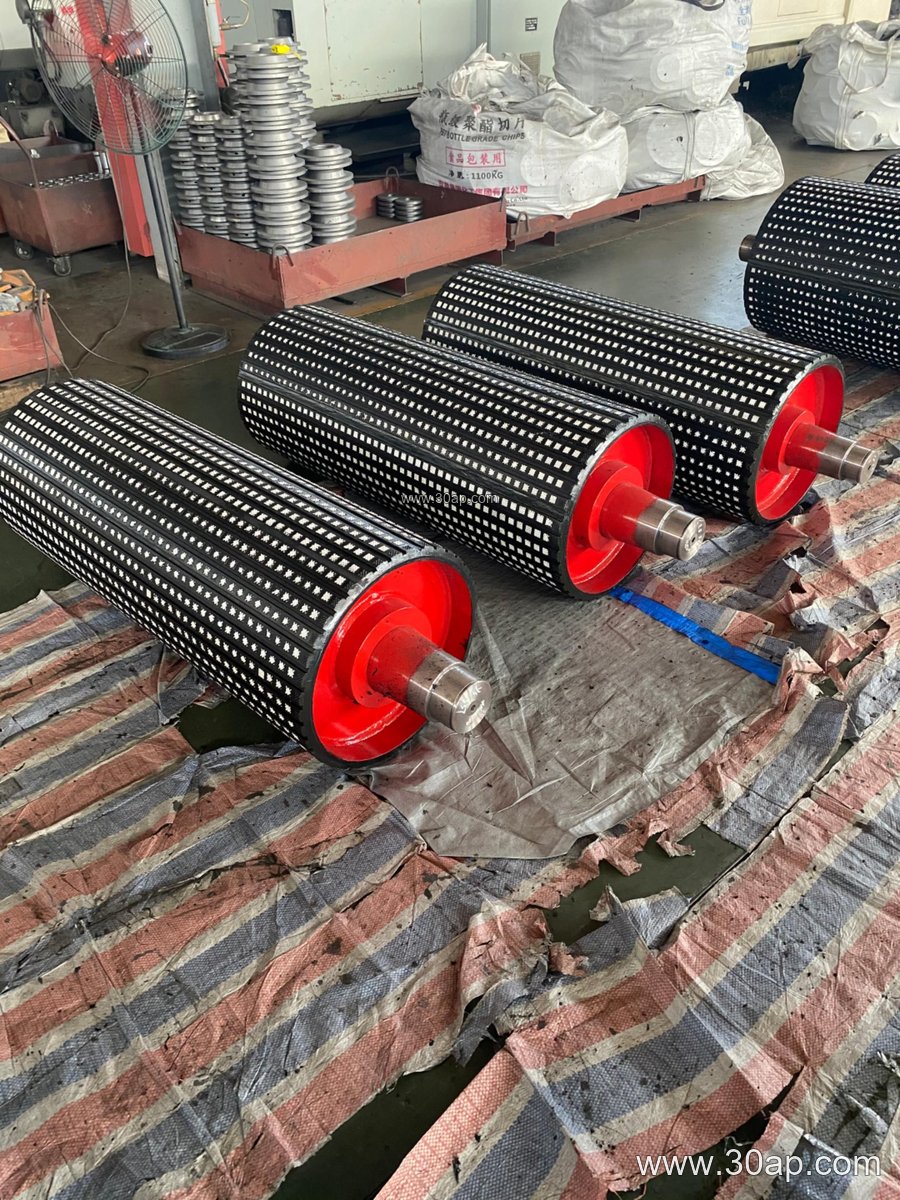
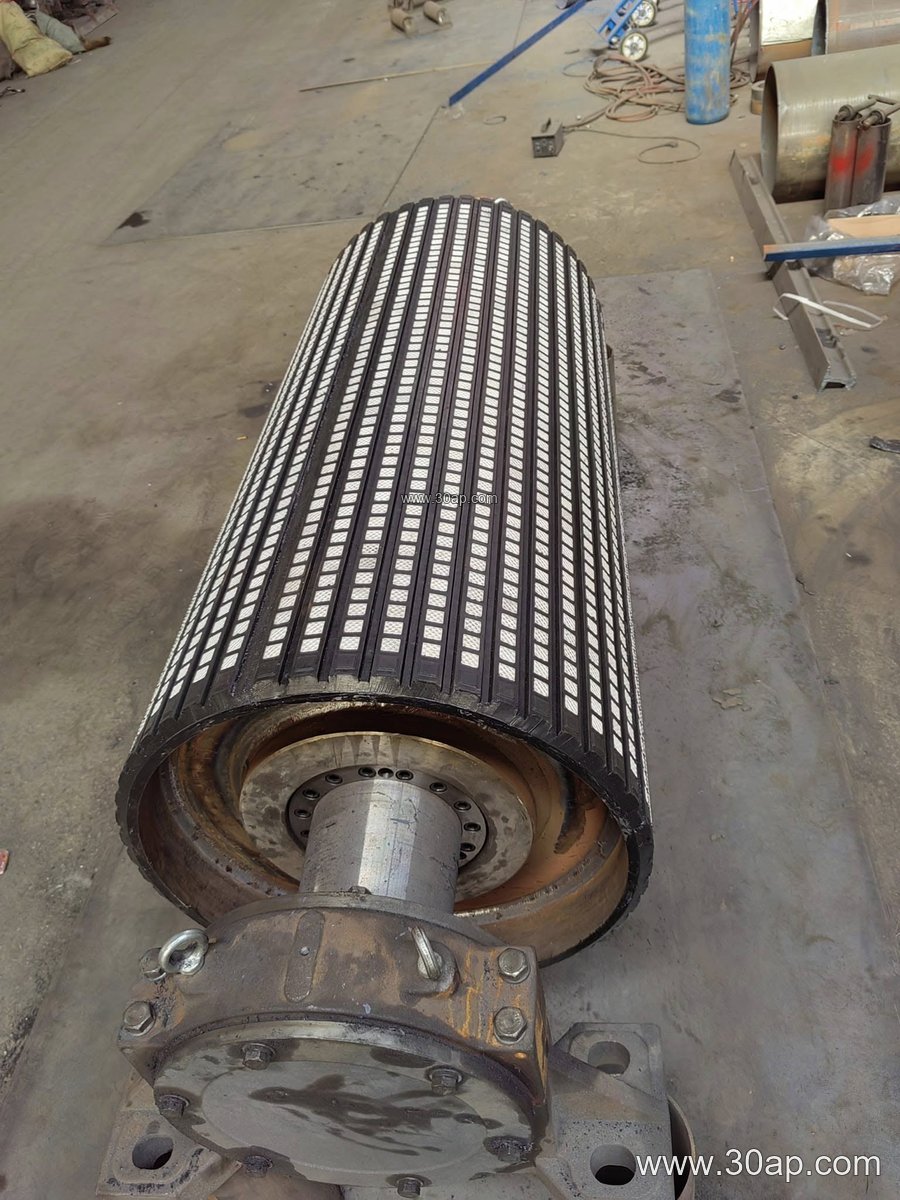
- Ceramic lagging where abrasive rock or sinter puts severe wear on the shell.
Common lagging thicknesses are 8, 10, 12, 15 and 20 mm. Thicker rubber lasts longer but adds weight and changes the effective drum diameter, so the drive calculation should account for it.
Where It Fits on the Conveyor
The main subject is the rubber covering itself, and its duty changes with pulley position. A head or drive pulley needs maximum grip and usually receives diamond or herringbone lagging. A tail pulley often uses plain or lightly patterned rubber to protect the shell from carryback. A bend or take-up pulley may use thinner lagging simply to keep the belt centered and reduce shell wear.
These positions are not interchangeable. A tail pulley specification should not be copied onto a drive pulley, because the friction demand and the risk of slip are different. Where a conveyor has a snub or pressure pulley, a thinner flat rubber is often enough to guide the belt without overloading the shaft.
Sizing Notes for Buyers
Lagging is ordered against the pulley shell width and diameter, not against belt width alone. Shell width is normally slightly greater than the belt width, as the reference values below suggest. These are typical figures for orientation, not fixed supply promises.
| Belt width | Typical shell width |
|---|---|
| B400 | about 500 mm |
| B650 | about 750 mm |
| B800 | about 950 mm |
| B1000 | about 1150 mm |
| B1200 | about 1400 mm |
| B1400 | about 1600 mm |
| B1600 | about 1800 mm |
Pulley diameters commonly range from Ø200 up to Ø1800, and combinations such as B800 × Ø500, B1200 × Ø1000 or B1400 × Ø800 appear in real installations. A given belt width can work with more than one drum diameter, so the final choice belongs to the conveyor designer. Shaft diameter is set by torque and load, commonly Ø50 to Ø200, and should never be guessed from belt width alone.
Selection and Maintenance Points
Ask for the rubber compound, hardness, thickness and surface pattern in writing, and confirm whether the lagging will be cold-bonded on site or hot-vulcanized in a workshop. Check that the pulley shell has been cleaned and, for cold bonding, that ambient temperature and humidity suit the adhesive.
During operation, inspect lagging for grooves, glazing, lifted edges and embedded stone. Worn diamond or herringbone patterns lose water-shedding ability and slip returns. Re-lagging a drive pulley is far cheaper than replacing a scorched conveyor belt, and it also protects the conveyor bracket and bearing from the vibration that slip creates.
Rubber pulley lagging is a small part of the conveyor, but it decides how much of the drive motor’s effort reaches the belt. Matching pattern, thickness and bond method to the pulley position is the core of a sound specification.