What a Conveyor Support Leg Does
A conveyor support leg is the vertical structural member that carries the weight of a belt conveyor frame and transfers it to the floor, foundation, or steel structure below. In a typical conveyor section, the support leg sits under the stringer or longitudinal beam and connects to a conveyor bracket that holds the idler roller or conveyor pulley assembly. Without properly sized legs, the frame sags, the belt misaligns, and the whole conveying line loses reliability.
The support leg is not a glamorous component, but it is a load-bearing one. In a quarry or aggregate line, a heavy frame filled with stone demands sturdy legs spaced at regular intervals. In a coal mining conveyor or underground coal mining conveyor, legs must fit tight galleries and still resist vibration from the drive. The same basic part appears across many industries, from cement plants to power plant coal handling.
How the Leg Is Built
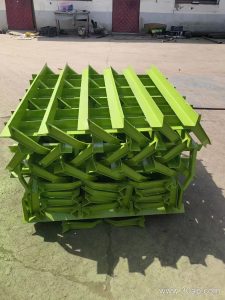
Most support legs are fabricated from angle steel, channel steel, or folded steel plate. The choice depends on the load and the mounting style. A welded leg with a base plate and bolt holes is common for fixed installations, while an adjustable leg uses slotted holes or a telescoping section to fine-tune frame height during installation.
Typical details include:
- Base plate with anchor bolt holes for floor or foundation mounting
- Top plate or clevis that bolts to the stringer or conveyor bracket
- Gussets or stiffeners at the corner welds to resist bending
- Optional height adjustment of a few tens of millimeters for alignment
The leg height and cross-section follow the conveyor design. A short leg under a B650 frame carrying a light fabric core conveyor belt is very different from a tall leg under a B1800 heavy-duty mining conveyor belt. The mounting hole spacing and beam length usually change with belt width and trough angle, so these values should be confirmed against the frame drawing rather than assumed.
Where Support Legs Are Used
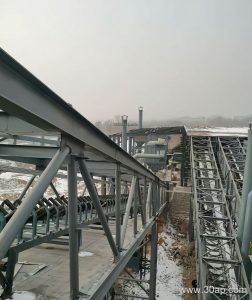
Support legs appear wherever the conveyor frame needs ground support. In a stone crushing plant, legs hold the sections between the crusher conveyor belt and the screening deck. In a port or ship loading conveyor, taller legs and braced frames carry the belt over long spans. In a cement plant, legs are often galvanized or painted to handle dust and moisture.
They are also common in less obvious places. A food grade conveyor belt line in a processing hall uses stainless or coated legs for hygiene. A fertilizer or grain silo conveyor uses compact legs to keep the frame low. Even a pipe conveyor belt system, which encloses the material, still relies on support legs along its trestle.
Matching Legs to Frame and Idlers
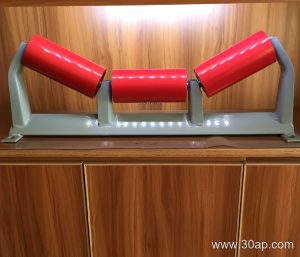
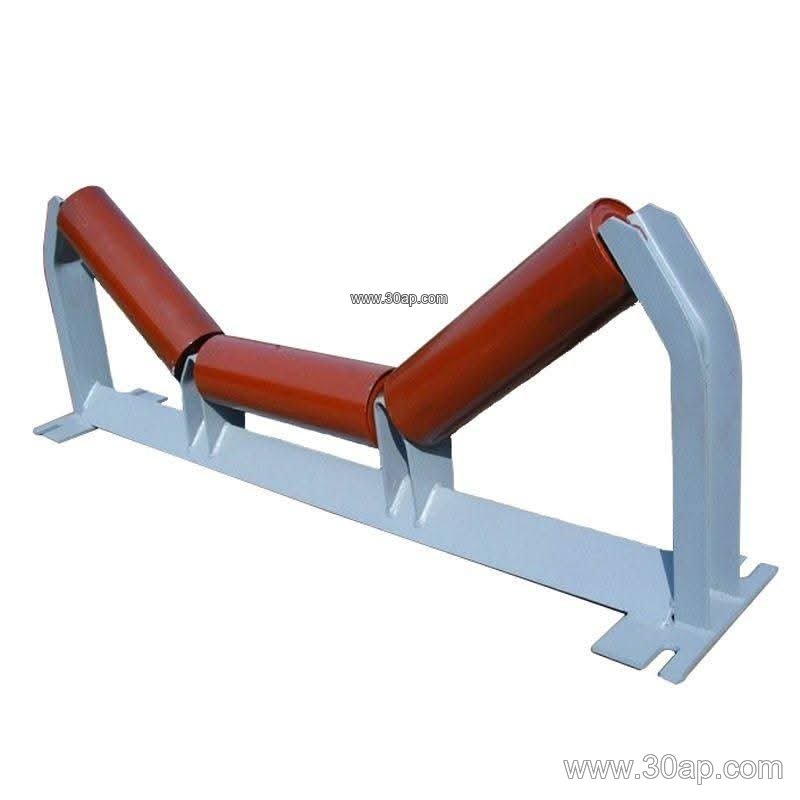
The support leg works as part of a system. The trough angle of the idler set affects the frame width and therefore the leg position. Common trough angles are 20, 30, 35, and 45 degrees, and an adjustable bracket can shift between these settings. Idler diameters such as Ø89, Ø108, Ø133, Ø159, and Ø194 also influence the frame height and the clearance under the belt.
Below is a reference table of common frame combinations. These are examples, not fixed rules.
| Belt Width | Trough Angle | Idler Diameter | Typical Use |
|---|---|---|---|
| B650 | 30 degrees | Ø89 | Light aggregate, sand line |
| B800 | 35 degrees | Ø108 | Quarry, cement plant |
| B1000 | 35 degrees | Ø133 | Coal handling, power plant |
| B1200 | 45 degrees | Ø133 | Iron ore, heavy bulk material |
| B1400 | 35 degrees | Ø159 | Port, ship loading |
| B1600 | 45 degrees | Ø159 | Mining, primary crushing |
A wider belt such as a 1200mm wide conveyor belt or 1500mm wide conveyor belt needs a longer cross beam, which in turn changes the leg top connection. The leg itself does not have to be wider, but its mounting plate and bracing must match the frame. Do not assume that one belt width locks in one pulley diameter or one leg size; the design engineer sets the combination.
What Buyers Should Check
Before ordering, confirm the frame drawing, the leg height, the base plate hole pattern, and the surface treatment. Ask whether the leg is fixed or adjustable, and whether it is designed for a trough bracket, a return bracket, or a transition section. For a coal mining conveyor belt or a heat resistant conveyor belt application, check that the coating or galvanizing suits the environment.
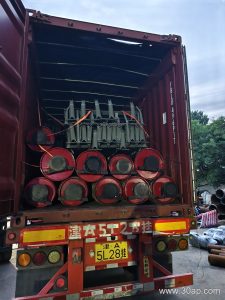
Also consider the installation sequence. Legs are often shipped loose and aligned on site, so a small adjustment range helps. Spare legs and base plates are worth keeping for maintenance. For more conveyor structure guidance, visit www.beltconveyorparts.com/conveyor-support-leg and review related pages on idler roller and conveyor pulley frames.