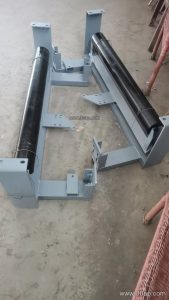
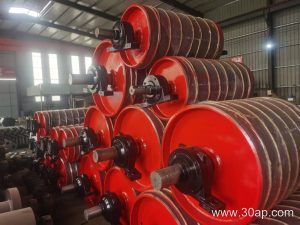
What a Large Conveyor Pulley Does on a Heavy-Duty Line
A large conveyor pulley is the drum that carries and drives the belt at the highest load points of a bulk handling system. In a quarry, a limestone mine, or a coal preparation plant, the head pulley may be the single most heavily stressed rotating part on the line. It has to transmit drive torque, hold belt tension, and keep the belt tracking without flexing under load. Because of that, large drums are usually specified together with the belt they serve, whether that is a heavy-duty mining conveyor belt, an abrasion resistant conveyor belt, or a steel cord conveyor belt carrying ore over long distances.
Buyers often treat the drum as a simple accessory. In practice, the pulley diameter, face width, shaft size, and lagging all interact with belt construction and tonnage. A drum that is too small for the belt stiffness will shorten belt life; a drum that is oversized adds cost and inertia without benefit.
Construction of a Large Drum
The body is normally a rolled steel shell, machined at the ends and welded to dished or flat end discs. The shaft is keyed or shrink-fitted into the hubs, and bearing housings sit on a sturdy frame or conveyor bracket. Larger units often use a turbine or wing-type end disc to reduce weight while keeping stiffness.
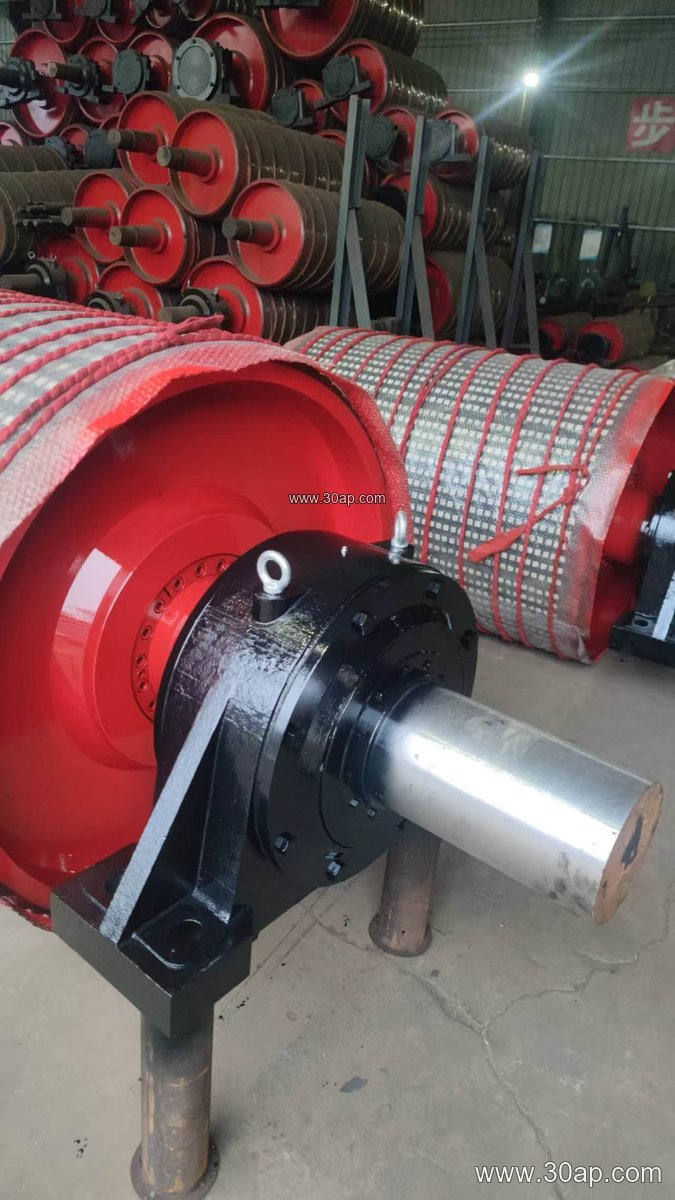
- Shell thickness selected for belt tension and local load
- Shaft diameter set by torque and bending load, not by belt width alone
- Lagging applied to improve grip and protect the shell
- Bearings sized for radial load and service life
Surface options include plain, hot-vulcanized rubber, cold-bonded rubber, diamond groove, herringbone, and ceramic lagging. Common lagging thicknesses are 8, 10, 12, 15, and 20 mm. Herringbone or diamond patterns help shed water and fines on wet quarry belts, while ceramic tiles suit high-slip drive positions.
Matching Diameter and Face Width to the Belt
Face width is usually a little wider than the belt. Common references include B800 with roughly 950 mm face, B1000 with about 1150 mm, B1200 with about 1400 mm, and B1400 with about 1600 mm. Diameters commonly range from Ø200 up to Ø1800, though heavy head drums in iron ore or copper ore duty often sit in the Ø800 to Ø1400 band. A combination such as B1200 × Ø1000 or B1400 × Ø800 is a normal reference, not a rule; the same belt width can work with more than one drum diameter depending on tension and belt stiffness.
| Belt width | Typical face width | Reference diameter range |
|---|---|---|
| B800 | about 950 mm | Ø500 to Ø1000 |
| B1000 | about 1150 mm | Ø630 to Ø1250 |
| B1200 | about 1400 mm | Ø800 to Ø1400 |
| B1400 | about 1600 mm | Ø800 to Ø1600 |
Shaft diameters commonly fall between Ø50 and Ø200, but the final value must come from torque and load calculation. Do not assume a shaft size from belt width alone.
Where Large Pulleys Are Used
In a sand and gravel plant, the head drum at the discharge end of a crusher conveyor sees constant abrasion. In a power plant coal yard, flame retardant and anti-static belt grades are common, and the drive pulley must be lagged for wet, dusty conditions. Cement plants use large tail and bend drums on clinker lines where heat resistant conveyor belt grades are needed. Port bulk terminals rely on wide face drums for ship loading conveyors, and tunnel spoil lines use compact but strong bend pulleys to route the belt around curves.
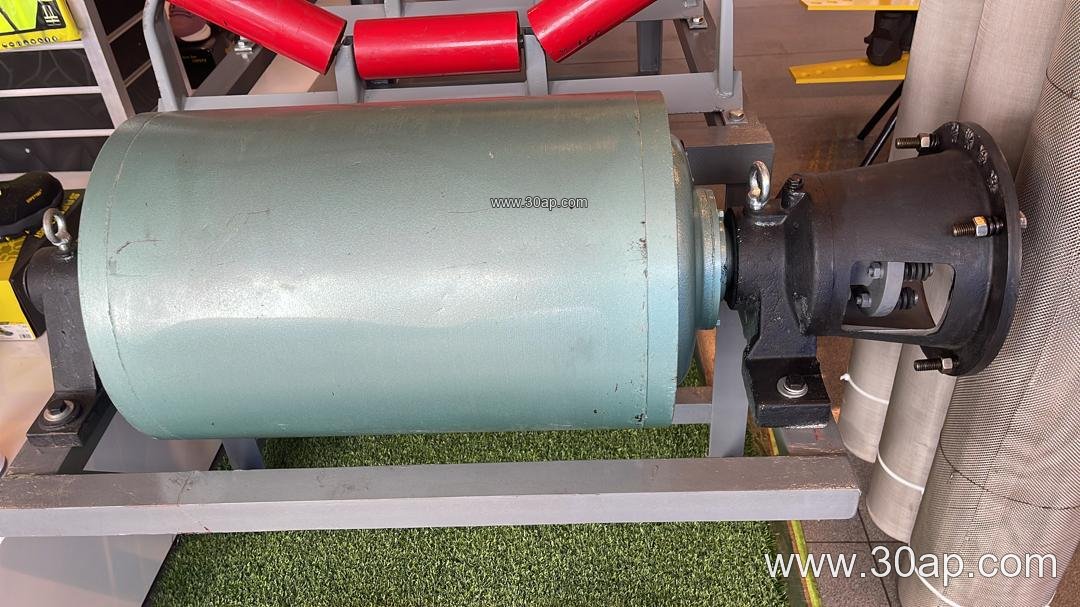
The drive, tail, and bend positions are not interchangeable. A drive pulley transmits torque and usually carries the thickest lagging; a tail pulley tensions and trains the belt; a bend pulley only changes direction and can be smaller and lighter for the same belt. Electric drums combine motor and gearbox inside the shell and are used where space is tight.
Buyer Checklist
- Confirm belt type and tension: EP, NN, multi-ply fabric core, or steel cord
- Check drum diameter against belt minimum bend radius
- Specify lagging pattern and thickness for the duty
- Provide shaft load data so the supplier can size the shaft and bearings
- Confirm face width, keyway, and mounting bracket dimensions
- Plan inspection of lagging wear, bearing temperature, and tracking
For any large conveyor pulley project, share the belt specification and the duty point first. The drum, conveyor belt, and idler roller set work as one system, and the right drum is the one sized for that system rather than copied from a catalogue page.