What Is an Anti-Static Conveyor Belt?
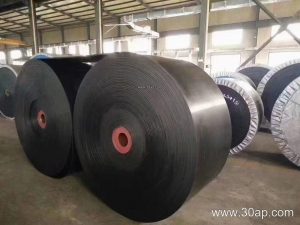
An anti-static conveyor belt is a rubber or fabric-reinforced belt designed to dissipate static electricity that builds up as the belt runs over pulleys and idler rollers. In dusty or explosive atmospheres—such as coal mining, cement plants, power plants, and sand and gravel yards—a spark from accumulated static can be a serious hazard. This belt minimizes that risk by providing a controlled path for electrical charges to bleed off, rather than storing them on the belt surface.
The product is also called an antistatic conveyor belt, and both terms refer to the same static-dissipative belt construction. It is not a replacement for a flame retardant conveyor belt, though the two properties are often combined in underground coal mining conveyor belts where both fire and static risks exist.
Construction and Static-Control Features
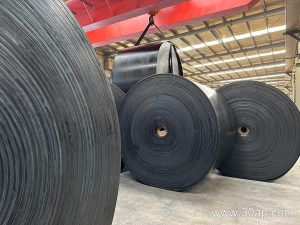
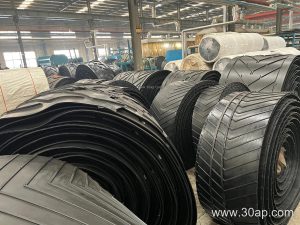
An anti-static belt typically uses a fabric core—EP conveyor belt or NN conveyor belt—with rubber covers that include conductive carbon black or other antistatic additives. The cover compound is formulated to reach a surface resistance low enough to prevent charge accumulation, while still meeting the mechanical demands of the application. Common cover thicknesses are 3+1.5 mm, 4+2 mm, 5+2 mm, and 6+2 mm, with 2 to 6 fabric plies depending on strength class.
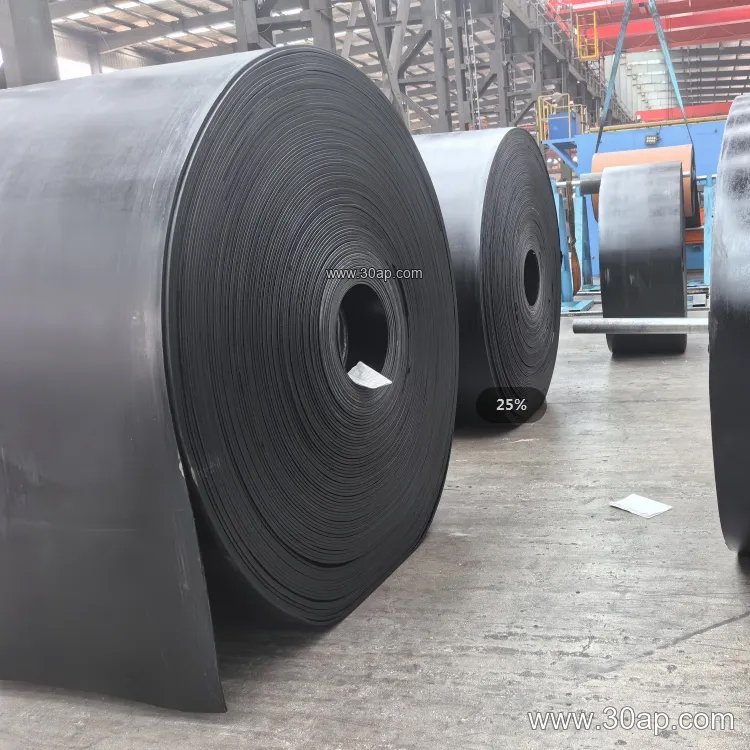
The belt may also be produced as a multi-ply fabric core conveyor belt for heavy loads, or with a steel cord conveyor belt core when very high tension is required. Static control is a property of the compound and construction, not a separate layer, so it must be specified together with abrasion resistance, flame resistance, or oil resistance as needed.
Where It Is Used
Static buildup is a concern wherever dry bulk materials move fast and dust is present. Typical industries include:
- Coal mining and underground coal mining operations, where anti-static and flame retardant properties are often required together.
- Cement plants and power plants handling coal, clinker, or fly ash.
- Quarries, aggregate plants, and sand making plants moving crushed stone and sand.
- Ports and ship loading facilities where bulk material conveyor belts run at high speed.
- Recycling and construction waste lines where mixed materials generate triboelectric charge.
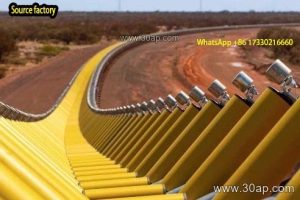
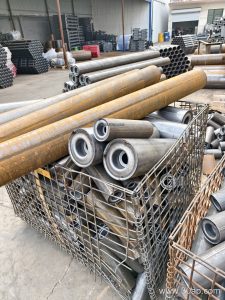
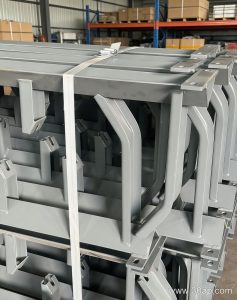
In these settings, the belt works alongside conveyor pulleys, idler rollers, and conveyor brackets that must be properly grounded to complete the dissipation path. A static-conductive belt alone is not sufficient if the conveyor frame is not grounded.
Specifications and Selection Notes
Anti-static belts are available in the same strength and width ranges as standard fabric core belts. The table below shows common reference values; actual supply depends on the manufacturer and the conveyor design.
| Property | Common Reference Range |
|---|---|
| Strength class (EP) | EP200, EP315, EP400, EP500, EP630, EP800, EP1000, EP1250, EP1600 |
| Belt width | B500, B650, B800, B1000, B1200, B1400, B1600, B1800, B2000 |
| Cover thickness | 3+1.5 mm, 4+2 mm, 5+2 mm, 6+2 mm |
| Number of plies | 2 to 6 (fabric core) |
| Static property | Anti-static (surface resistance typically specified by the buyer) |
When selecting an anti-static conveyor belt, confirm the required strength class, belt width, cover thickness, and whether flame retardant or heat resistant properties are also needed. For example, a coal mining conveyor belt may need anti-static plus flame retardant, while a cement plant belt may need anti-static plus abrasion resistance. The belt width must be matched to the conveyor pulley and idler roller dimensions by the conveyor designer; one belt width does not dictate a single pulley diameter.
Buyer Checklist
- Verify that the antistatic property is stated in the supplier’s technical data, not assumed from a general rubber compound.
- Check that the conveyor frame, pulleys, and idler rollers are grounded to allow static discharge.
- Consider combined properties: flame retardant conveyor belt for underground use, heat resistant conveyor belt for hot materials, oil resistant conveyor belt for oily loads.
- Match belt strength and width to the conveyor design, not to a fixed rule of thumb.
- Inspect splices and edges, as these areas can affect both mechanical life and static continuity.
For more information on anti-static conveyor belts and related components such as conveyor idler rollers and pulleys, contact your conveyor belt supplier with the full duty description.