What the Ø159 Conveyor Idler Is
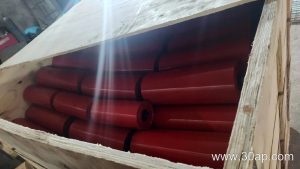
The Ø159 Conveyor Idler is a carrying or return roller with a nominal shell diameter of 159 mm, widely used on medium and large belt conveyors where the belt carries dense or abrasive bulk material. In the trench of a three-roll trough set, this diameter sits between the lighter Ø133 group and the very heavy Ø178 and Ø194 sizes, which makes it a practical middle choice for main haulage lines in quarry conveyor belt circuits, cement plants and power station coal handling.
It is not a pulley. A conveyor pulley drives, returns or bends the belt at the ends of the machine, while an idler roller supports the belt along its run. The Ø159 roller is a support component, and its job is to keep the belt profile stable, reduce sag between frames and let the belt travel with low rolling resistance.
Construction Details
A typical Ø159 Conveyor Idler is built from a steel tube shell, a through shaft, sealed bearing housings at both ends, and a set of bearing seals that keep dust and water out. A simple outline is shown below.
- Shell: welded steel tube, machined at the ends for bearing fit
- Shaft: cold drawn or turned steel, with flattened ends for bracket mounting
- Bearings: commonly 6305, 6306, 6308 or 6310, chosen by load and speed rather than by diameter alone
- Seals: labyrinth or combined lip seal, sometimes with a dust guard
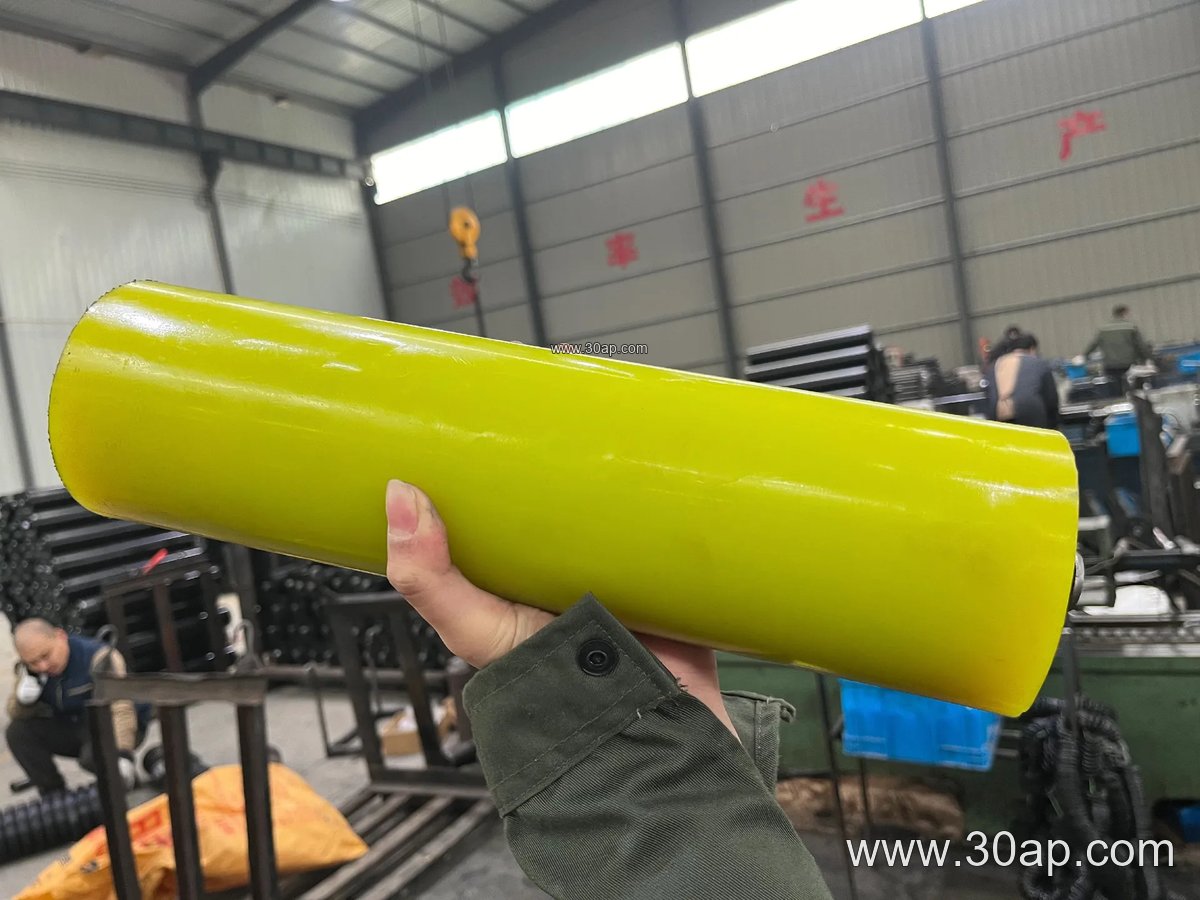
- Surface: plain steel, painted, nylon coated, ceramic lagged or fitted with rubber rings
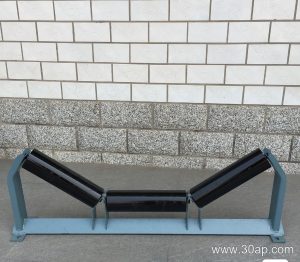
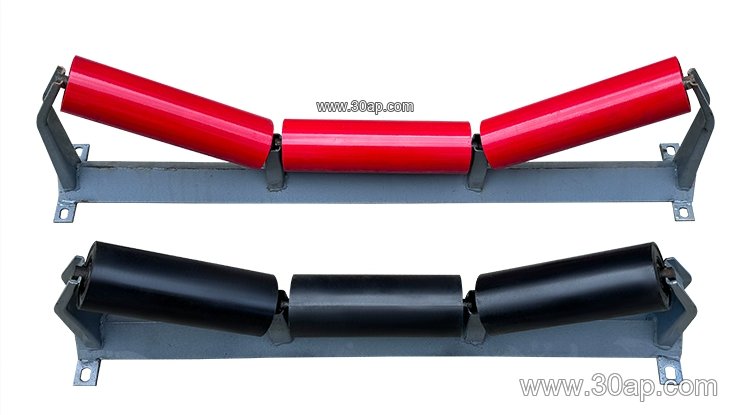
The shell surface is worth attention. A plain steel roll works for clean, dry material. A rubber ring version absorbs impact at transfer points, while ceramic or nylon surfaces help where sticky fines build up on the shell. The Ø159 size is often paired with a three-roll trough set at 30, 35 or 45 degrees, and the roll length is fixed by belt width, trough angle and frame design, not by the diameter alone.
Where It Fits on the Conveyor
These rollers appear in several positions. Troughing idlers carry the loaded belt, return idlers hold the empty belt, and transition idlers ease the belt from flat to troughed shape near the tail. Impact idlers with rubber rings sit under the loading chute, and self-aligning or friction-aligning versions correct belt wander on long runs.
Two settings suit the Ø159 Conveyor Idler especially well. In a limestone quarry or aggregate plant, the belt may be 1000 mm to 1400 mm wide and carry sharp crushed rock, so a robust shell and good sealing matter. In a coal-fired power plant or a coal preparation plant, the belt is often a flame retardant type and the idlers must run quietly for long shifts. In both cases, the roller works together with the conveyor belt, the conveyor pulley at each end, and the conveyor bracket that fixes the frame to the structure.
Common Size References
The following values are common examples, not fixed matches. Actual roll length and bearing size are confirmed by the conveyor design.
| Reference item | Common example |
|---|---|
| Roller diameter | Ø159 mm |
| Belt width | B800, B1000, B1200, B1400, B1600 |
| Trough angle | 30°, 35°, 45° |
| Roll length, three-roll trough (example) | About 315 mm at B800, 380 mm at B1000, 465 mm at B1200, 530 mm at B1400, 600 mm at B1600 |
| Bearing options | 6305, 6306, 6308, 6310 |
| Surface forms | Steel, nylon, ceramic, rubber ring |
Side rolls and centre rolls can differ in length, and a two-roll or single-roll arrangement changes the picture again. A Ø159 roller is not automatically required for every wide belt, and a narrow belt is not limited to one diameter.
Buyer Checklist
Before ordering, confirm the belt width, trough angle, roll length, shaft end shape, bearing number and sealing class. Ask how the roller will be mounted, because bracket dimensions vary between frames. Check the expected belt speed and load, since a larger diameter turns more slowly and can suit high-speed main lines, while smaller diameters may be enough on short transfer conveyors.
For abrasive duty, consider a high abrasion resistant conveyor belt and rollers with thick shells. For hot clinker or sinter, a heat resistant conveyor belt and heat-tolerant bearing grease are more important than the roller diameter. Where coal dust is present, a flame retardant conveyor belt and anti-static components belong in the same specification.
Finally, plan maintenance. Seized rollers damage belts quickly, so keep spare units, check rotation by hand during inspections, and replace any roller that runs hot or wobbles. A well-chosen Ø159 Conveyor Idler, matched to the belt, frame and material, gives long service in demanding plants.