What a Friction Idler Does on a Conveyor
A friction idler is a self-aligning idler roller that corrects belt drift by using the friction between the moving conveyor belt and the roller surface. When the belt wanders to one side, the angled or offset rollers in the assembly turn slightly, and the resulting friction force steers the belt back toward the center line. Unlike a fixed training idler, this design relies on contact and rotation rather than a separate powered actuator. It is a practical, mechanical way to keep a conveyor belt tracking well, especially on long runs where small misalignments would otherwise grow.
The term is sometimes written as friction self-aligning idler or friction training idler. These are accurate equivalent names for the same product. They should not be confused with a drive pulley, tail pulley, or bend pulley. Those are conveyor pulleys that transmit power or change belt direction, and they are not interchangeable with any idler type. A friction idler is part of the idler group that supports and guides the belt, not a pulley that drives it.
How It Is Built
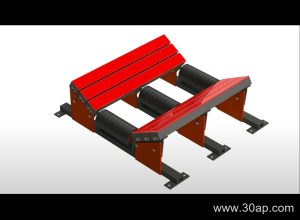
A typical friction idler assembly includes two or more rollers mounted on a pivoting frame. The rollers may be tapered or set at a slight angle, and the frame is free to rotate a small amount around a vertical axis. When the belt contacts the rollers, friction causes the frame to pivot. The direction of pivot depends on which side of the belt is touching with more force, which naturally pushes the belt back to the middle.
Common construction details include:
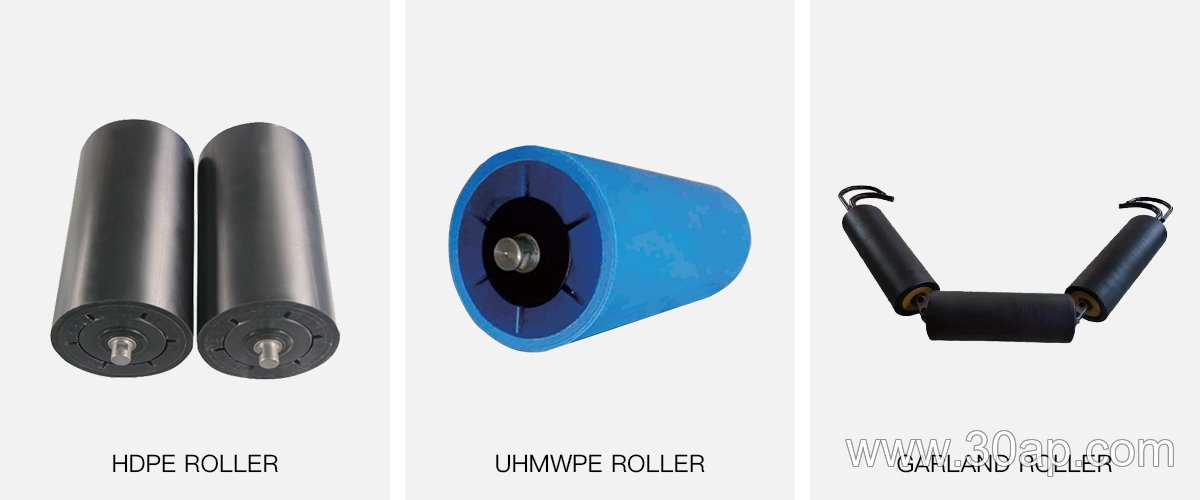
- Roller shell in steel tube, nylon, ceramic, or rubber rings, depending on the material and wear conditions.
- Bearing sizes such as 6204, 6205, 6305, 6306, 6308, or 6310, selected according to the load and roller diameter.
- A pivot mechanism with a vertical shaft and a bracket that mounts to the conveyor frame.
- Seals and grease retention features to keep dust and moisture out of the bearings.
Roller diameter is usually chosen from a range that includes Ø63, Ø76, Ø89, Ø102, Ø108, Ø127, Ø133, Ø159, Ø178, Ø194, and Ø219. Larger diameters generally suit higher belt speeds and heavier loads, but the final choice depends on the conveyor design, not on a single fixed rule. Belt width and roller diameter are matched by calculation, not by a simple one-to-one table.
Where Friction Idlers Are Used
These idlers appear in many bulk material handling systems. In a quarry or a limestone mine, a friction idler is often placed on the carrying side after the loading point to correct belt drift caused by uneven material feed. In a coal washing plant, they help keep the belt centered through transitions and around curves. They are also found in sand and gravel lines, crushing and screening plants, and cement plants.
The table below shows common belt width and roller length examples for three-roll troughing sets. These are typical references, not mandatory combinations.
| Belt width | Common roller length (side roller example) |
|---|---|
| B500 | 200 mm |
| B650 | 250 mm |
| B800 | 315 mm |
| B1000 | 380 mm |
| B1200 | 465 mm |
| B1400 | 530 mm |
| B1600 | 600 mm |
| B1800 | 670 mm |
| B2000 | 750 mm |
Troughing angles of 20, 30, 35, and 45 degrees are common. A forward tilt of about 1.5 to 2 degrees is sometimes used in training idlers to assist alignment, but it is not required in every application. The roller surface may be plain steel, nylon, ceramic, or rubber rings. Rubber rings are often chosen for buffer idlers and impact zones, while ceramic or nylon may be preferred where abrasion or buildup is a concern.
What Buyers Should Check
Before selecting a friction idler, confirm the belt width, the troughing angle, and the mounting position. Check the roller diameter and bearing size against the load and speed. Review the seal type for the site conditions, especially if the conveyor runs in a dusty or wet area. Ask how the pivot mechanism is protected from material buildup, because a jammed pivot will not align the belt.
Also consider the surrounding equipment. A friction idler works with the conveyor belt, the idler roller group, the conveyor pulley, and the conveyor bracket that holds the assembly. It does not replace a drive pulley or a tail pulley. If belt misalignment is severe, check the loading point, the pulley alignment, and the structure before adding more training idlers. A friction idler is a helpful correction device, but it is not a substitute for proper conveyor design and maintenance.