What a Heavy-Duty Lagged Pulley Does on a Conveyor
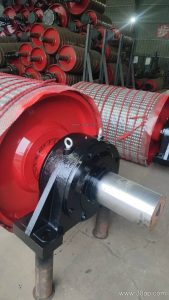
A heavy-duty lagged pulley is a conveyor pulley built for high belt tension, abrasive material, and continuous operation, with a rubber or ceramic lagging bonded to the shell to improve grip and protect the belt. In practice it is usually a drive pulley, though the same heavy construction can appear at the tail or in a bend position. The lagging is what separates it from a plain steel drum: it raises friction between the shell and the conveyor belt, reduces slip under load, and shields the shell from wear.
In a quarry or a limestone crushing line, that grip matters most at the head drive, where the belt carries the full load and the pulley must transfer torque without polishing the belt cover. In a coal handling plant or a power station coal yard, a lagged drum also helps keep the belt tracking through dust and moisture.
Construction Details That Matter
The core is typically a rolled steel shell with welded end discs and a shaft sized by torque and radial load, not by belt width alone. Common shaft diameters include Ø80, Ø100, Ø120, Ø140, Ø160 and Ø180, with larger sizes for heavy drives. The shell is machined, then lagging is applied by hot vulcanizing, cold bonding, or casting directly onto the drum.
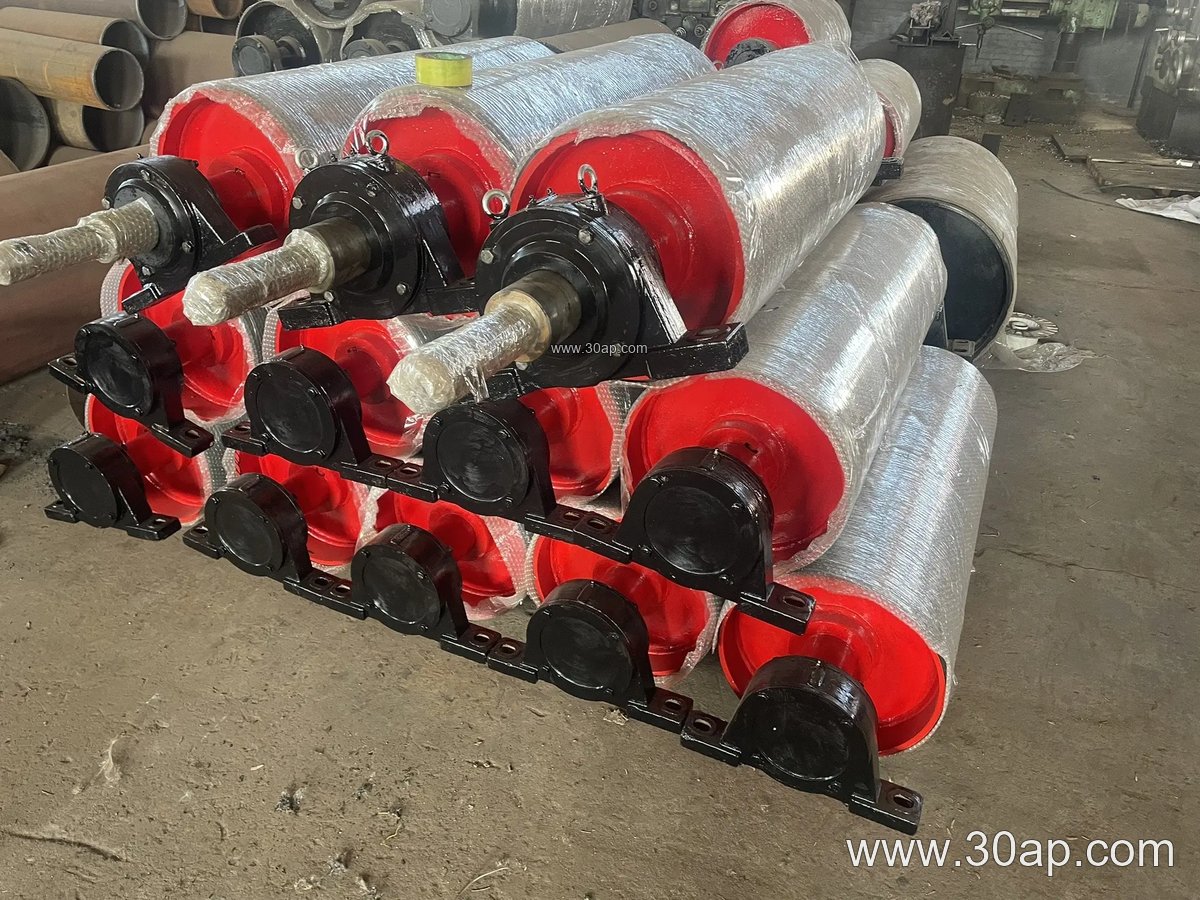
Surface forms are chosen for the duty:
- Diamond lagging for general grip and water shedding
- Herringbone lagging for centering the belt on reversing or long conveyors
- Plain rubber lagging where gentle contact is preferred
- Ceramic lagging for very abrasive, wet, or oily conditions
Lagging thickness is commonly 8, 10, 12, 15 or 20 mm. Thicker lagging extends wear life but adds weight and changes the effective diameter, so it should be specified with the pulley design rather than added later.
Sizing a Heavy-Duty Lagged Pulley
Diameter and face width follow the belt and the tension profile. A useful starting point is that the shell face is usually wider than the belt, for example B650 with roughly 750 mm face, B1000 with about 1150 mm, or B1400 with around 1600 mm. Diameter is then selected from the required wrap angle, belt stiffness, and torque, giving combinations such as B800 × Ø500, B1200 × Ø1000 or B1400 × Ø800. None of these pairings is fixed; a given belt width can work with several diameters depending on the conveyor layout.
| Parameter | Typical Range | Notes |
|---|---|---|
| Belt width | B400 to B2400 | Face width normally exceeds belt width |
| Pulley diameter | Ø200 to Ø1800 | Set by wrap angle and belt tension |
| Lagging thickness | 8 to 20 mm | Match to abrasion and slip risk |
| Shaft diameter | Ø50 to Ø200 | Determined by torque and bearing load |
Where It Fits and What to Check Before Buying
Heavy-duty lagged pulleys appear at drive, tail and bend positions on overland conveyors, stockyard belts, sinter lines, and aggregate plants. They are also used on tunnel spoil belts and fertilizer handling systems where the belt must stay engaged in damp conditions.
Before ordering, confirm the belt width and speed, the calculated torque and radial load, the lagging type and thickness, and whether the pulley is crowned or flat. Check that the conveyor bracket and bearing housings match the shaft ends, and that the idler roller layout upstream does not feed the belt off-center. Ask for the balance grade and runout if the pulley will run at high speed. A heavy-duty lagged pulley is a long-life component, so the specification should come from the conveyor design, not from a catalogue shortcut.