What an Aggregate Production Line Idler Does
In a crushing and screening circuit, the belt conveyor is the artery that moves material between stages. The aggregate production line idler is the rotating component that supports the conveyor belt and the load it carries. Without these rollers, the belt would sag, drag, and wear out quickly. An idler roller is not a motorized part; it spins passively as the belt moves, using bearings and a stationary shaft. In aggregate operations, the environment is abrasive, dusty, and often wet, so idler design must balance free rotation with protection against contamination.
The term idler covers several positions on a conveyor. The most common is the carrying idler, which supports the loaded side of the belt. Return idlers support the empty side. Impact idlers sit under the loading point to absorb the force of falling rock. Training idlers help keep the belt centered. Each position may use a different roller diameter, wall thickness, and bearing size. A buyer should match the idler to the belt width, the material size, and the tonnage per hour, not simply pick the cheapest roller available.
How an Idler Roller Is Built
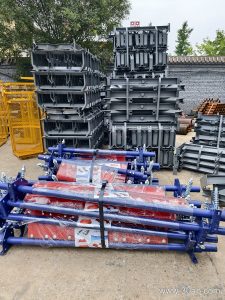
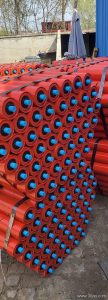
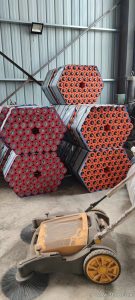
A typical aggregate production line idler consists of a steel tube, a shaft, bearing housings, bearings, and seals. The tube is often made from seamless or welded steel pipe, machined at the ends to hold the bearing seats. Common roller diameters include Ø63, Ø76, Ø89, Ø102, Ø108, Ø127, Ø133, Ø159, and larger sizes up to Ø219 mm. The shaft is usually cold-drawn steel, with flattened ends for mounting into the conveyor bracket. Bearings are typically deep-groove ball bearings such as 6204, 6205, 6305, 6306, 6308, or 6310, selected according to load and speed. Seals may be labyrinth, felt, or contact types, depending on the dust and moisture level.
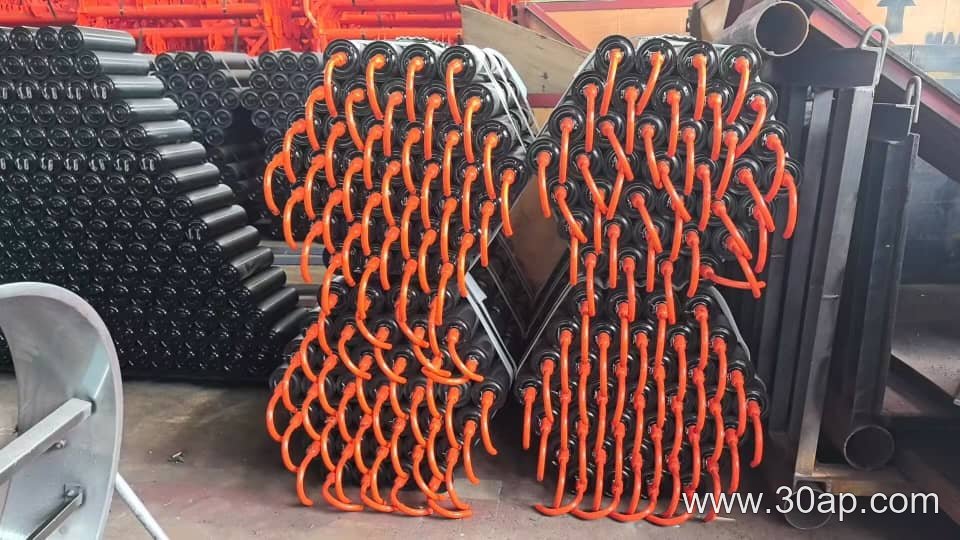
The roller surface can be plain steel, nylon, ceramic, or rubber rings. Rubber rings are common on impact idlers because they cushion lumps and reduce belt damage. Ceramic or nylon coatings may be used where material buildup or abrasion is severe. The bearing housing is often pressed or welded into the tube, and the shaft is fixed so that only the tube and bearing outer race rotate. This simple arrangement keeps friction low and allows the belt to move with minimal power loss.
Where These Idlers Fit in an Aggregate Plant
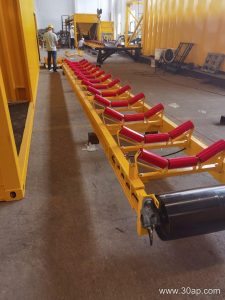
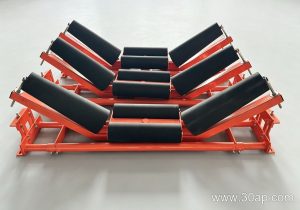
Aggregate production line idlers are found on every belt conveyor in a quarry, sand and gravel pit, or crushing and screening plant. They are also used in concrete batching plants, cement plants, and coal preparation facilities where similar bulk handling occurs. On a primary jaw crusher discharge belt, impact idlers are placed under the crusher outlet to handle large, sharp rocks. Along the main transfer conveyor, three-roll troughing idlers with a 20-degree, 30-degree, 35-degree, or 45-degree trough angle keep the material centered. On the return strand, flat or V-return idlers support the empty belt. Transition idlers are used near pulleys to gradually change the belt from troughed to flat, reducing stress at the belt edges.
Belt width and idler length are related but not fixed. For a three-roll troughing set, common roll lengths are approximately 200 mm for B500, 250 mm for B650, 315 mm for B800, 380 mm for B1000, 465 mm for B1200, 530 mm for B1400, 600 mm for B1600, 670 mm for B1800, and 750 mm for B2000. These are typical examples, not universal rules. The side rolls and center roll may differ in length depending on the trough angle and frame design. A buyer should always confirm the belt width, trough angle, and mounting dimensions before ordering.
Selection and Maintenance Notes
Choosing the right idler involves more than diameter. The load per roller, belt speed, and operating hours determine bearing life. In dusty aggregate plants, sealed bearings and multi-stage labyrinth seals are preferred. The roller should rotate freely by hand before installation. After startup, check for abnormal noise, heat, or belt misalignment. Worn idlers can cause belt tracking problems, edge damage, and increased power consumption. Replacing a few failed rollers early is often cheaper than replacing a damaged conveyor belt.
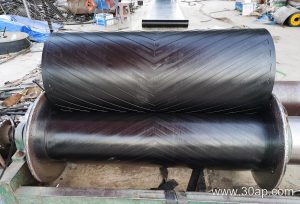
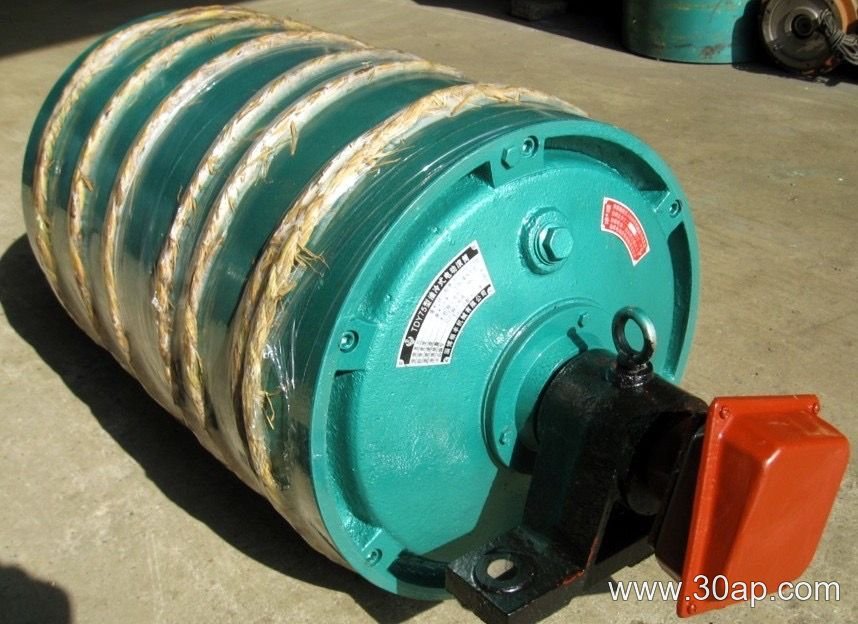
When comparing idler types, remember that a training idler is not a substitute for a carrying idler, and a return idler is not a replacement for an impact idler. Each has a specific role. A conveyor pulley, such as a drive pulley or tail pulley, is a different component and cannot be interchanged with an idler roller. Likewise, a conveyor bracket holds the idler shaft but does not rotate. Keeping these distinctions clear helps maintenance teams order the correct parts and keep the aggregate line running.