What a Tail Pulley Assembly Does
A tail pulley assembly is the return-end rotating group on a belt conveyor. It supports and guides the conveyor belt as it loops back toward the head drive, and it often serves as the mounting point for tensioning devices that keep the belt tracking correctly. In many layouts the assembly includes the pulley shell, shaft, hubs, bearings, bearing housings, and a take-up frame or slide base. The tail pulley is not a drive pulley and not a bend pulley; each has a distinct role, and they are not interchangeable.
Because the tail end is usually the lowest-tension zone, a tail pulley assembly can be lighter than a drive pulley assembly of similar diameter. However, it still must resist belt pull, material buildup, and misalignment forces. A properly built unit helps prevent belt wander, reduces edge damage, and keeps the return strand stable.
Construction and Key Components
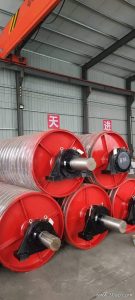
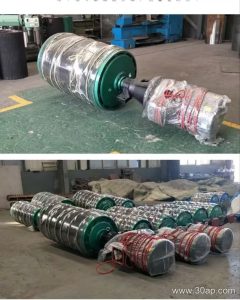
The main body is a cylindrical shell, often made from seamless pipe or rolled plate. End discs are welded to the shell, and the shaft passes through the center. Hubs connect the shaft to the end discs, and bearing housings bolt to the conveyor bracket or tensioning frame. Common surface options include plain, rubber lagged, and ceramic lagged. Rubber lagging may be cold bonded or hot vulcanized, with plain, diamond, or herringbone patterns. Lagging thickness is commonly 8, 10, 12, 15, or 20 mm, chosen according to belt speed, material, and slip risk.
Shaft diameter is determined by torque and load, not by belt width alone. Typical shaft sizes range from Ø50 to Ø200 mm in many standard designs, but the final value should come from the conveyor designer. Diameters such as Ø200, Ø250, Ø315, Ø400, Ø500, Ø630, Ø800, and larger are used across different belt widths, and a B1200 belt might work with a Ø1000 tail pulley in one system while a shorter, lighter conveyor uses a smaller diameter. There is no fixed rule that one belt width matches only one pulley diameter.
Where It Fits in a Conveyor
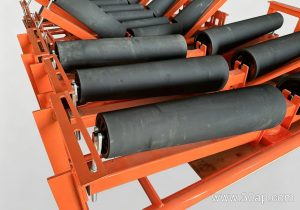
Tail pulley assemblies appear in quarries, limestone mines, coal preparation plants, sand and gravel lines, crushing and screening circuits, and port bulk terminals. In a quarry, the tail end may sit under a crusher discharge where fines and moisture collect. In a coal plant, the assembly might be part of a take-up station that compensates for belt stretch. The tail pulley works with the conveyor belt, idler rollers, and conveyor brackets to form a continuous loop. A bend pulley, by contrast, changes belt direction without tensioning, and a drive pulley transmits power. These functions should not be confused.
Selection and Buyer Checklist
- Confirm the belt width and the required face width. The pulley face is usually wider than the belt; for example, a B800 belt often uses a face around 950 mm, and a B1400 belt may use about 1600 mm.
- Match the shaft diameter to the calculated torque and bearing load. Do not assume a shaft size from belt width alone.
- Choose the lagging based on environment. Plain steel may suit dry, clean duties; rubber lagging improves grip in wet or dusty conditions; ceramic lagging can help where abrasive fines cause wear.
- Check the bearing type, sealing, and lubrication method. Regreasing intervals depend on speed, temperature, and contamination.
- Verify the take-up travel and mounting interface. The assembly must fit the conveyor bracket and allow enough movement for belt tensioning.
Maintenance Notes
Inspect the tail pulley assembly for material buildup on the shell, worn lagging, loose bolts, and bearing noise. Misalignment often shows as uneven belt tracking or frayed edges. Keep the return strand clear of spillage, and confirm that the tensioning frame moves freely. When replacing a tail pulley, check the shaft and bearing seats for wear rather than assuming only the shell needs attention. A well-maintained tail pulley assembly supports smooth belt travel and reduces unplanned downtime.