What a Conveyor Frame Does on a Belt Conveyor
A conveyor frame is the steel structure that carries the idler roller sets, holds the conveyor pulley at each end, and keeps the belt path aligned from loading point to discharge. It is more than a set of legs under a belt: the frame sets the trough angle, fixes the spacing between idlers, and transfers the load from the belt and material into the ground or into a larger steel structure. In a quarry, a cement plant, or a power plant coal yard, the frame is the part that decides whether the belt runs true or wanders.
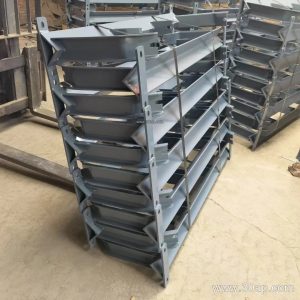
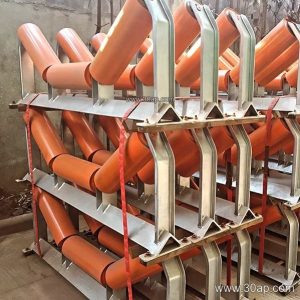
The frame is usually built from angle steel, channel steel, or folded steel plate. Cross beams, longitudinal stringers, and support legs are bolted or welded into a rigid section. The conveyor bracket that joins the cross beam to the stringer is often adjustable, which helps during installation and later alignment work. On a long overland line, sections are modular so they can be transported and assembled on site.
Main Frame Sections and Their Positions
Frames are not one part but a family of sections along the belt path. Each section has a different job, and they should not be treated as interchangeable.
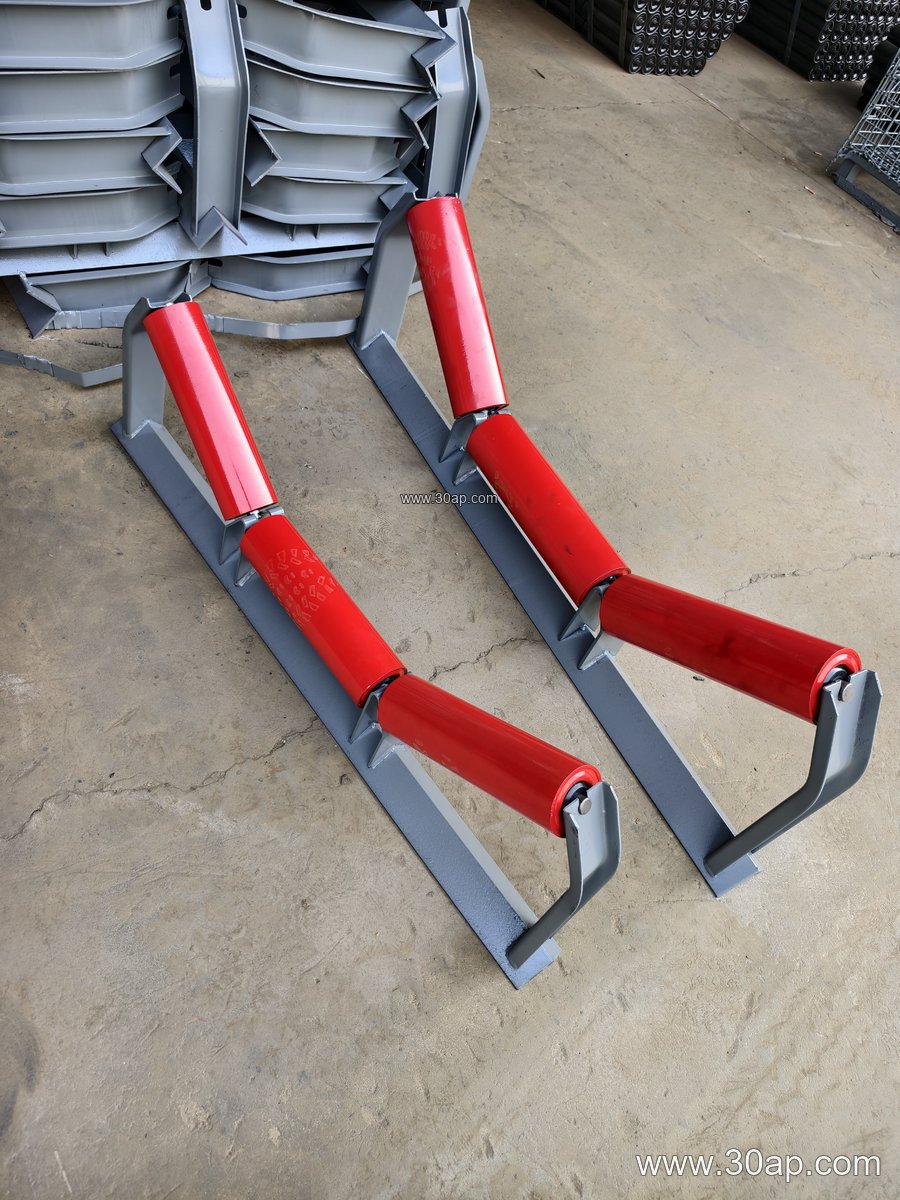
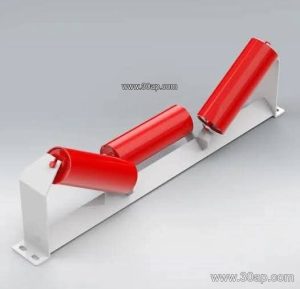
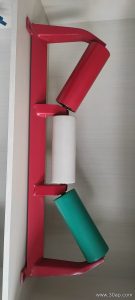
- Trough frame (carrying side): supports three or five idler roller sets at a set trough angle, usually 20, 30, 35, or 45 degrees.
- Transition frame: placed near the head and tail to guide the belt from flat to troughed shape gradually.
- Return frame: carries the belt on the return side, often with flat or V-type idlers.
- Impact frame: reinforced section under the loading point, fitted with impact idlers or buffer idlers.
- Self-aligning frame: holds training idlers that correct belt drift.
Drive pulley, tail pulley, and bend pulley are separate components mounted on the frame or on independent take-up structures; they are not frame subtypes and cannot replace one another in a specification.
Matching Frame Width, Trough Angle, and Idler Diameter
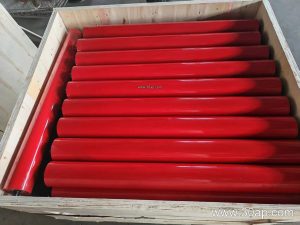
Frame width follows belt width. Common belt widths include B500, B650, B800, B1000, B1200, B1400, B1600, B1800, B2000, B2200. The trough angle and idler diameter are chosen from material characteristics, belt speed, and load, not from a fixed rule. A B800 frame might run 35 degrees with Ø108 idlers, while a B1200 section in a crushing line may use 45 degrees with Ø133 idlers; a B650 frame with Ø89 idlers is also normal for lighter duty. These are examples, not fixed pairings. Installation hole spacing and cross beam length change with belt width and trough angle, so they are set by design.
| Frame Parameter | Common Options | Notes |
|---|---|---|
| Belt width | B500 to B2200 | Selected to suit the conveyor belt and tonnage |
| Trough angle | 20, 30, 35, 45 degrees | Adjustable frames can change between angles |
| Idler diameter | Ø89, Ø108, Ø133, Ø159, Ø194 | Matched to load and belt speed |
| Material | Angle steel, channel steel, folded plate | Depends on span and duty |
Fixed Versus Adjustable Frames
A fixed frame is welded or bolted to a set geometry and is simple and stiff. An adjustable frame allows the trough angle to be changed and the idler position to be trimmed after the belt is running. Adjustable types are useful in plants where the material changes, for example a cement plant handling both clinker and limestone, or a port terminal switching between aggregate and ore. Pre-tilted frames, often set at about 1.5 to 2 degrees forward, help keep the belt centered on fast-running lines.
Where These Frames Are Used
You will find them in limestone mines feeding a primary crusher, in coal handling systems at power plants, and in sand and gravel lines where a crusher conveyor belt works under constant impact. A steel plant sinter line and a fertilizer granulation plant also rely on robust frames, often paired with a heat resistant conveyor belt or an abrasion resistant conveyor belt depending on the duty. For underground coal mining, flame retardant conveyor belt and PVG800S conveyor belt are common alongside heavier frame sections.
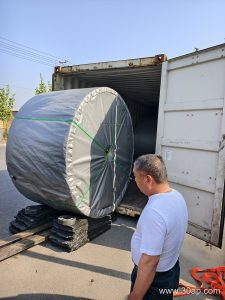
Frame choice should also respect the belt: a steel cord conveyor belt needs straighter, stiffer support than a multi-ply fabric core belt, and a pipe conveyor belt or corrugated sidewall belt needs frames built for its special idler arrangement. A chevron conveyor belt on an incline may need closer idler spacing to control sag.
Buyer Checklist
- Confirm belt width and the actual trough angle required, not just the nominal size.
- Ask for the idler diameter and spacing the frame is drilled for.
- Check steel section, finish, and whether the frame is fixed or adjustable.
- Confirm mounting hole positions and cross beam length against your drawing.
- Plan for transition and impact sections, not only standard carrying frames.
For more on matching frames with conveyor idlers and belts, see the product pages at beltconveyorparts.com and review typical frame drawings before ordering.