What a Welded Pulley Is and How It Is Built
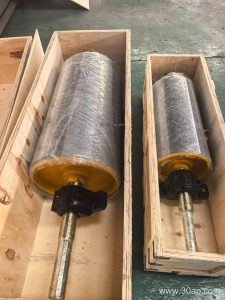
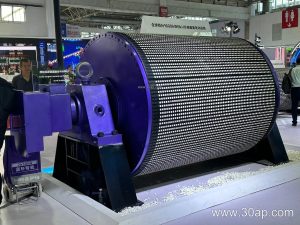
A welded pulley is a conveyor pulley whose shell, end discs, and hub assembly are joined by welding rather than by casting or bolting. In a typical fabrication sequence, the cylindrical shell is rolled from steel plate, the end discs are machined and welded to both ends, and the shaft is fitted through welded hubs. After welding, the assembly is stress-relieved where required, machined for concentricity, balanced, and finally coated or lagged. This fabrication route makes the welded conveyor pulley a practical choice for heavy-duty conveying in quarries, coal preparation plants, cement works, and power station coal handling.
Because the structure is welded, the pulley can be produced in a wide range of diameters and face widths without new casting patterns. Common shell diameters include Ø200, Ø250, Ø315, Ø400, Ø500, Ø630, Ø800, Ø1000, and Ø1250 mm, with larger sizes such as Ø1400 and Ø1600 mm available for high-tension duties. Face width is normally wider than the belt it carries; for example, a B800 belt usually runs on a pulley with roughly 950 mm face width, and a B1200 belt on about 1400 mm. These are reference values, not fixed pairings, and final dimensions follow the conveyor design.
Welded Pulley vs. Other Pulley Types
The welded pulley is one family within the broader group of conveyor pulleys. It should not be confused with a drive pulley, tail pulley, or bend pulley, which describe the pulley’s position and function on the conveyor rather than its manufacturing method. A welded pulley can serve as a drive pulley at the head, as a tail pulley at the loading end, or as a bend pulley on a return run, depending on how it is specified. Likewise, a wing pulley is a distinct subtype used for self-cleaning at the tail, and an electric pulley integrates a motor inside the shell; neither replaces the welded pulley as the main subject here.
Where Welded Pulleys Are Used
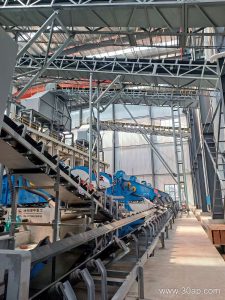
These pulleys appear wherever a conveyor belt must be turned, tensioned, or driven under load. In an iron ore or copper ore operation, a welded head pulley transmits torque to a steel cord conveyor belt carrying crushed rock. In a limestone quarry or aggregate line, a welded tail pulley supports the belt at the loading point, often paired with impact idler rollers to absorb material fall. In a cement plant, welded bend pulleys guide the return strand through a take-up zone, while in a coal-fired power plant they handle a flame retardant conveyor belt on the coal handling system. Sand and gravel plants, tunnel mucking lines, and port bulk terminals also rely on them.
Surface Options and Lagging
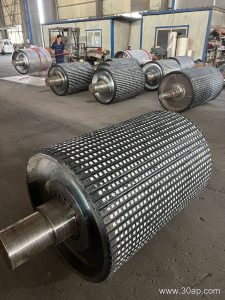
The contact surface between pulley and belt strongly affects grip and wear. A welded pulley may be supplied plain, or with lagging applied by cold bonding, hot vulcanizing, or casting. Common surface forms include smooth, diamond pattern, herringbone, and ceramic lagging, with lagging thickness typically 8, 10, 12, 15, or 20 mm. Diamond and herringbone profiles help shed water and fine material, while ceramic tiles suit abrasive duty. For a conveyor moving an abrasion resistant conveyor belt in a wet quarry, a lagged welded pulley usually gives better traction than a plain shell. The choice should match the belt cover, the load, and the environment rather than follow a single rule.
Dimensions, Shafts, and Bearing Fit
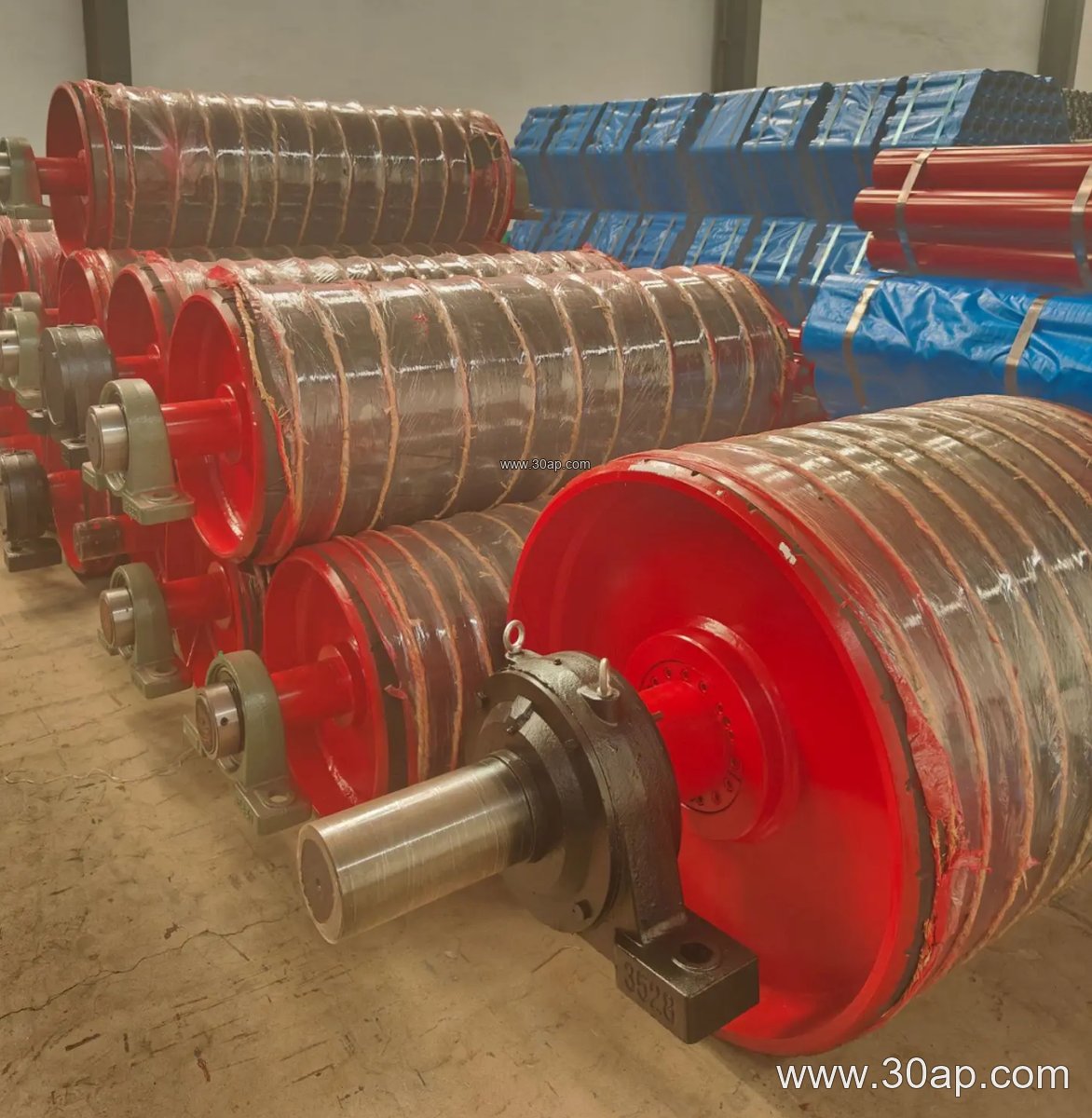
Buyers should treat diameter, face width, shaft size, and bearing type as a coordinated set determined by torque, belt tension, and radial load. Shaft diameters commonly range from Ø50 to Ø200 mm, but the correct shaft size is calculated from the drive duty, not selected from the belt width alone. A B1400 belt, for instance, may run on a pulley with Ø800 mm diameter and a shaft sized for the actual tension, while a shorter, lighter conveyor could use a smaller combination. The table below lists reference values only.
- Belt width B400: pulley face approx. 500 mm
- Belt width B650: pulley face approx. 750 mm
- Belt width B1000: pulley face approx. 1150 mm
- Belt width B1400: pulley face approx. 1600 mm
- Belt width B1800: pulley face approx. 2000 mm
Combinations such as B800 × Ø500 or B1200 × Ø1000 are common examples, but no single belt width is tied to one diameter. Shaft ends, keyways, and bearing housings should be confirmed against the conveyor bracket and frame drawing before ordering.
Buyer Checklist and Maintenance Notes
When specifying a welded pulley, confirm the function on the conveyor, the belt type and tension, the required lagging, the shaft and bearing arrangement, and the balancing grade. Ask for weld inspection records and dimensional reports where the duty is critical. During service, check lagging wear, shell runout, and bearing temperature at intervals. A worn lagged surface reduces grip and can cause belt slip, especially on a heavy-duty mining conveyor belt carrying wet ore. Re-lagging a welded pulley is often simpler than replacing the whole unit, which is one reason the welded design remains popular in bulk material handling.