What a Port Bulk Material Conveyor Idler Does
In a port, bulk cargo moves fast and does not stop for maintenance. Iron ore, coal, fertilizer, grain, and aggregate are transferred from ship unloaders to stockyard conveyors, then reloaded onto trucks or trains. The Port Bulk Material Conveyor Idler is the rotating support under the belt along every one of those runs. It carries the loaded strand, guides the return strand, and keeps the belt tracking straight enough that material stays in the trough. Because port conveyors often run at high capacity and in salt-laden air, these idlers are built for continuous duty rather than occasional peaks.
The same component is also called a port bulk handling conveyor idler roller. Both names describe the same product; neither refers to a drive pulley or a bend pulley, which are separate parts of the conveyor.
How the Idler Is Built
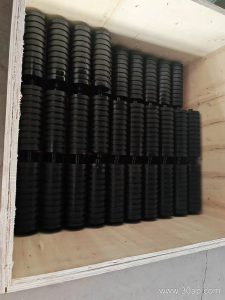
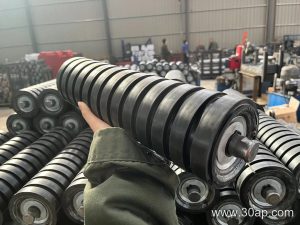
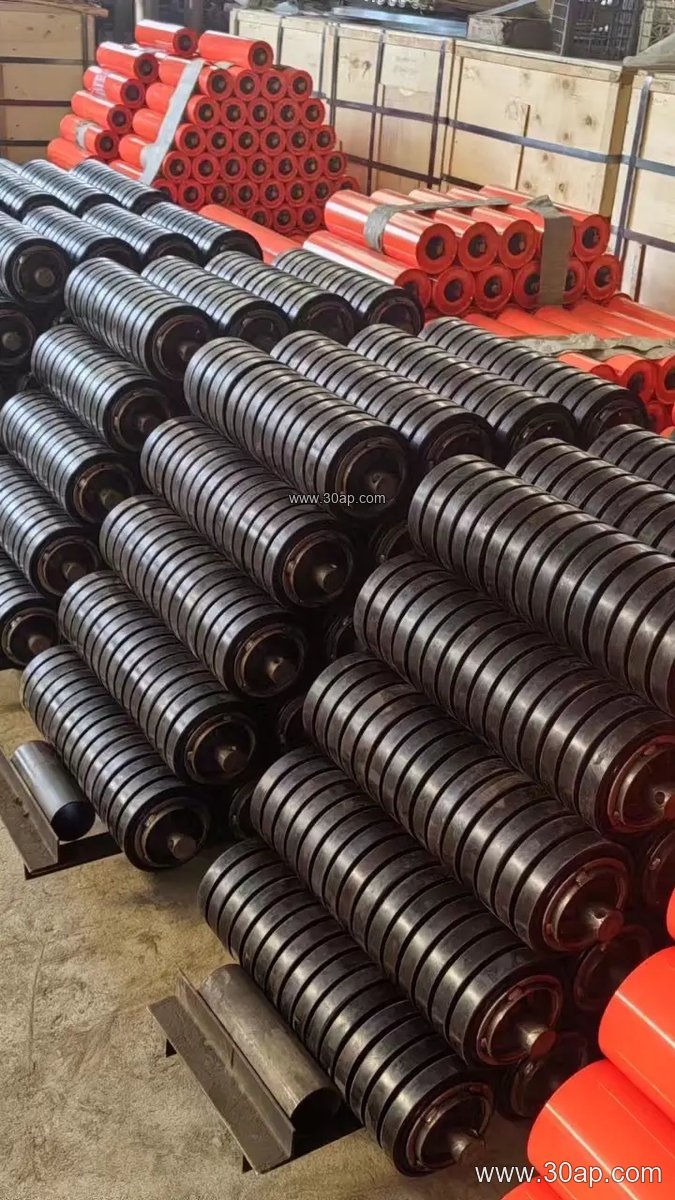
A typical unit is a steel tube with a shaft through the center, two bearing housings, and a sealing system at each end. The shell may be plain steel, nylon-coated, ceramic-lined, or fitted with rubber rings for impact absorption. Bearings are usually deep-groove ball types such as 6204, 6205, 6305, 6306, 6308, or 6310, matched to the load and shaft size rather than to a single belt width.
Sealing matters more at a port than in a dry inland plant. Salt spray, fine ore dust, and wash-down water attack bearings from both sides. Labyrinth seals combined with contact lips are common. A well-sealed idler roller protects the bearing far longer than a thicker tube does.
Where These Idlers Sit on a Port Conveyor
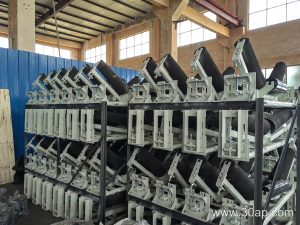
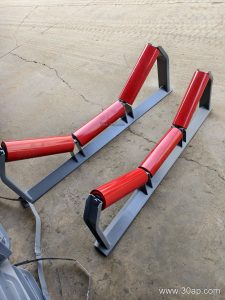
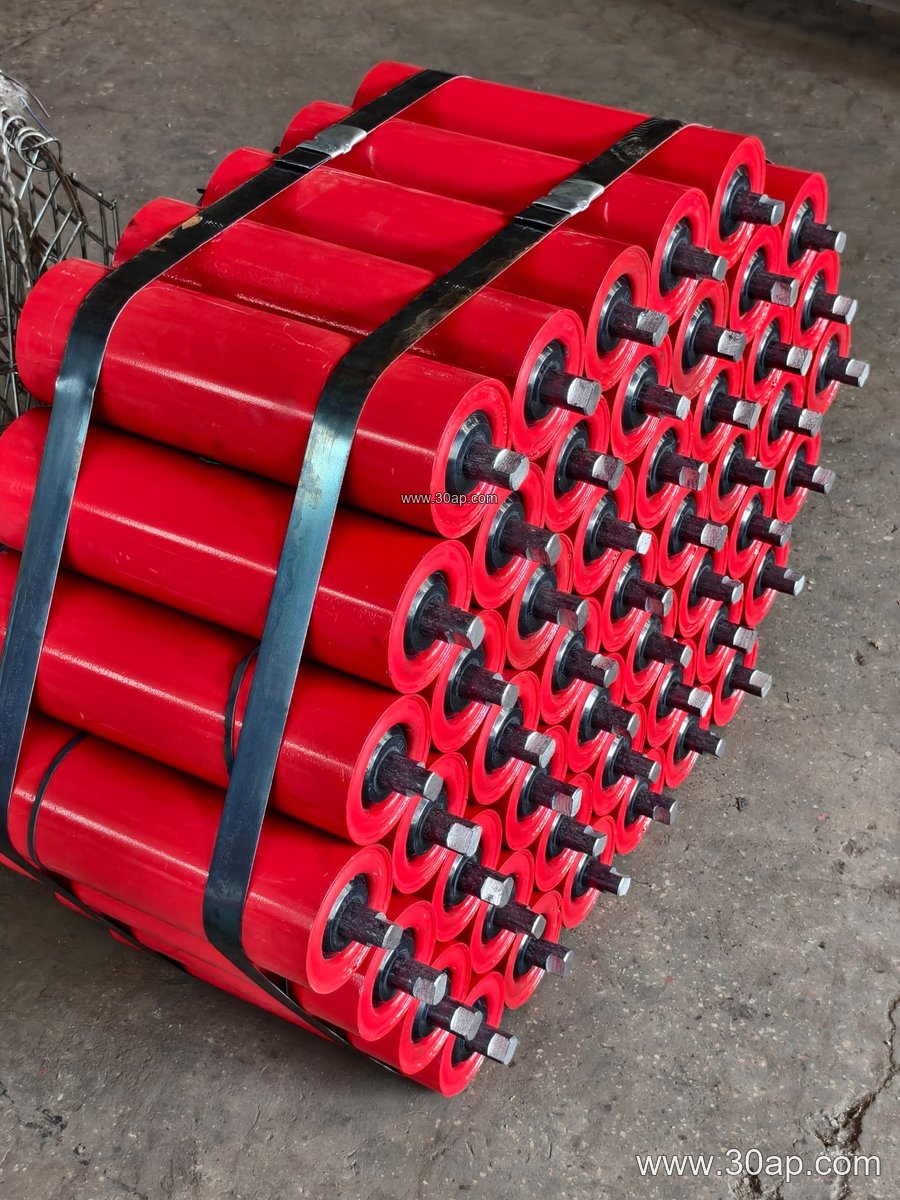
Position determines the type. The carry side usually uses three-roll troughing sets at 20, 30, 35, or 45 degrees. Transition idlers sit near the head and tail to ease the belt from flat to troughed. Impact idlers with rubber rings go under the loading point where ore drops onto the belt. On the return side, flat or V-return rollers support the empty strand. Self-aligning idlers, including friction and tapered designs, correct minor tracking drift on long stockyard runs.
Idler length follows belt width, trough angle, and roll arrangement. Common examples for a three-roll troughing set are roughly 200 mm rolls at B500, 250 mm at B650, 315 mm at B800, 380 mm at B1000, 465 mm at B1200, 530 mm at B1400, 600 mm at B1600, 670 mm at B1800, and 750 mm at B2000. Side rolls and center rolls can differ, so these are references, not fixed pairings.
Reference Dimensions for Planning
The tables below collect typical values used when specifying idlers for a port conveyor. They are starting points for discussion with a supplier, not universal specifications.
Common Roll Diameters
| Roll diameter | Typical position |
|---|---|
| Ø63, Ø76, Ø89 | Light return runs, small belt widths |
| Ø102, Ø108, Ø127 | General troughing and return sets |
| Ø133, Ø159 | Heavier loaded strands |
| Ø178, Ø194, Ø219 | High-load impact and mainline zones |
Belt Width and Common Roll Length
| Belt width | Common roll length (three-roll set) |
|---|---|
| B400 | about 160 mm |
| B500 | about 200 mm |
| B650 | about 250 mm |
| B800 | about 315 mm |
| B1000 | about 380 mm |
| B1200 | about 465 mm |
| B1400 | about 530 mm |
| B1600 | about 600 mm |
| B1800 | about 670 mm |
| B2000 | about 750 mm |
| B2200, B2400 | larger, by design |
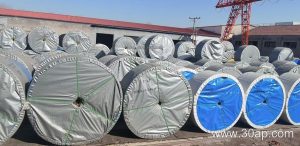
Roll length is not the only variable. The belt itself must match the duty: a Steel Cord Conveyor Belt on a long ship-loading run, an EP Conveyor Belt on a yard transfer, or a Flame Retardant Conveyor Belt where coal dust is present. The idler, the conveyor pulley, and the conveyor bracket are selected together as a system.
Buyer Checklist
- Confirm the actual belt width and trough angle before ordering roll length.
- State the material: ore, coal, grain, or fertilizer each call for different sealing and surface choices.
- Ask for bearing designation and seal type, not just tube thickness.
- Check shaft diameter against the bracket and frame, not against belt width alone.
- For coastal sites, confirm corrosion protection for shells, shafts, and fasteners.
- Keep a small stock of spare rollers for the loading zone, where wear is fastest.
Port conveyors reward careful idler choice. A roller that seals well, spins freely, and matches the belt and frame will keep ore, coal, and grain moving through the terminal with fewer stoppages.