What a Terminal Conveyor Pulley Does
A terminal conveyor pulley is the rotating drum at the discharge or tail end of a belt conveyor system. In a quarry or cement plant, it is the component that changes the belt direction, maintains tension, and helps discharge material onto the next stage. The same product is often called a terminal drum or terminal roller in workshop language. It is not a drive pulley, a tail pulley, or a bend pulley by default; those are separate functional positions, and each has its own load profile and design logic.
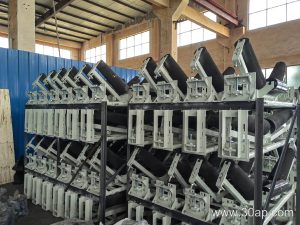
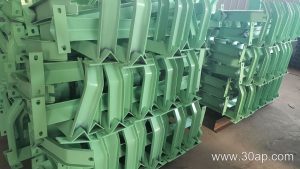
The terminal pulley works together with the conveyor belt, idler rollers, and conveyor brackets to keep the belt tracking and tensioned. In a limestone crushing line or a coal handling system at a power plant, a poorly matched terminal pulley can cause belt misalignment, premature wear, or spillage.
Construction and Surface Options
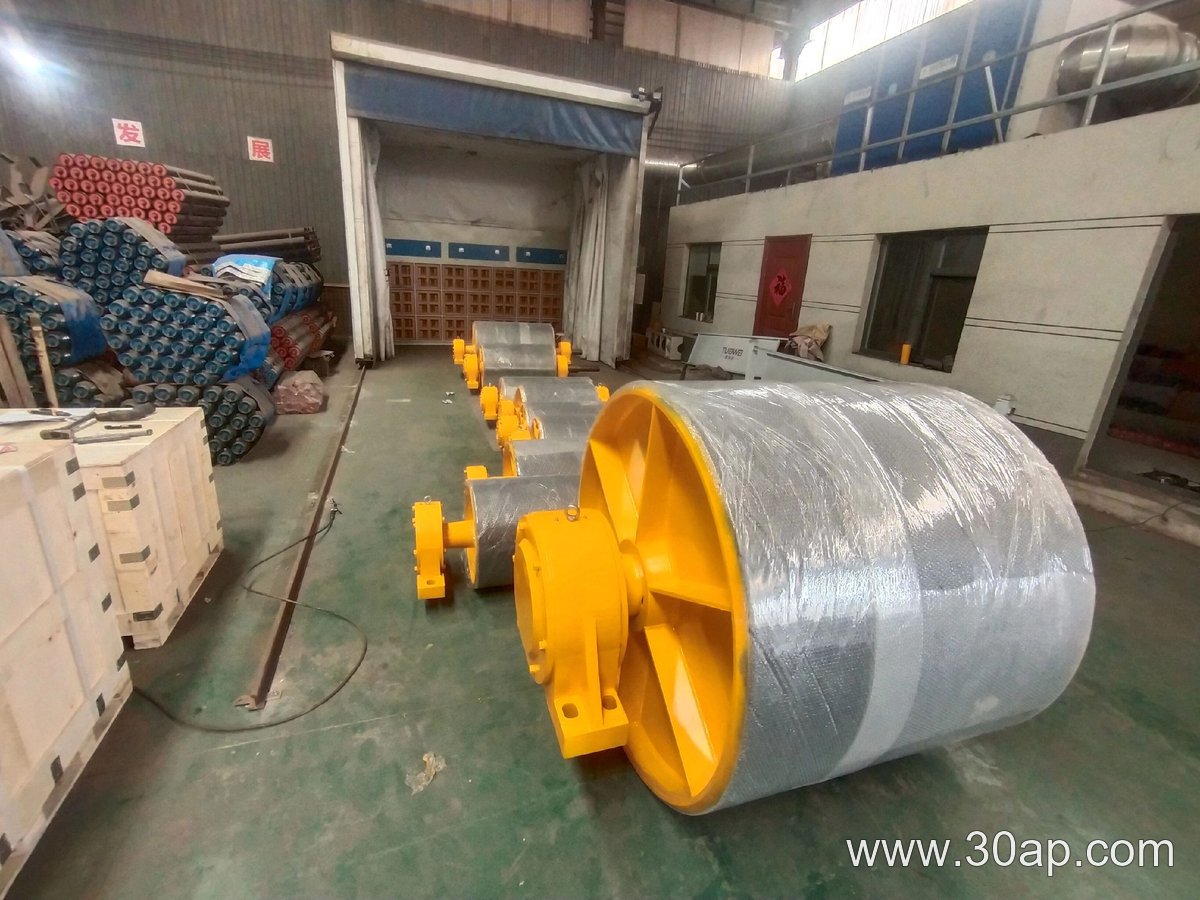
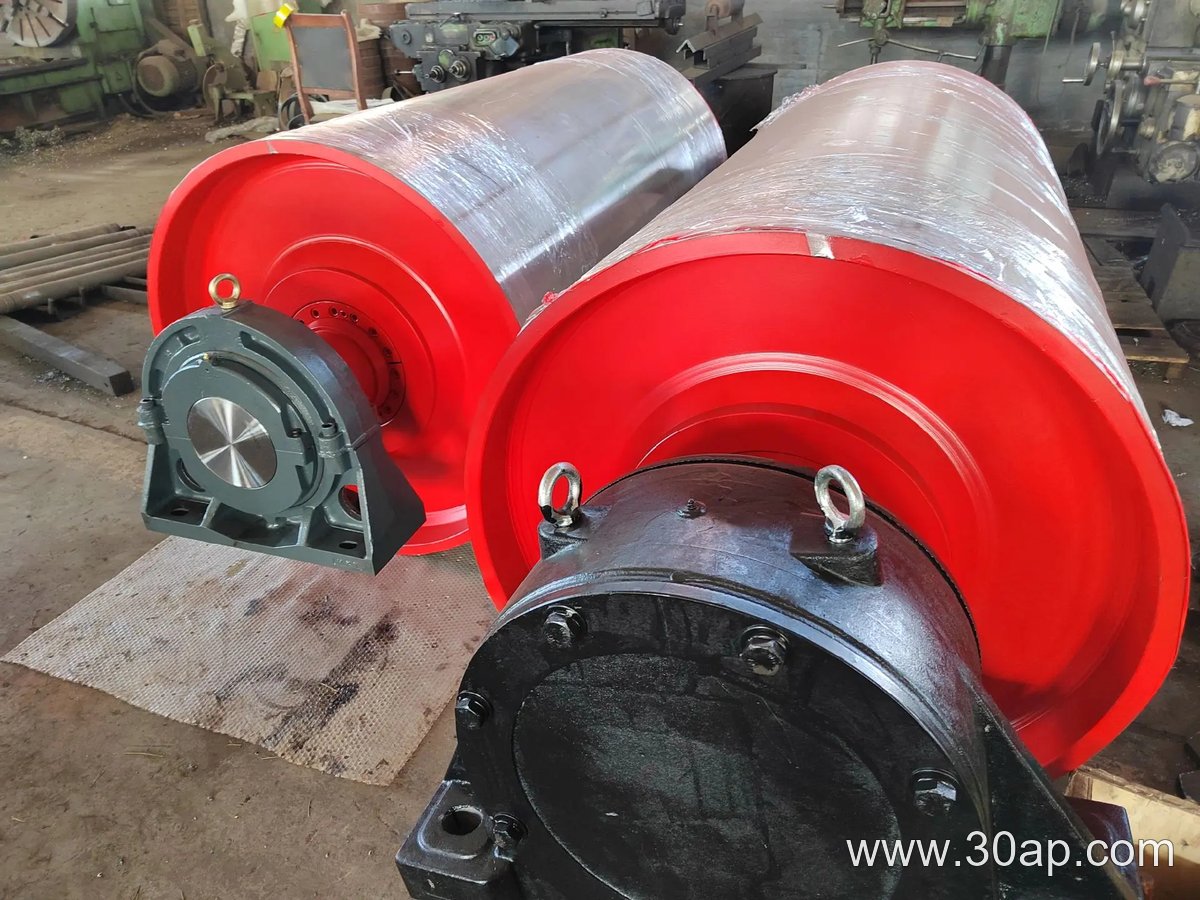
A typical terminal conveyor pulley consists of a cylindrical shell, two end discs, a shaft, and bearing housings. The shell is usually made from steel tube or fabricated plate, machined to balance. The shaft diameter is determined by torque and load, not simply by belt width. Common shaft sizes include Ø50, Ø60, Ø70, Ø80, Ø90, Ø100, Ø120, Ø140, Ø160, Ø180, and Ø200 mm. The surface can be plain, rubber-lagged, or ceramic-lagged. Lagging thickness often ranges from 8 mm to 20 mm, with 10 mm and 12 mm being frequent choices in abrasive service.
Surface patterns matter for grip and material release. Diamond lagging, herringbone lagging, and plain rubber are common. In a sand and gravel plant, diamond lagging helps with wet, sticky feed. In a cement plant handling clinker, ceramic lagging may be chosen for extra wear resistance. The pulley face width is normally wider than the belt. For example, a B800 belt often uses a pulley face around 950 mm, while a B1200 belt may use about 1400 mm. These are reference values, not fixed rules.
Where It Fits in Bulk Handling
Terminal pulleys appear in many industries: limestone mines, iron ore concentrators, copper mines, coal washing plants, aggregate crushing and screening circuits, cement clinker lines, power plant coal conveying, port bulk terminals, steel sintering plants, concrete batching stations, tunnel muck removal, fertilizer plants, and grain silos. In each case, the terminal pulley is usually at the head or tail of the conveyor, guiding the belt as it returns or discharges.
Do not confuse a terminal pulley with a drive pulley, which transmits power, or a bend pulley, which only changes direction. A tail pulley may serve as a terminal pulley in some layouts, but the terms are not interchangeable. For a comparison, a wing pulley is sometimes used at the tail to shed sticky material, while a terminal drum is more often a solid-shell design for general duty.
Key Parameters for Buyers
When specifying a terminal conveyor pulley, buyers should provide the belt width, pulley diameter, face width, shaft diameter, lagging type, and bearing style. Common diameters include Ø200, Ø250, Ø315, Ø400, Ø500, Ø630, Ø800, Ø1000, Ø1250, and Ø1400 mm. A B650 belt might work with a Ø400 pulley in one layout, while a B1000 belt could use Ø630 or Ø800 depending on tension and space. There is no single mandatory pairing.
| Belt Width | Typical Pulley Face Width | Common Diameter Range |
|---|---|---|
| B400 | About 500 mm | Ø200–Ø315 |
| B650 | About 750 mm | Ø250–Ø500 |
| B800 | About 950 mm | Ø315–Ø630 |
| B1000 | About 1150 mm | Ø400–Ø800 |
| B1200 | About 1400 mm | Ø500–Ø1000 |
| B1400 | About 1600 mm | Ø630–Ø1250 |
Use these as general reference data. Actual selection depends on belt tension, material weight, speed, and the conveyor profile. For a terminal pulley in a tunnel muck line or a fertilizer plant, corrosion resistance and lagging choice may matter as much as diameter.
Maintenance and Selection Tips
Check bearing lubrication, lagging wear, and shell runout during scheduled shutdowns. In a coal washing plant or a copper mine, abrasive slurry can shorten lagging life, so thicker rubber or ceramic tiles may be justified. Keep the conveyor belt aligned and the idler rollers turning freely; a seized idler can overload the terminal pulley. Ensure the conveyor bracket and bearing housings are square to the belt centerline.
For a new project, share the belt width, expected tonnage, and pulley position with the supplier. Ask for the shaft diameter calculation and lagging recommendation. Do not assume a B1200 belt always requires a Ø1000 pulley; it could be Ø800 or Ø1250 depending on the drive and take-up arrangement. A terminal conveyor pulley is a wear part and a safety-critical component, so match it to the duty, not to a catalog shortcut.