What a Conveyor Carrying Bracket Does
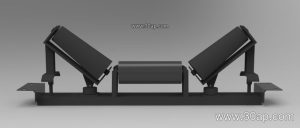
A conveyor carrying bracket is the structural element that holds the upper idler rollers in position and gives the belt its trough shape. On a running conveyor, the belt sits on three or more idler roller sets, and those rollers must be held at a consistent angle and height. The carrying bracket, often called an upper troughing bracket or troughing idler support, is the frame that makes this possible. It is a small component compared with a conveyor pulley or a drive unit, but its geometry decides how the belt tracks and how the load is distributed.
The bracket is usually mounted on the conveyor stringer or main frame. It can be fixed or adjustable, bolted or hooked, and it may carry two, three or five rollers depending on the trough profile. In a quarry or a crushing and screening line, a stable bracket means fewer belt edge failures and less spillage at transfer points.
Construction and Common Forms
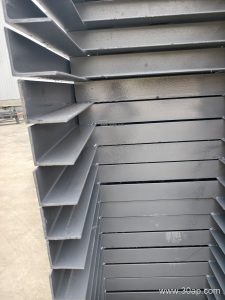
Most carrying brackets are fabricated from angle steel, channel steel, or bent steel plate. The material and thickness are chosen according to belt width, load, and the number of rollers supported. A typical bracket has a central roller seat and two inclined wings set at a trough angle. The wings may be welded or bolted, and the roller seats usually have slots or holes so that the idler shaft can be positioned.
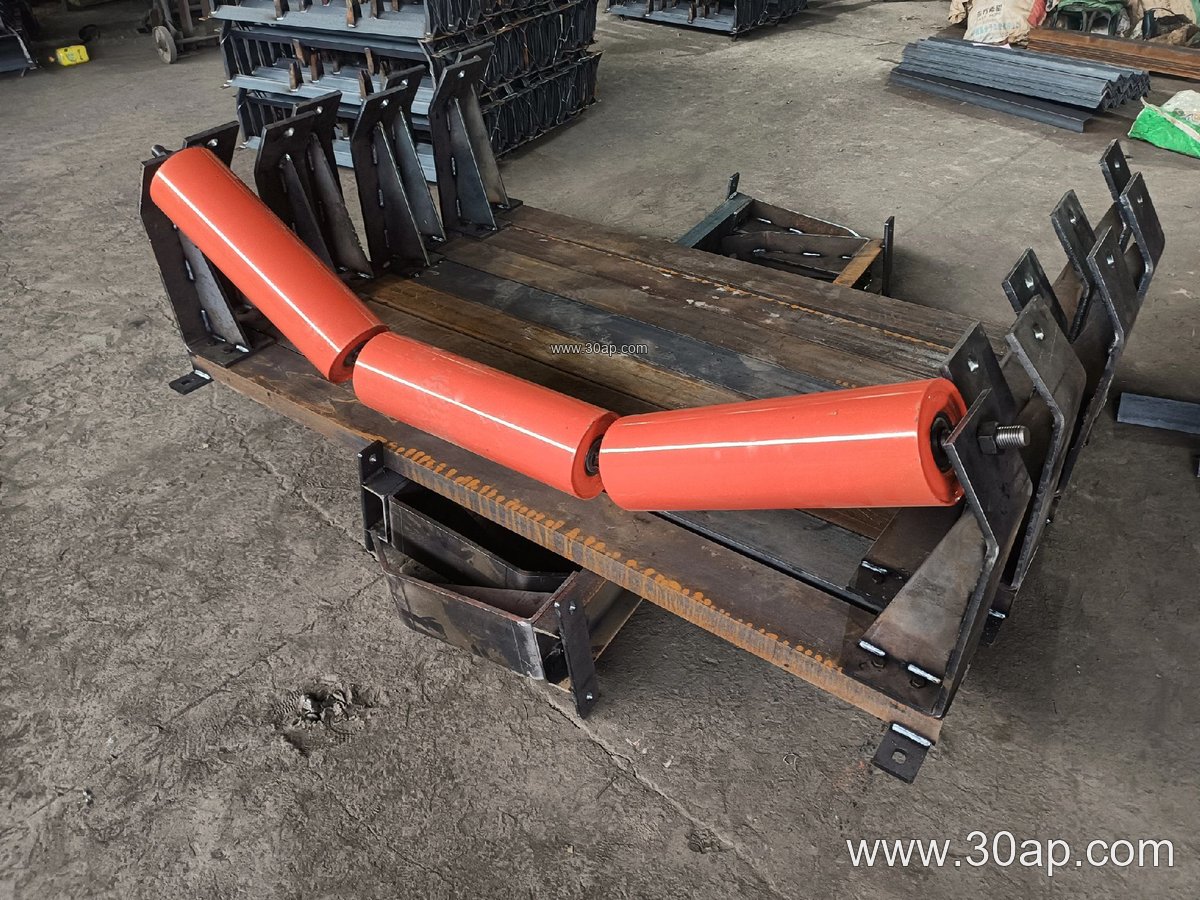
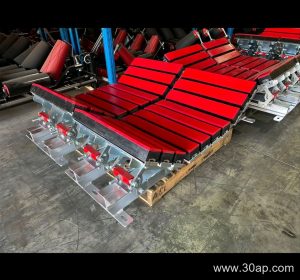
Common forms include fixed troughing brackets, adjustable brackets, transition brackets near the tail pulley, impact brackets under loading points, and self-aligning or forward-leaning designs. The adjustable version allows the trough angle to be changed between positions such as 20, 30, 35 and 45 degrees. Forward-leaning brackets are often set at about 1.5 to 2 degrees to help keep the belt centered. These are different products from a bend pulley or a return bracket, and they should not be confused with one another.
Trough Angle and Roller Diameter
The carrying bracket, the idler roller and the belt width work as a set. A wider belt usually needs a longer crossbeam and a matching bracket span, but belt width alone does not fix the roller diameter or the trough angle. A B800 conveyor might run at 30 or 35 degrees with Ø108 or Ø133 rollers, while a B1200 unit may use 35 or 45 degrees with Ø133 or Ø159. These are common references, not fixed pairings. The final choice is made by design, taking into account capacity, material lump size and belt tension.
Typical Reference Combinations
| Belt width | Trough angle | Roller diameter | Typical bracket use |
|---|---|---|---|
| B650 | 30 degrees | Ø89 | Light aggregate lines, small transfer points |
| B800 | 35 degrees | Ø108 | Sand and gravel, cement plant feed |
| B1000 | 35 degrees | Ø133 | Coal handling, power plant coal conveying |
| B1200 | 45 degrees | Ø133 | Iron ore, heavy bulk material |
| B1400 | 35 degrees | Ø159 | Port loading, large stone crushing plants |
| B1600 | 45 degrees | Ø159 | Mining and high-capacity ore transport |
Installation hole spacing and crossbeam length change with belt width and trough angle. They should be confirmed from the drawing rather than assumed from a single number.
Where Carrying Brackets Are Used
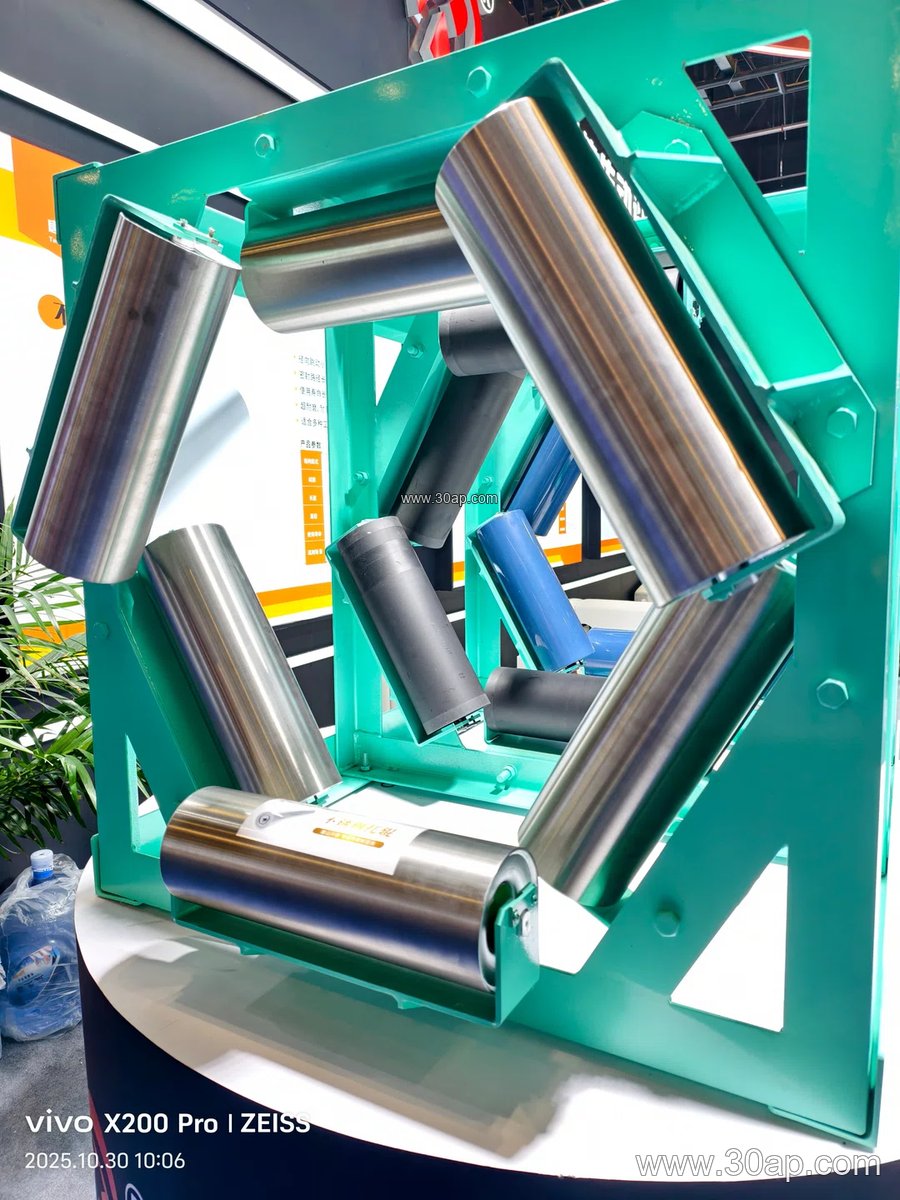
These brackets appear wherever a belt must be supported between the tail pulley and the head pulley. In a coal washing plant they hold the troughing idlers that carry coal through the washing and dewatering sections. In a cement plant they support the belt on clinker and raw meal lines, where dust and heat are normal. In a port or a bulk terminal, long carrying sections rely on brackets that keep the belt aligned under heavy loads. A conveyor carrying bracket also works alongside a conveyor belt such as an EP conveyor belt or a steel cord conveyor belt, and the bracket must suit the belt stiffness and the load it carries.
For abrasive materials, an abrasion resistant conveyor belt may be used together with impact brackets at the loading zone. In cold regions, a cold resistant conveyor belt still needs brackets that do not distort or loosen. The bracket is not the belt, but the two are selected together.
Buyer Checklist
- Confirm the belt width, trough angle, and idler diameter before ordering, and match the bracket to the actual idler shaft.
- Check whether a fixed or adjustable bracket suits the conveyor; adjustable types help when the trough angle may be tuned later.
- Review the mounting hole pattern and crossbeam length against the stringer drawing.
- Choose the steel form and thickness for the load and environment, and use galvanizing or coating where corrosion is a concern.
- Ask for bracket drawings that show the roller seat position, since small errors affect belt tracking.
- Keep spare brackets for high-wear loading points, where impact and spillage shorten service life.
A well-matched bracket is a low-cost part that protects the idler roller, the belt and the whole conveyor frame. Buyers who check the trough angle, the roller seat and the mounting details before purchase avoid most tracking problems later.