What a Carrying Idler Set Does on a Belt Conveyor
A carrying idler set is the group of rollers mounted on the load side of a conveyor to hold up the belt and the material riding on it. In everyday plant language it is often called a troughing idler set or simply carrying rollers. The set usually combines two or three idler rollers fixed in a frame so that the belt forms a trough, which keeps bulk material centered instead of spilling over the edges. This is the part of the conveyor that does the most visible work: every tonne of ore, clinker or aggregate passes over it.
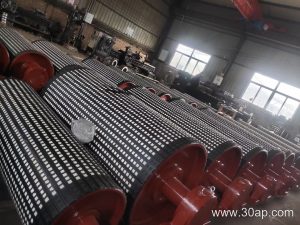
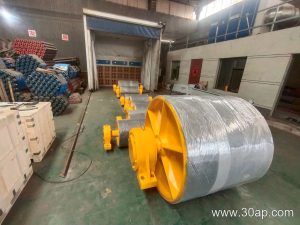
The set is not the same thing as a conveyor pulley. Drive, tail and bend pulleys turn the belt and transmit tension at the ends of the machine, while carrying idlers support it along the run. Both belong to the same conveyor, but they are selected for different duties and should never be treated as interchangeable.
How the Set Is Built
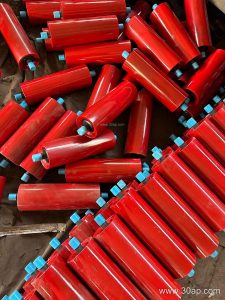
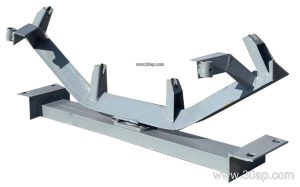
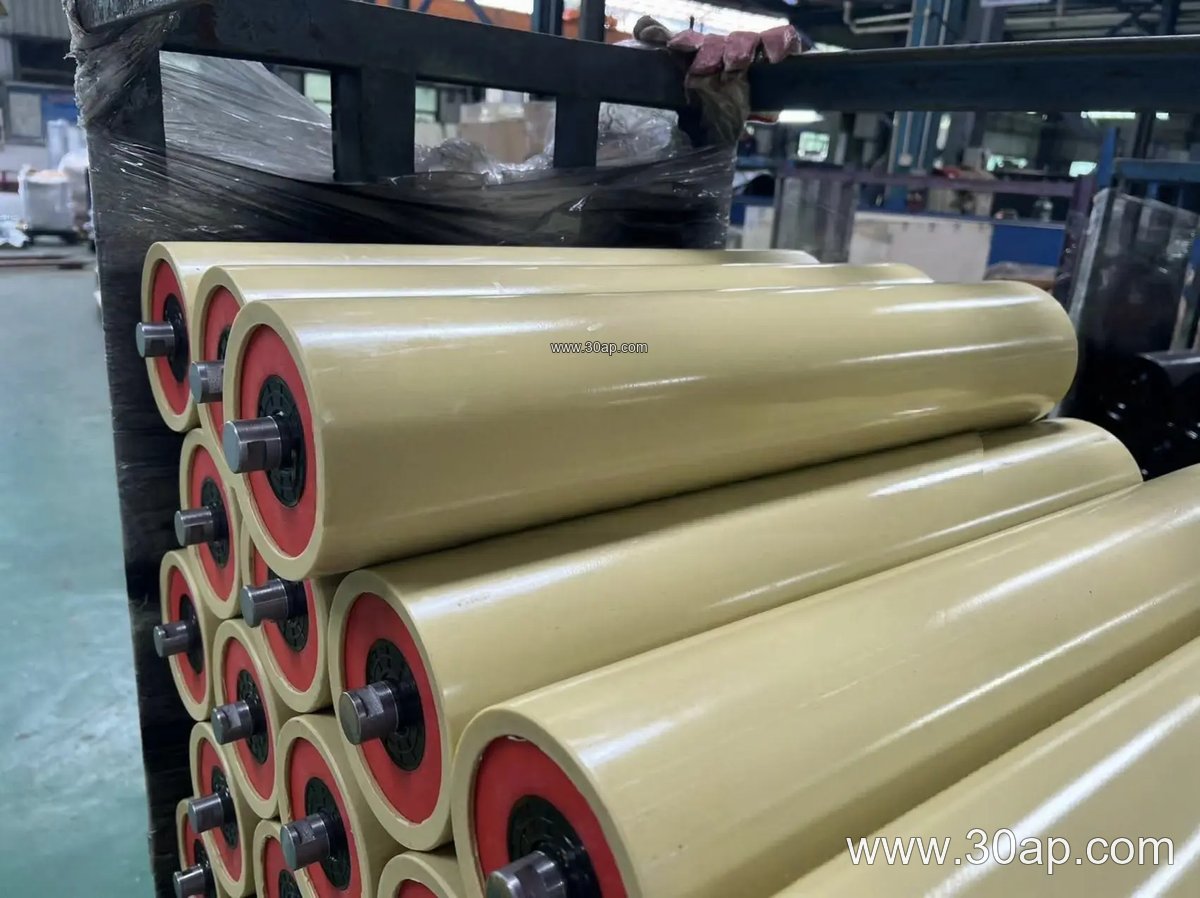
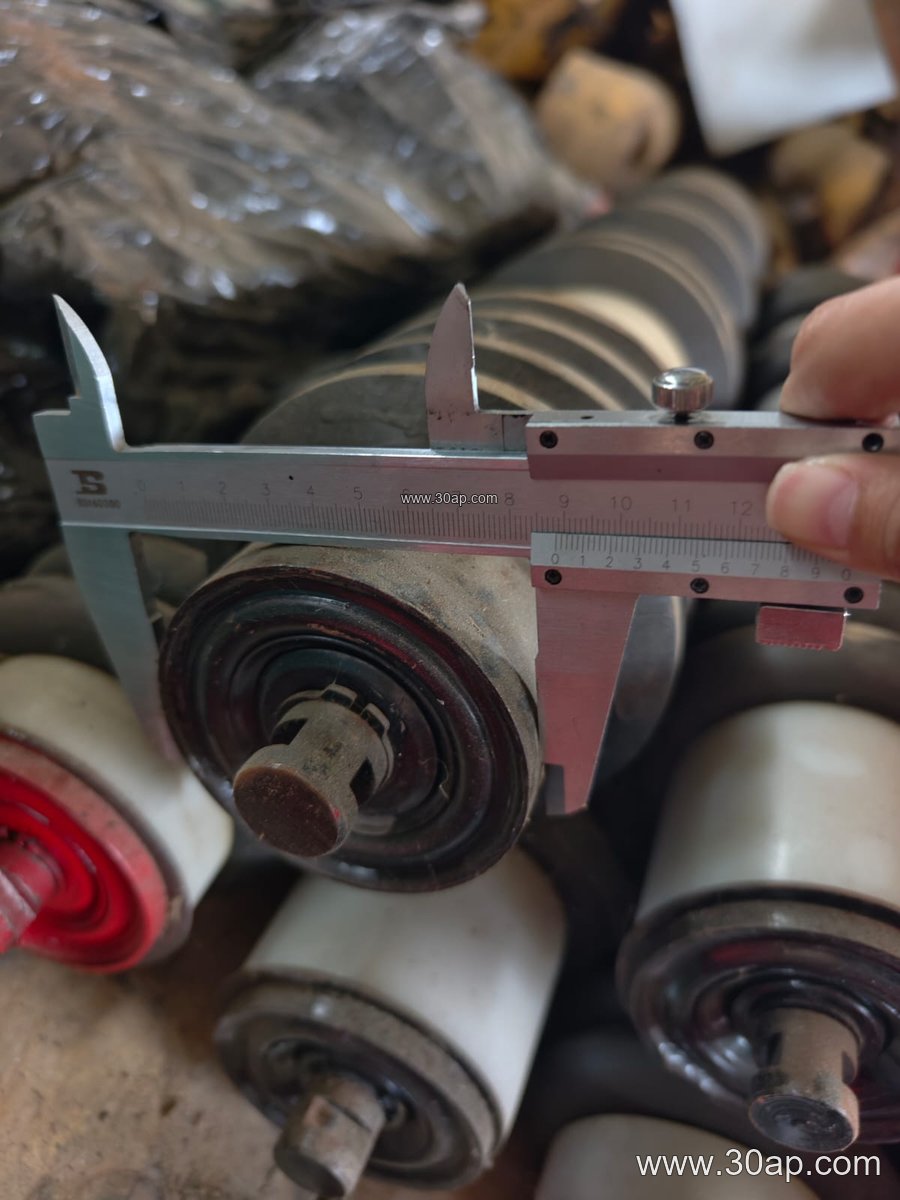
A typical assembly has two or three idler rollers, a steel frame, and a bracket that fixes the set to the conveyor stringer. Each roller is a steel tube fitted with a shaft, bearing housings and a sealing arrangement. The seal matters as much as the tube: dust from a crusher or a coal stockyard will destroy an unprotected bearing long before the roller shell wears out.
Rollers can be supplied with a plain steel surface, nylon, ceramic or rubber rings. Rubber rings are common on impact sections below a crusher discharge, where lump size is large and the belt needs cushioning. The frame is usually bolted to the conveyor bracket, so a damaged set can be lifted out without cutting the belt.
Common Reference Dimensions
The values below are common examples used in design discussions, not fixed rules. Roller length changes with belt width, trough angle and the number of rollers in the set, and the side rollers of a three-roll set may differ from the centre roller.
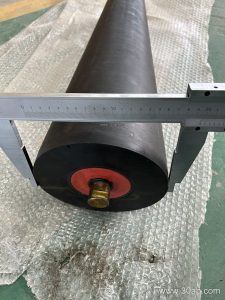
- Roller diameter: Ø63, Ø76, Ø89, Ø102, Ø108, Ø127, Ø133, Ø159, Ø178, Ø194, Ø219 mm
- Belt width: B400, B500, B650, B800, B1000, B1200, B1400, B1600, B1800, B2000, B2200, B2400
- Trough angle: 20, 30, 35 or 45 degrees
- Bearing: 6204, 6205, 6305, 6306, 6308, 6310 and similar sizes
For a three-roll troughing set, a B800 belt often uses rollers around 315 mm long and a B1200 belt around 465 mm, but the final figure comes from the conveyor designer. A wide belt does not automatically dictate one pulley diameter, and belt width alone does not fix the shaft size.
Where These Sets Are Used
You will find carrying idler sets in almost any plant that moves bulk material. In a limestone quarry they sit under the belt that carries blasted rock from the primary crusher to the screening plant. In a coal washing plant they support the belt through long horizontal runs and gentle curves, where a flame retardant conveyor belt is often specified for safety. Cement plants use them on clinker and raw meal lines, power plants on coal handling systems, and port terminals on ship loading conveyors handling thousands of tonnes per shift.
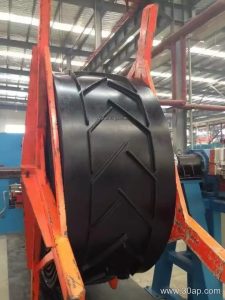
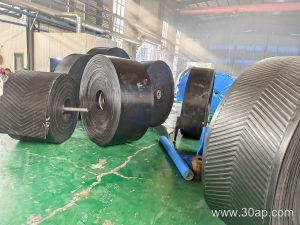
The belt itself may be a rubber conveyor belt, an EP conveyor belt with fabric plies, or a steel cord conveyor belt on a long overland route. The idler set has to match the belt: a heavy-duty mining conveyor belt carrying iron ore needs a more robust roller and frame than a light aggregate conveyor belt in a small sand plant.
Trough Angle and Roller Arrangement
The trough angle controls how deeply the belt sits in the set. A 20 degree set gives a shallow trough and suits fine, free-flowing material. A 35 degree set is a common middle choice for mixed aggregate, and 45 degrees gives a deep trough for high-capacity lines where the belt must hold a large cross-section without spillage. Steeper angles increase the load on the side rollers and can raise belt edge stress, so the choice should follow the material and the belt construction rather than habit.
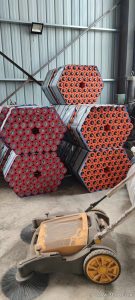
Sets are also made as single-roller, two-roll and three-roll versions. Three-roll troughing is the standard for most bulk handling, while a single roller is used for flat carrying runs or where space is tight.
What a Buyer Should Check
Before ordering, confirm the belt width, the trough angle, the number of rollers and the mounting dimensions of the existing bracket. Ask for the roller diameter and bearing size together, because a larger roller runs cooler and lasts longer on a high-speed line, but it also adds weight and cost. Check the seal design for the actual environment: a dusty quarry and a wet coal yard need different protection. On a inclined conveyor, consider whether the set should be offset or forward-tilted to help the belt track; a small forward tilt of about 1.5 to 2 degrees is sometimes used on carrying sets for this reason.
Finally, keep a small stock of complete sets rather than loose rollers. Replacing a whole carrying idler set is faster and keeps the trough geometry correct, which protects the belt edge and reduces the chance of mistracking. For related components such as the conveyor pulley, belt and frame, match the duty class of the whole conveyor rather than upgrading one part in isolation.