What a Diamond Grooved Lagged Pulley Is
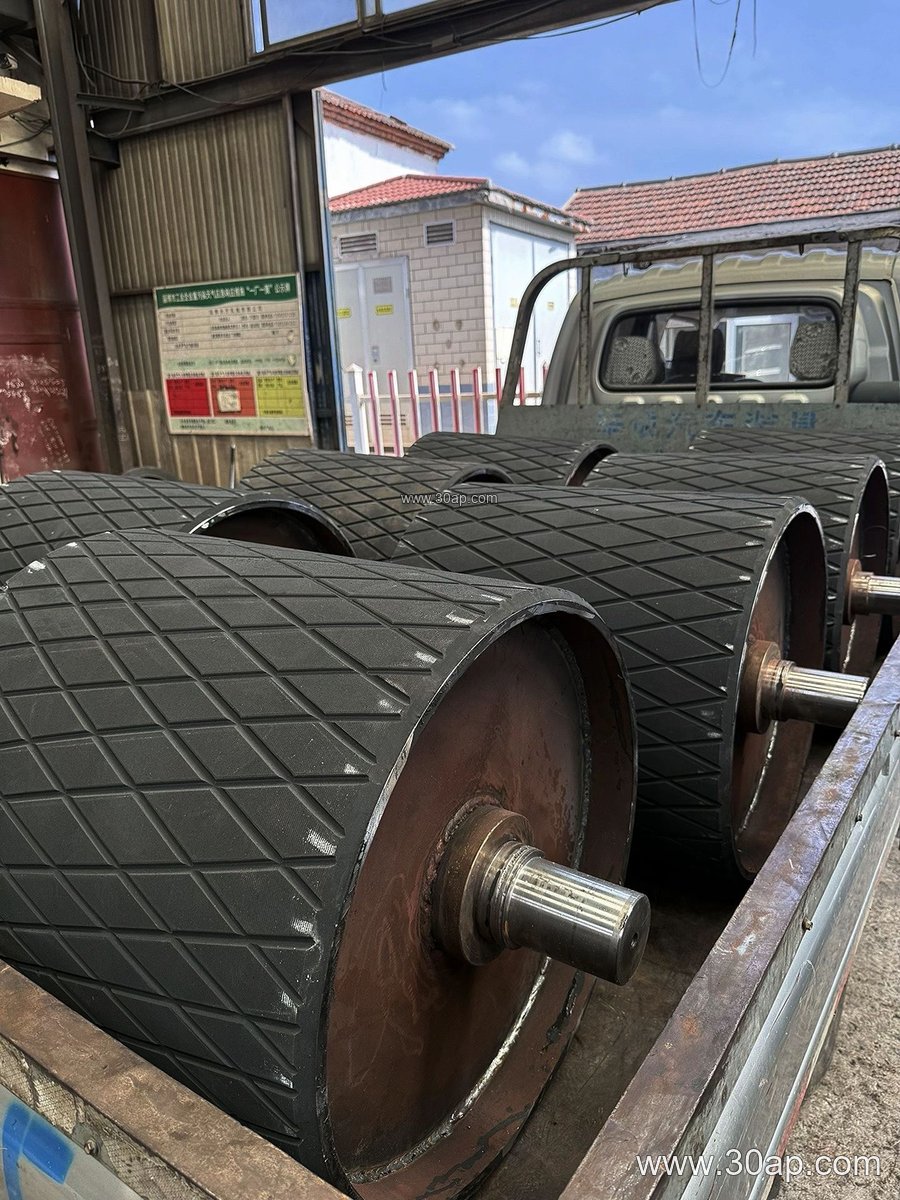
A diamond grooved lagged pulley is a conveyor pulley whose shell is covered with rubber lagging carrying a diamond-shaped groove pattern. This surface form is also called diamond lagging or diamond grooved rubber lagging. The pulley itself may be a drive pulley, tail pulley, or bend pulley, but the diamond groove is a surface treatment applied to the lagging, not a separate pulley type. In aggregate plants, coal washing facilities, and cement clinker lines, this pulley helps maintain friction between the conveyor belt and the pulley face while giving water and fine debris a path to escape.
Construction and Surface Details
The base is a welded steel shell with shaft, hubs, and bearing housings. Lagging is bonded to the shell by hot vulcanization, cold bonding, or cast rubber, depending on the supplier and duty. Diamond grooves are pressed or cut into the rubber after bonding. Common lagging thicknesses are 8, 10, 12, 15, and 20 mm. The diamond pattern is often specified where the belt runs wet or dusty, because the grooves reduce hydroplaning and improve traction compared with a plain rubber surface.
Common Reference Dimensions
The following values are reference data, not universal specifications. Final dimensions are determined by conveyor design, belt tension, and torque.
- Belt widths: B400, B500, B650, B800, B1000, B1200, B1400, B1600, B1800, B2000
- Pulley diameters: Ø200, Ø250, Ø315, Ø400, Ø500, Ø630, Ø800, Ø1000, Ø1250
- Lagging thickness: 8 mm, 10 mm, 12 mm, 15 mm, 20 mm
- Shaft diameters: Ø50, Ø60, Ø70, Ø80, Ø90, Ø100, Ø120, Ø140, Ø160
Shell face width is usually slightly wider than the belt. For example, a B800 belt may run on a pulley with about 950 mm face width; a B1200 belt may use about 1400 mm. A combination such as B1200 × Ø1000 or B800 × Ø500 is common in reference tables, but no single belt width is tied to one diameter. Shaft diameter follows torque and load, not belt width alone.
Where It Fits in a Conveyor
A diamond grooved lagged pulley is often used as a drive pulley at the head of a quarry or limestone conveyor, where the belt must transmit power without slipping. It can also appear as a tail pulley in a tunnel muck line or as a bend pulley in a power plant coal handling system. The diamond groove is especially useful on pulleys that see wet conditions, such as wash plant circuits or outdoor stockyard conveyors. For comparison, a plain lagged pulley may be chosen in dry, clean service where groove cleaning is not needed; a ceramic lagged pulley may be considered for very high abrasion, but it is a different surface form.
Buyer Checklist
Before ordering, confirm the pulley role: drive, tail, or bend. These are not interchangeable, and the required lagging pattern may differ. Check belt width, pulley diameter, face width, shaft diameter, bearing type, and lagging thickness. Ask how the diamond groove is formed and whether the rubber is hot vulcanized or cold bonded. Verify the conveyor bracket and bearing housing interface so the pulley fits the existing frame. Also review the conveyor belt specification and the allowable take-up travel, because a lagged pulley changes the effective diameter slightly. For a new conveyor, the pulley supplier and the idler roller supplier should coordinate dimensions so the belt line runs true.
Maintenance Notes
Inspect the diamond groove for wear, glazing, or embedded material. Worn grooves reduce grip and may cause belt slip, especially on a drive pulley. Keep the pulley face clean and check that the conveyor belt is tracking correctly. When lagging thickness wears below the design allowance, re-lagging may be needed. In dusty service such as a sand and gravel plant, regular cleaning of the groove pattern helps maintain friction. Always follow the pulley manufacturer’s torque and installation instructions for the shaft and bearing assembly.