What a Turning Pulley Does on a Belt Conveyor
A turning pulley is the drum that changes the direction of a conveyor belt without driving it. On a route that bends around a corner, rises to a transfer point, or returns slack belt to the tail, this pulley guides the belt along its new path while the drive remains elsewhere. In many plants the same component is called a bend pulley, and both names describe the same non-driven redirection drum. It should not be confused with a drive pulley, which transmits torque, or a tail pulley, which sets belt tension at the loading end.
Because the turning pulley carries belt tension and centrifugal load rather than drive torque, its design priorities differ from a head drum. Bearing selection, shaft stiffness, and shell roundness matter more than torque capacity, and the wrap angle at each bend decides how much radial load the shaft must absorb.
Construction and Surface Options
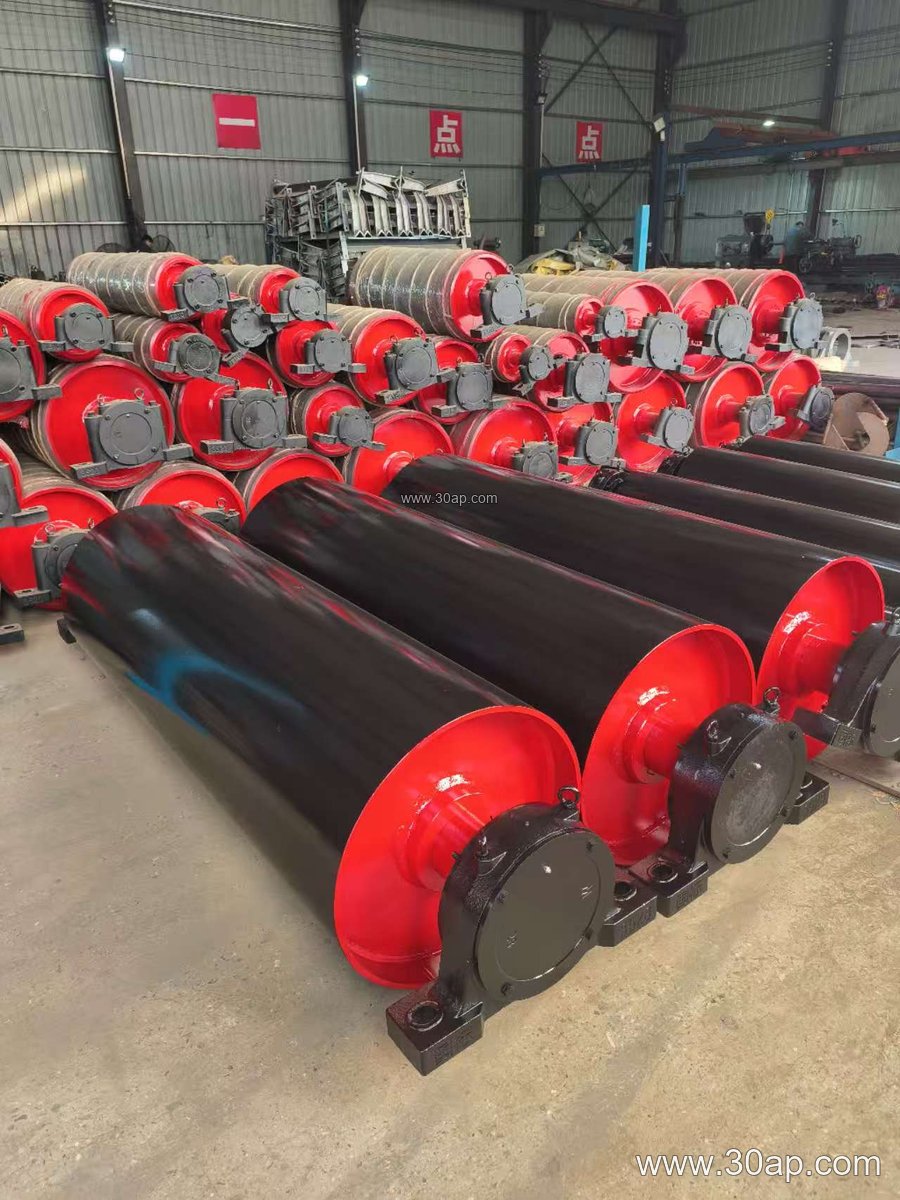
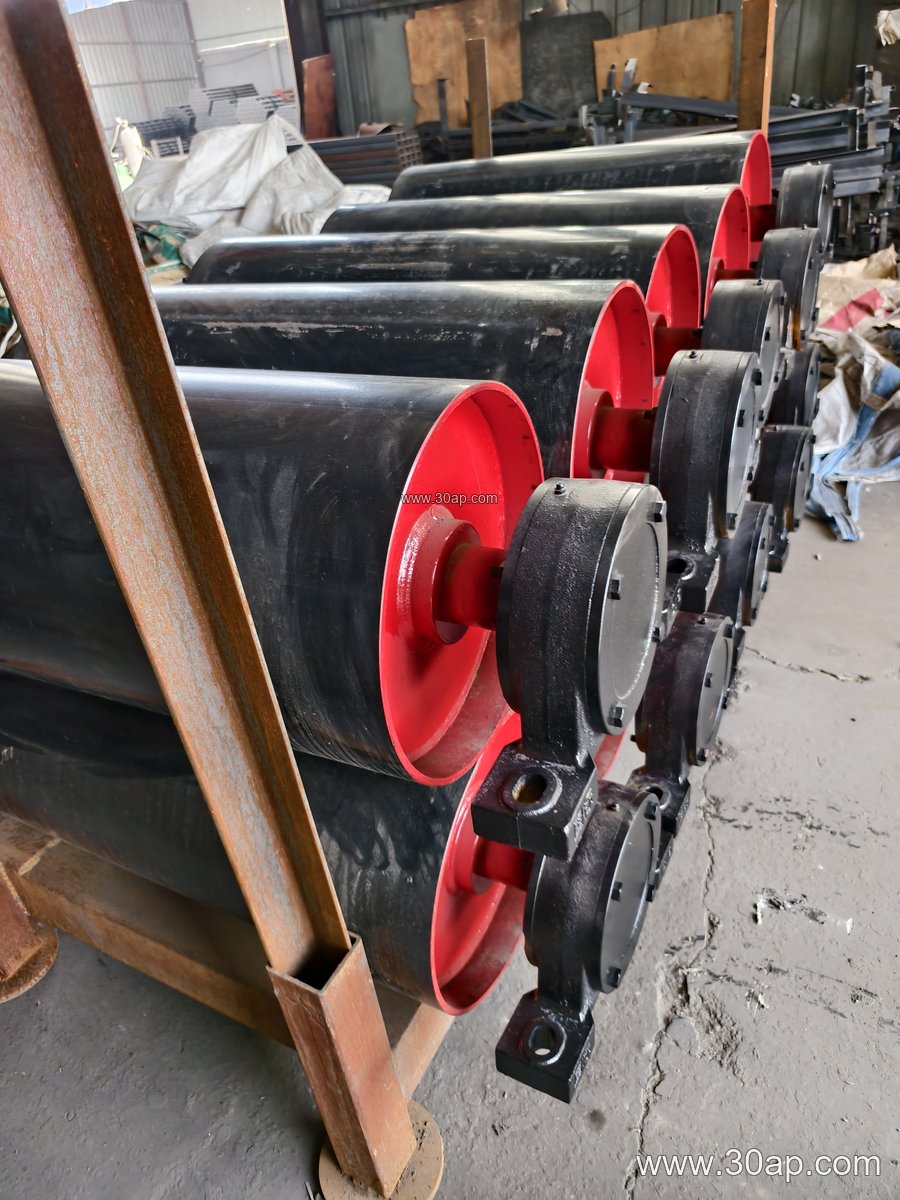
A typical turning pulley combines a rolled steel shell, welded or shrunk-on end discs, a through shaft, and self-aligning bearing housings mounted in conveyor brackets. Shell thickness and shaft diameter are chosen from the belt tension and the resultant load at the bend, not from belt width alone. Common shaft sizes include Ø80, Ø100, Ø120, and Ø140, but the final value follows the torque and load calculation for the specific installation.
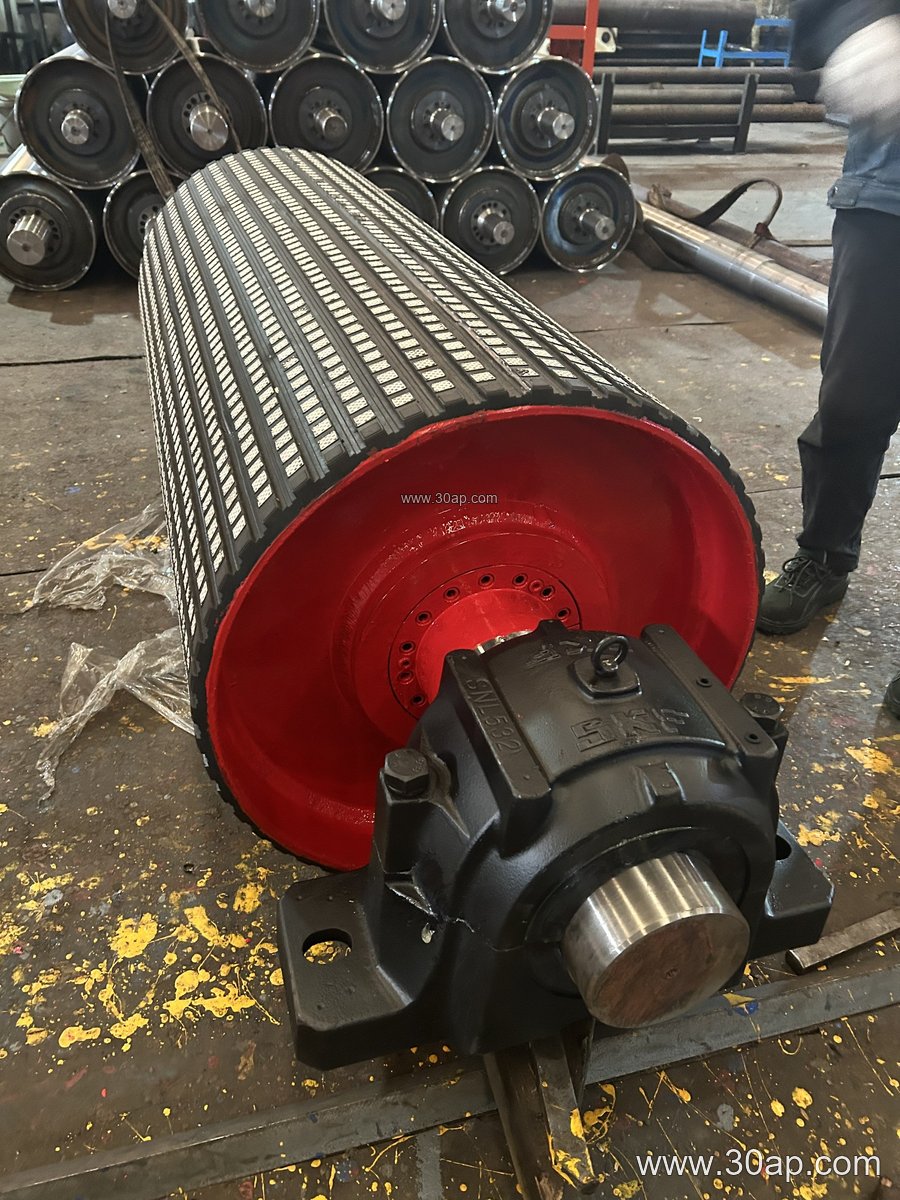
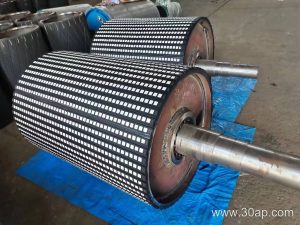
The belt-facing surface can be plain, rubber-lined, or ceramic-lined. Plain shells suit clean, dry return runs. Rubber lagging in 8, 10, or 12 mm helps grip and cushions the belt on bends with modest wrap angles. Diamond or herringbone grooving improves water shedding in washdown areas such as a coal preparation plant, while ceramic tiles resist abrasive slip in a limestone quarry. Lagging on a bend pulley is for traction and wear protection, not for power transmission.
Where Turning Pulleys Fit in Bulk Handling
In a copper concentrator, a turning pulley may redirect the return strand around a structural column. At a power station coal yard, several bend pulleys guide the belt through a transfer tower before it reaches the head. Cement plants use them to route clinker belts around kiln piers, and aggregate lines use them to gain height before a screen deck. In each case the pulley works with the conveyor belt, idler rollers, and support frame rather than as a standalone machine.
Typical reference combinations include B800 × Ø500 and B1200 × Ø1000, where the shell face width usually exceeds the belt width by roughly 100 to 200 mm. A B650 belt, for example, commonly runs on a shell around 750 mm wide. These are reference points, not fixed pairings; a wider belt can run on a smaller-diameter bend drum if the wrap angle and tension allow.
Dimensions Buyers Usually Confirm
| Parameter | Common reference values | Notes |
|---|---|---|
| Belt width | B500, B650, B800, B1000, B1200, B1400 | Match to existing conveyor |
| Pulley diameter | Ø250, Ø315, Ø400, Ø500, Ø630, Ø800, Ø1000 | Set by belt stiffness and wrap angle |
| Shell face width | About belt width plus 100–200 mm | Confirm with frame clearance |
| Shaft diameter | Ø60, Ø80, Ø100, Ø120, Ø140, Ø160 | Calculated from load and torque |
| Lagging thickness | 8, 10, 12, 15 mm | Plain shell if not required |
| Surface form | Plain, rubber, diamond, ceramic | Choose for material and moisture |
Selection and Maintenance Points
- Confirm the wrap angle at each bend, since a sharper turn raises shaft load and bearing duty.
- Check that the pulley diameter suits the belt’s minimum bend radius; a stiffer belt needs a larger drum.
- Verify bearing housing fit in the conveyor bracket and allow for thermal growth in hot clinker or sinter service.
- Inspect lagging wear and shell runout during scheduled shutdowns, and re-grease bearings at the interval set for the duty.
- Keep the pulley aligned with the belt centerline to avoid edge wear and mistracking through the following idler roller set.
A turning pulley is a simple part, but its position in the belt path makes it sensitive to misalignment and under-sizing. Buyers who confirm wrap angle, belt width, shaft load, and surface form before ordering avoid most field problems.