What a Tail Bend Pulley Does
A tail bend pulley is a non-driven conveyor pulley placed near the tail end of a belt conveyor. Its job is to change the direction of the conveyor belt, usually to route it around a tensioning device or to guide it back toward the tail pulley. It is sometimes called a tail deflection pulley or a tail snub pulley, but those names refer to the same component. It is not a drive pulley, which transmits power, and it is not a tail pulley, which is the terminal roller at the loading end. A bend pulley simply redirects the belt without driving it.
Because it does not transfer torque, the tail bend pulley experiences lower radial loads than a drive pulley. However, it still must handle belt tension and keep the belt tracking smoothly. It works together with the conveyor belt, idler rollers, and conveyor brackets to maintain a stable path.
Construction and Common Features
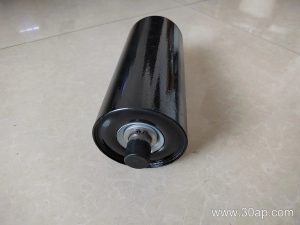
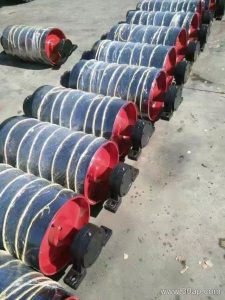
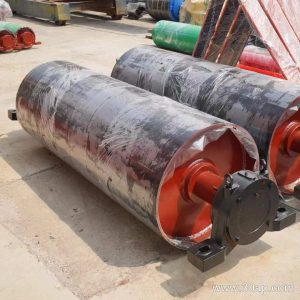
A tail bend pulley is typically built as a welded steel drum with a shaft, bearing housings, and a machined surface. The shell is often seamless pipe or rolled plate, and the shaft is sized according to torque and load, not simply by belt width. Common shaft diameters include Ø50, Ø60, Ø80, Ø100, Ø120, and Ø140 mm, with larger sizes for heavy-duty applications.
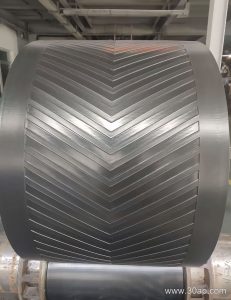
Surface finish can be plain, rubber-lagged, or ceramic-lagged. Lagging helps grip the belt and protect the shell from wear, especially in dusty or wet conditions. Rubber lagging may be cold-bonded or hot-vulcanized, with thicknesses such as 8, 10, 12, or 15 mm. Diamond or herringbone patterns are also used to improve tracking and shed material.
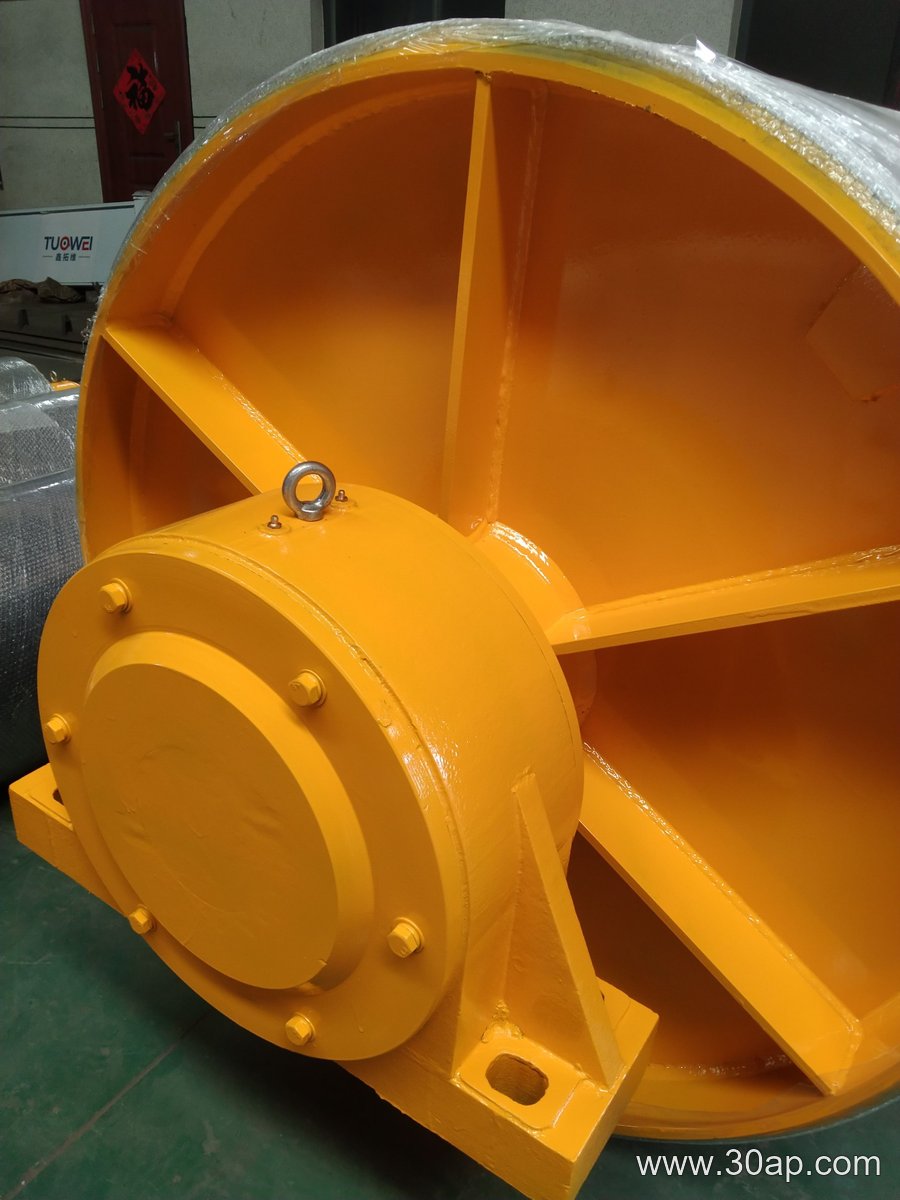
Diameters vary with belt width and tension. A small tail bend pulley might be Ø200 or Ø250 mm, while larger systems use Ø400, Ø500, or Ø630 mm. For example, a B800 belt might use a Ø500 mm bend pulley, and a B1200 belt could use a Ø1000 mm unit. These are common pairings, not fixed rules. The pulley face width is usually wider than the belt: B400 about 500 mm, B650 about 750 mm, B1000 about 1150 mm. The exact dimensions depend on the conveyor design.
Where It Fits in a Conveyor
You will find tail bend pulleys in bulk material handling systems such as aggregate plants, coal washing plants, and cement clinker lines. They are common in crushing and screening circuits, where they help route the belt around a gravity take-up or a horizontal tensioning arrangement. In a tunnel mucking operation, a tail bend pulley may guide the belt through a tight turn near the tail end.
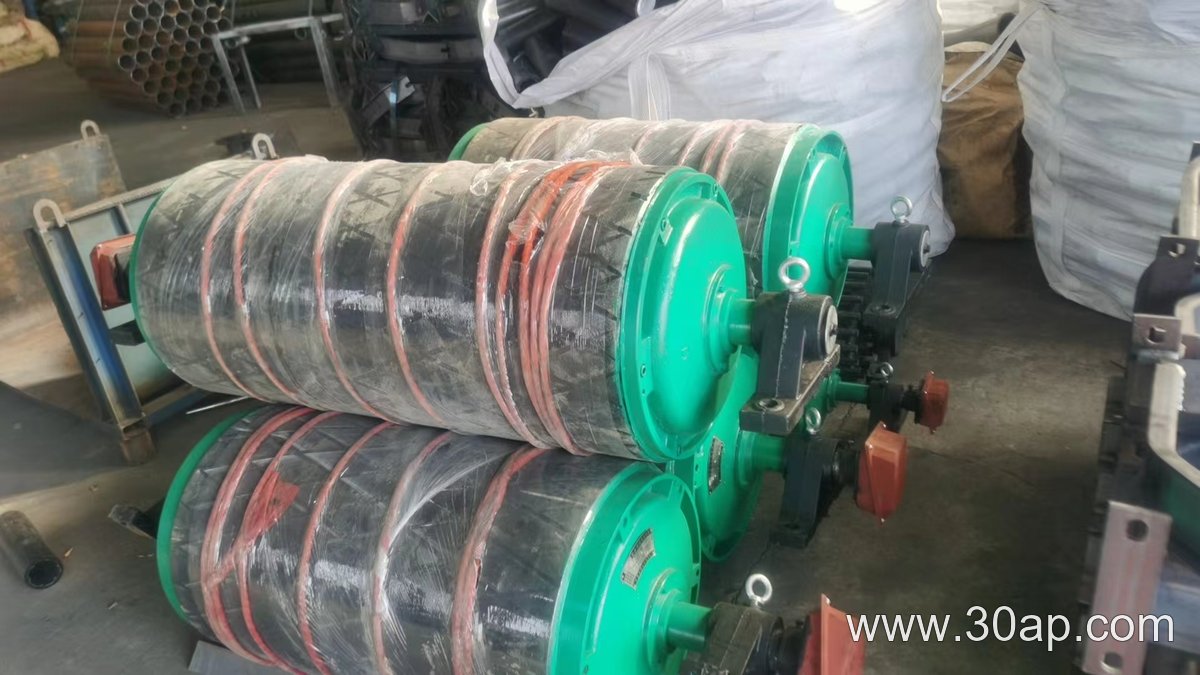
They are not interchangeable with drive pulleys, head pulleys, or tail pulleys. A drive pulley has a motor and gearbox; a head pulley discharges material; a tail pulley receives material. A bend pulley only changes direction. For this reason, maintenance and replacement decisions must respect the specific role of each pulley.
Selection and Buyer Guidance
When specifying a tail bend pulley, start with the belt width and the required wrap angle. Then confirm the pulley diameter and shaft size with the conveyor designer. Do not assume that a given belt width must match one diameter. For instance, a B650 belt can work with a Ø315 mm bend pulley in a light-duty system or a Ø500 mm unit in a high-tension layout.
Consider the environment: abrasive dust calls for thicker lagging, while wet conditions favor diamond or herringbone rubber. Check the bearing type and sealing to match the duty cycle. The pulley should be balanced and the shaft should be sized by torque and load, not by belt width alone.
- Belt width examples: B400, B500, B650, B800, B1000, B1200, B1400, B1600
- Common diameters: Ø200, Ø250, Ø315, Ø400, Ø500, Ø630, Ø800, Ø1000
- Lagging options: plain, rubber, ceramic, diamond, herringbone
- Lagging thickness: 8 mm, 10 mm, 12 mm, 15 mm, 20 mm
- Shaft diameters: Ø50, Ø60, Ø70, Ø80, Ø90, Ø100, Ø120, Ø140, Ø160, Ø180, Ø200 mm
Always request a dimensional drawing and confirm the shaft diameter, bearing centers, and lagging type before ordering. A tail bend pulley may look simple, but it must match the conveyor’s tension, speed, and environment to avoid belt mistracking or premature wear.