What a Striped Lagged Pulley Does
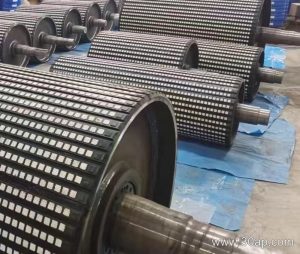
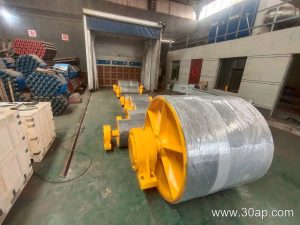
A striped lagged pulley is a conveyor pulley whose outer shell carries a rubber or polymer covering with a raised striped pattern. The stripes may run straight across the face or in a chevron arrangement, and their job is to improve friction between the pulley and the conveyor belt while giving water, dust and fine material a place to escape. In everyday plant language this item is also called a grooved lagging pulley, and both names describe the same product. The stripes are not decoration; they are a surface form chosen for grip and self-cleaning.
This pulley is normally part of the drive train of a belt conveyor, but it can appear in other positions where torque transfer is needed. It should not be confused with a drive pulley, a tail pulley or a bend pulley, since those names refer to positions and duties rather than to the striped surface itself. A drive pulley may be striped, and so may a tension pulley, but the stripe pattern is a separate design decision from the pulley’s role on the conveyor.
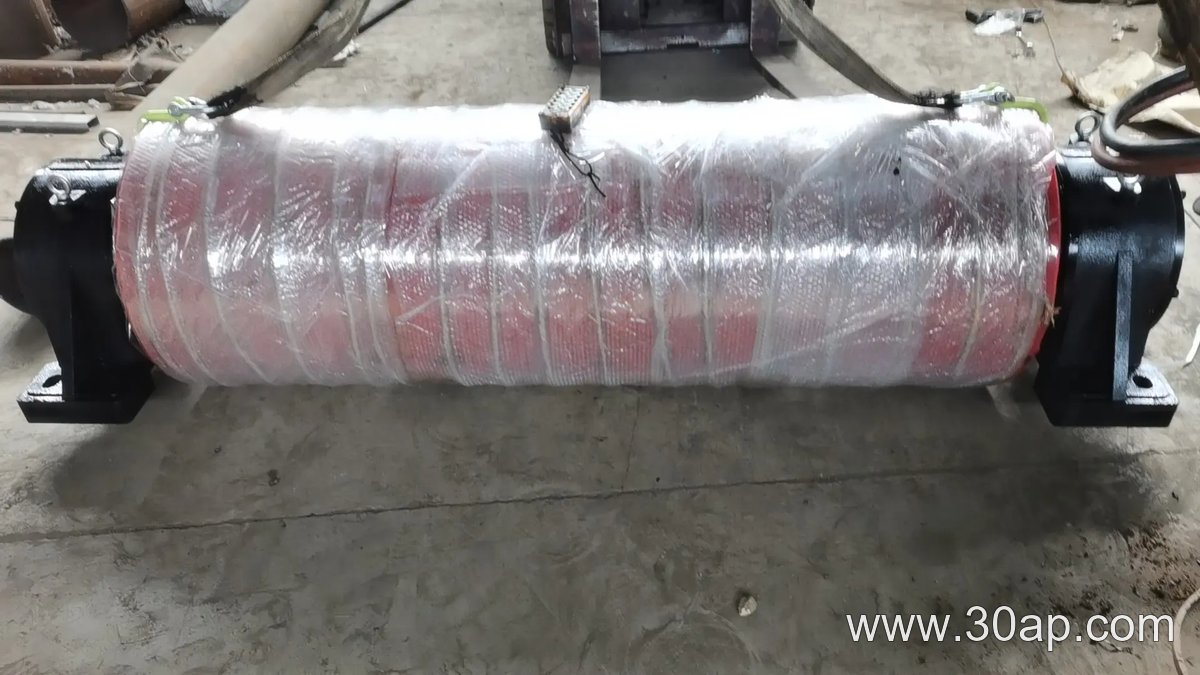
How the Striped Surface Is Built
The base is a steel drum with end discs and a shaft, machined so the shell runs true. Lagging is then applied in one of several ways. Cold bonded rubber is glued on and rolled into place; hot vulcanized rubber is cured under heat and pressure for a stronger bond; cast lagging is poured or molded directly onto the shell. The stripe pattern is formed during the molding or cut into the rubber after bonding.
Common lagging thicknesses are 8 mm, 10 mm, 12 mm, 15 mm and 20 mm. Thicker covers last longer in abrasive service but add weight and may affect the pulley diameter. Rubber hardness, usually expressed as a Shore value, is selected together with the pattern: softer compounds grip better on smooth belts, while harder compounds resist cutting by sharp ore. Stripes are often combined with a plain band at the edges to protect the belt from the pulley rim.
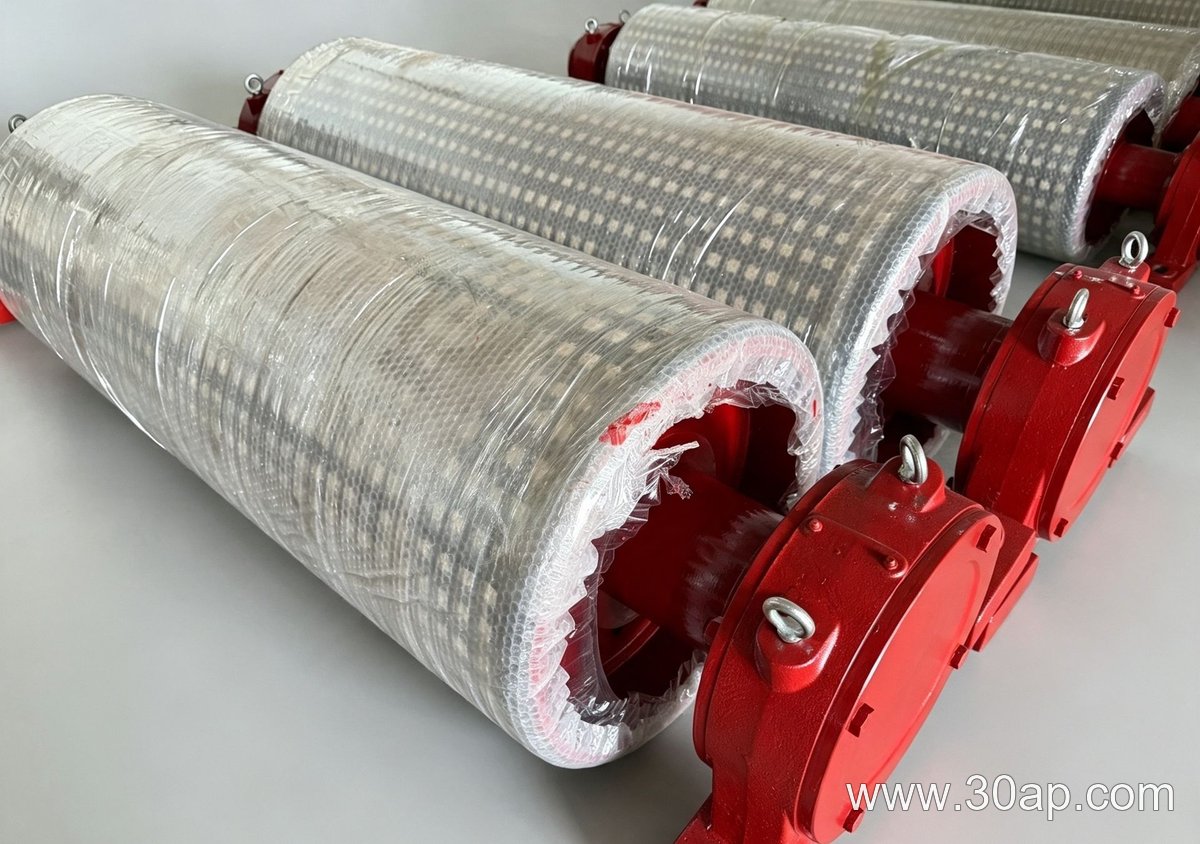
Where It Fits on a Conveyor
A striped lagged pulley is found in bulk handling plants where the belt must keep traction under wet or dirty conditions. Typical locations include the head drive of an aggregate line, the drive of a coal yard conveyor, the tension station of a long overland belt, and the drive of a crushed stone conveyor feeding a screen. In a quarry or a sand and gravel plant, rain and wash water often reach the belt, and the stripes help the pulley hold the belt without slipping.
On a cement plant clinker line, fine dust can polish a smooth lagging surface over time. A striped pattern breaks the contact area into smaller zones and lets dust move out from under the belt. The same logic applies in a fertilizer or grain silo conveyor, where a smooth rubber cover may glaze and lose grip.
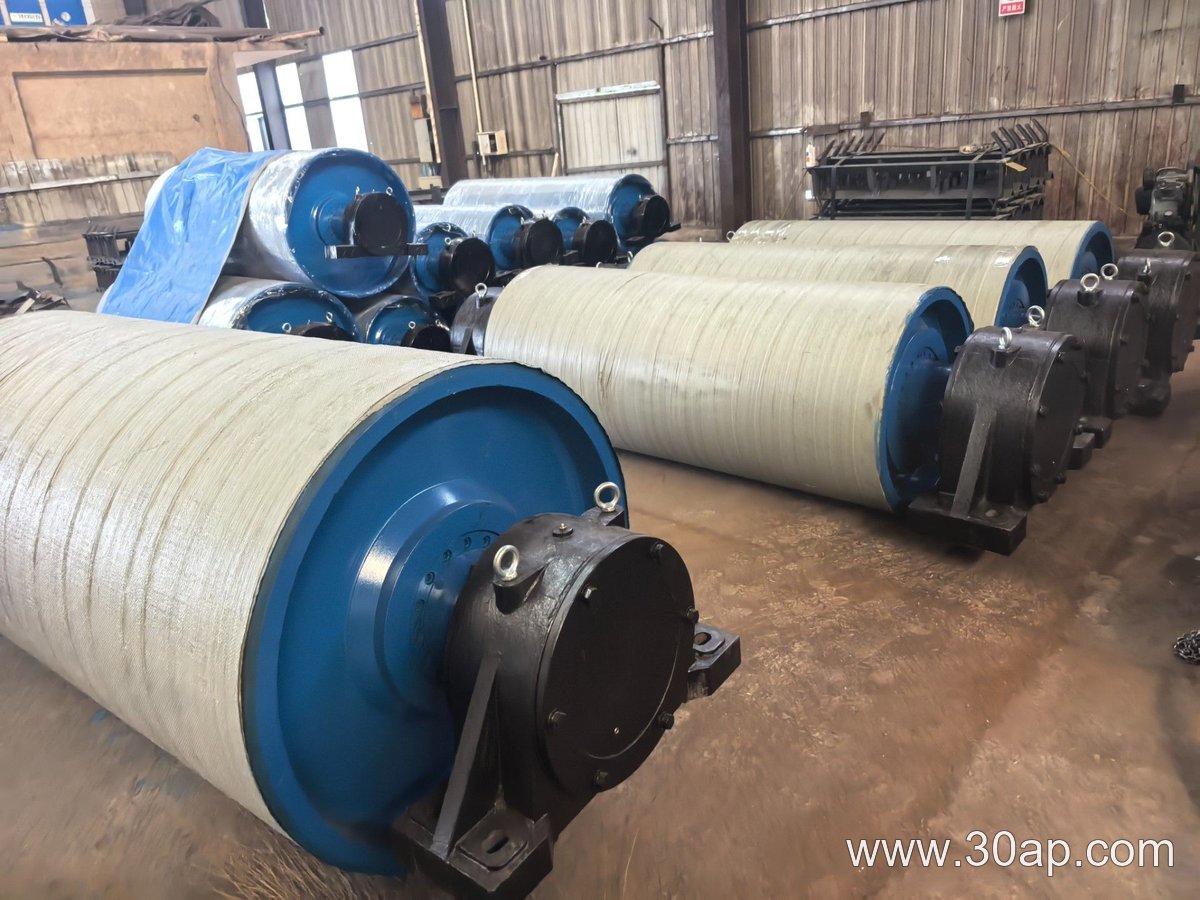
Matching the Pulley to the Belt
The pulley face is usually wider than the conveyor belt. As a rough reference, a B500 belt often runs on a pulley with about a 600 mm face, a B800 belt on about 950 mm, and a B1200 belt on about 1400 mm. These figures are reference points, not fixed rules, and the final face width should follow the belt width and the required edge clearance.
Diameter is selected from belt tension, wrap angle and the allowable belt stress, not from belt width alone. Common diameters include Ø200, Ø250, Ø315, Ø400, Ø500, Ø630, Ø800 and Ø1000. A mid sized combination such as B800 x Ø500 or B1200 x Ø1000 may appear in a design, but many other pairings are possible. Shaft diameter is determined by torque and bending load, with common sizes including Ø50, Ø60, Ø80, Ø100, Ø120 and Ø160. No single shaft size can be read off a belt width.
Buyer Checklist
- Confirm the pulley’s duty: drive, tension, bend or snub, and state it clearly in the inquiry.
- Give the belt width, pulley face width and required diameter range.
- Specify the stripe pattern, lagging material and thickness, for example 12 mm hot vulcanized rubber with straight stripes.
- State the environment: wet, dusty, abrasive, oily or high temperature.
- Ask about dynamic balancing, bearing type and the conveyor bracket interface.
- Request the shaft diameter based on the actual torque and load, not only on belt width.
When a striped lagged pulley is specified together with the conveyor belt, the idler roller and the conveyor bracket, the whole drive station works as a system. A well chosen stripe pattern improves grip, sheds water and dust, and helps the belt run centered, but it cannot correct a badly aligned frame or an overloaded drive. Buyers should treat the pulley as one part of that system and match its surface, diameter and shaft to the real duty.