An Impact Idler Absorbs Shock Better Than a Standard Idler but Its Rubber Rings Fail Faster
An impact idler, the subtype of idler roller designed with resilient rubber rings or discs at the load point, absorbs the shock of falling material far better than a standard steel idler, but those rubber rings wear faster and demand closer inspection. This judgment is the only one this article defends. Every paragraph below explains the mechanism behind that trade-off, the conditions under which it holds, or the conditions under which it does not.
Why the Rubber Rings Take the Hit
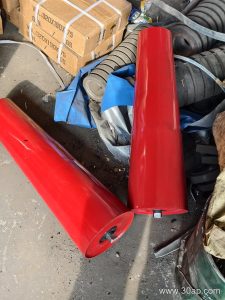
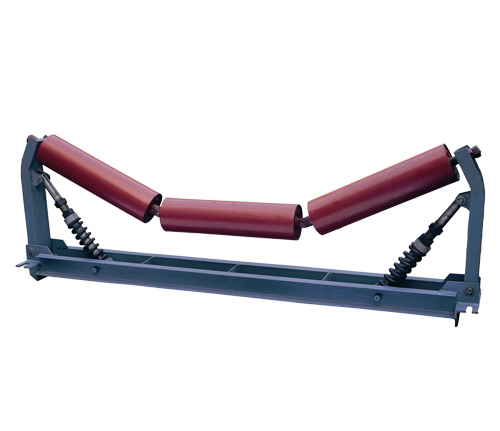
A standard idler roller presents a rigid steel shell to the belt. When a lump of ore or rock drops onto that shell, the energy of the fall has nowhere to go except into the belt carcass and the roller bearings. An impact idler changes that path. Its rubber rings sit between the belt and the steel shell, so the rings compress on impact, spread the force over a longer time, and return most of that energy gradually. The result is less bruising on the belt cover, less peak load on the bearing, and less noise. That is the mechanism that makes the impact idler the better choice at a transfer point.
But the same softness that absorbs shock also wears. Rubber deflects under a sharp lump, and repeated deflection at the same spot can tear, crack, or glaze the ring. Abrasive fines lodged against the rubber act like a grinding paste. A standard steel idler would simply resist that abrasion for a longer period, even though it transmits more shock. The trade-off is real: you buy belt and bearing protection with a consumable that has a shorter service interval than the steel shell it replaces.
The Check an Engineer Should Make Before Choosing an Impact Idler
Before specifying an impact idler, an engineer should verify two things. First, measure or estimate the actual drop height and lump size at the loading point. An impact idler earns its place when the falling material is heavy or the drop is high enough to bruise a standard belt cover. If the drop is gentle and the material is fine, the rubber rings add cost and a wear item without solving a real problem. Second, inspect the loading chute and skirt rubber. If the chute already controls the stream and the material lands with little free fall, a standard idler may survive as well as an impact idler and require less maintenance.
During operation, the maintenance angle is straightforward. Inspect the rubber rings for cuts, chunking, and flattening. A ring that has lost its round profile no longer absorbs shock; it has become a hard, uneven surface that can damage the belt. Check for missing rings, because a gap changes the support pattern and can cause the belt to track poorly. Listen for a change in noise at the load point. Also watch the idler’s rotation: if the rubber rings are worn unevenly, the roller may vibrate or drag. Signs that replacement is needed include visible cracks wider than a few millimeters, rubber that has become hard and glossy, and any ring that has separated from the shell. These are inspection cues, not universal intervals.
When the Judgment Holds and When It Does Not
The judgment holds in a dusty quarry or any transfer point where large, heavy lumps fall onto the belt. In that setting, the impact idler’s rubber rings protect the belt and bearings, and the faster ring wear is an acceptable cost because the alternative is a damaged belt. The judgment also holds when the material is abrasive but the drop is moderate. The rubber still cushions the blow, and the wear is predictable enough to plan for.
The judgment does not hold when the material is extremely hot, oily, or chemically aggressive. Rubber compounds have limits, and an impact idler in that service may fail by swelling or cracking rather than by abrasion, which changes the maintenance story. The judgment also does not hold when the loading point is already well controlled and the belt is heavy enough to shrug off the impact. In that case a standard idler roller will last longer and cost less to maintain, because there is no shock to absorb and no rubber to wear out. Finally, the judgment does not hold if the impact idler is installed at a location where it cannot be inspected. The whole advantage depends on catching ring wear before the belt is damaged, so an inaccessible installation turns the trade-off against the user.
What to Watch in a Dusty Quarry
In a hypothetical dusty quarry, the transfer point from the primary crusher to the main conveyor is the classic place for an impact idler. The maintenance crew should look at the rubber rings every week for the first month after installation, then adjust the interval based on what they see. If the rings show deep cuts or missing chunks, the drop height or the chute geometry may need attention before the next set of rings is installed. That is the practical shape of the decision: the impact idler is the right tool for shock, but it is a wear part, and the maintenance routine must treat it as one.