What the drive pulley actually does
The belt conveyor drive pulley is the component that turns motor torque into belt movement. Mounted at the head of the conveyor, it grips the inner surface of the belt and pulls the loaded strand toward the discharge point. In many layouts this same drum also acts as the head or discharge pulley, so its shell, lagging, shaft and bearings must handle continuous tension as well as the abrasive dust and fines that come off the belt. On a quarry face, a limestone mine or a cement clinker line, this drum is often the single most heavily loaded rotating part in the whole conveyor.
It is not a tail pulley and not a bend pulley. A tail pulley returns the belt at the loading end, and a bend pulley only changes belt direction to suit the profile. Only the drive pulley transmits power through friction between its lagged surface and the belt cover.
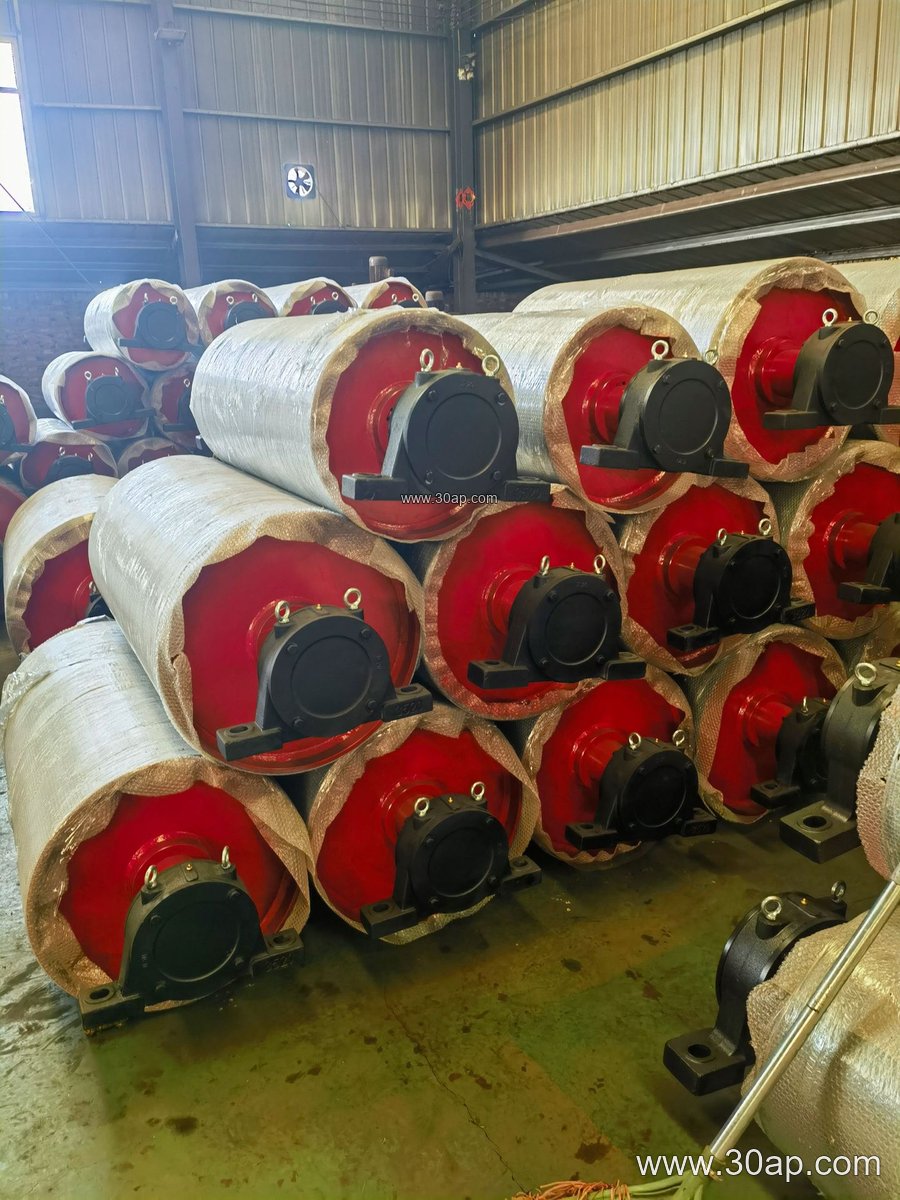
How a drive drum is built
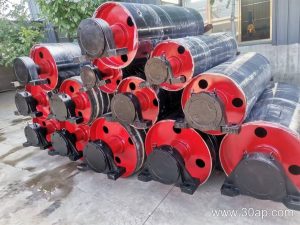
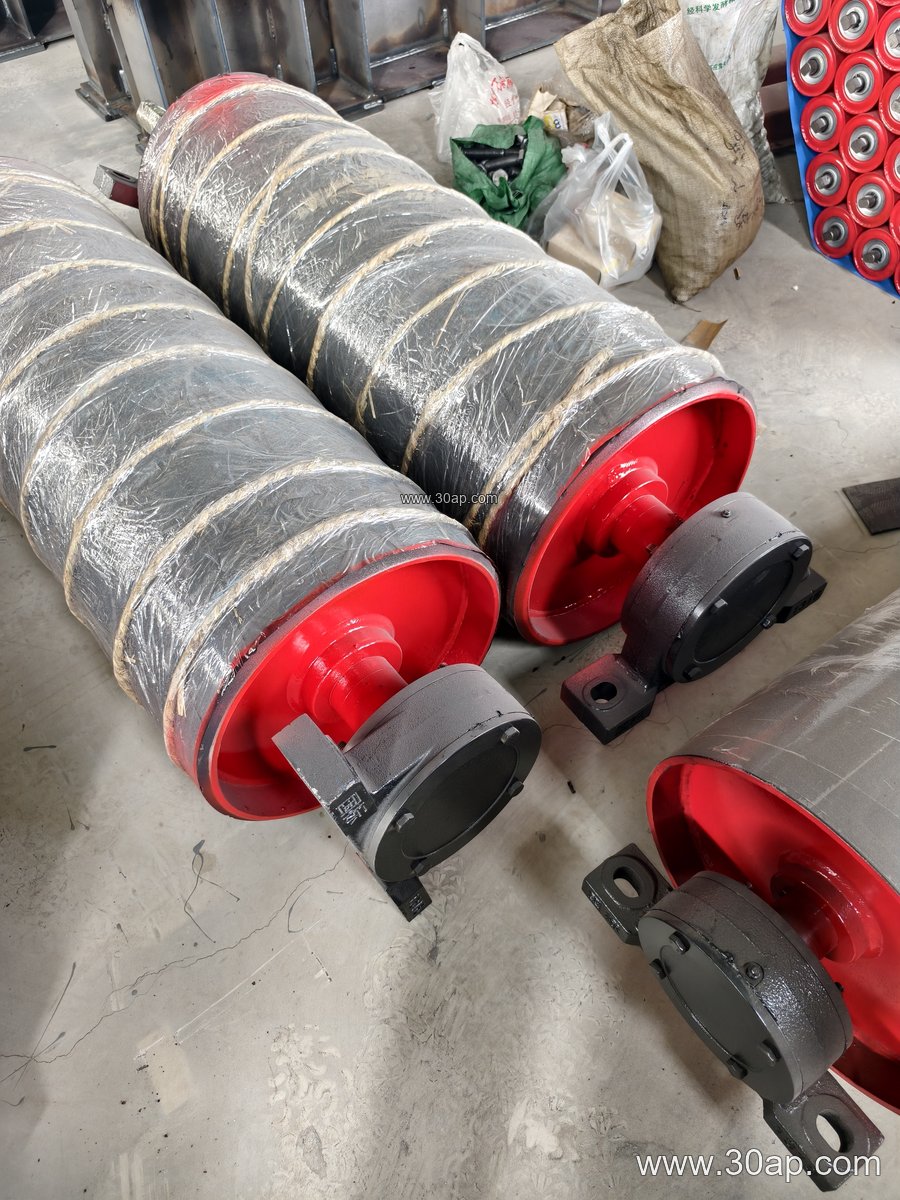
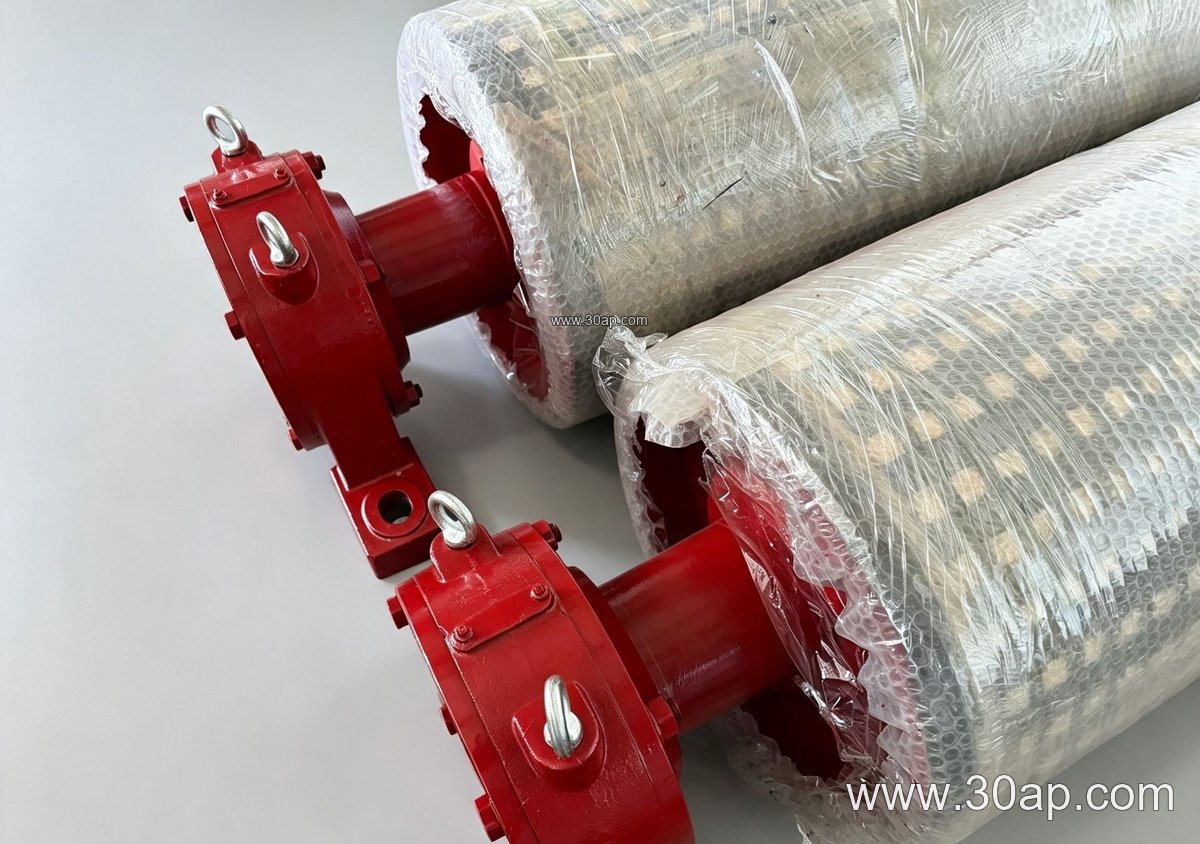
The typical assembly includes a welded or rolled steel shell, two end discs, a through shaft, hub connections, bearing housings and a lagged surface. Shell thickness and disc design follow the calculated torque and the belt tension at the head. Common shaft diameters in general conveying work run from Ø50 up to Ø200, but the final figure is set by torque and bearing load rather than belt width alone.
- Shell diameter: often Ø200 to Ø1800 depending on belt speed, tension and space
- Face width: usually wider than the belt, so B800 pairs with roughly 950 mm face
- Lagging: plain, hot-vulcanised rubber, cold-bonded rubber, diamond or chevron groove, or ceramic tile
- Lagging thickness: commonly 8, 10, 12, 15 or 20 mm
Diamond grooving helps water and fine dust escape from the contact zone. Ceramic lagging is chosen where slip risk is high and abrasive slurry is present. Plain finish is reserved for light duty or where a specific friction value is not critical.
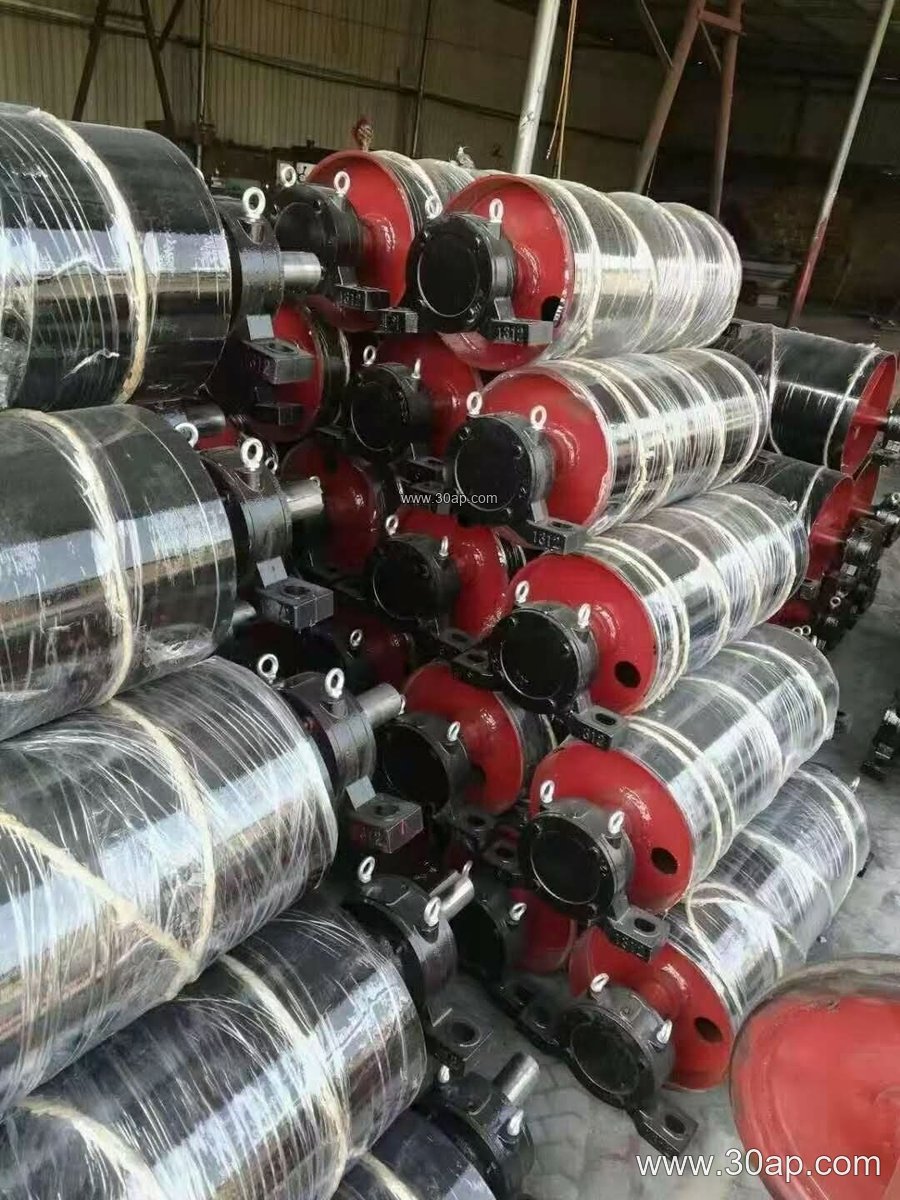
Matching the drum to the belt
A drive pulley works together with the conveyor belt it carries. A heavy-duty mining conveyor belt running at high tension needs a larger diameter and thicker lagging than a light fabric core belt on a short transfer. The table below shows reference combinations only; the drum diameter must be confirmed against belt tension, pulley wrap angle and the belt manufacturer’s minimum pulley recommendation.
| Belt width | Typical face width | Reference drum diameter | Reference lagging |
|---|---|---|---|
| B500 | about 600 mm | Ø250 or Ø315 | 8 to 10 mm |
| B650 | about 750 mm | Ø320 or Ø400 | 10 mm |
| B800 | about 950 mm | Ø500 | 10 to 12 mm |
| B1000 | about 1150 mm | Ø630 or Ø800 | 12 mm |
| B1200 | about 1400 mm | Ø1000 | 12 to 15 mm |
| B1400 | about 1600 mm | Ø800 or Ø1000 | 15 mm |
| B1600 | about 1800 mm | Ø1250 | 15 mm |
Two conveyors with the same belt width can use different drum sizes because their tension, speed and duty differ. Never treat one diameter as mandatory for a given width, and never derive a shaft diameter from belt width alone.
Where it is installed
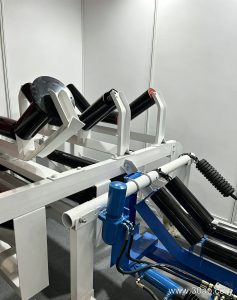
In a crushing and screening circuit, the drive drum usually sits at the discharge end above the screen feed. In a coal preparation plant it may be the head drum of a belt feeding the wash box, where flame retardant conveyor belt and anti-static properties matter as much as grip. Power plant coal handling and port bulk terminals tend to use large diameter drums with ceramic or diamond lagging to resist slip under wet conditions. Whatever the site, the drum must be aligned with the idler roller frames and the conveyor bracket so the belt tracks centrally.
Buyer checklist
- Confirm belt width, belt type and minimum pulley diameter with the belt supplier.
- State the calculated torque and belt tension, not just the motor power.
- Choose lagging by site condition: wet, oily, dusty or high-abrasion duty.
- Ask for the shaft material, keyway dimensions and bearing type.
- Check balancing grade, runout and shell-to-shaft weld quality.
- Confirm face width and any required crowning or flat profile.
For abrasion resistant conveyor belt lines and heavy ore duty at www.beltconveyorspareparts.com, a robust drive pulley with correct lagging reduces slip and extends both belt and drum life. For cement plant and power plant retrofits, matching the new drum to the existing conveyor bracket and bearing centre height keeps changeover time short. And for any project involving rubber conveyor belt or steel cord conveyor belt, request the drum drawing together with the belt specification so both are reviewed as one system. For example, a B1200 x Ø1000 drive pulley with 15 mm diamond lagging is a common reference point, but it is a starting point for engineering review, not a fixed rule.