What an Impact Resistant Idler Does
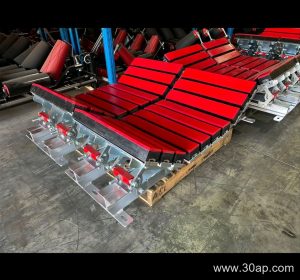
An impact resistant idler is a conveyor idler built to absorb the energy of falling material at loading points, transfer chutes, and other spots where the belt takes a direct hit. Instead of a plain steel shell, this idler roller usually carries rubber rings, rubber disks, or a cushioned shell that softens the drop and spreads the load across the belt surface. In a quarry, a coal preparation plant, or a crushing and screening line, the difference between a standard carrying idler and an impact resistant idler is most obvious right under the chute, where large lumps land first.
The product is also known as a buffer idler or shock-absorbing idler, and those names describe the same item. It belongs to the carrying side of the conveyor, not to the drive, tail, or bend pulley group, and it should not be confused with those components when specifying a system.
Construction and Surface Forms
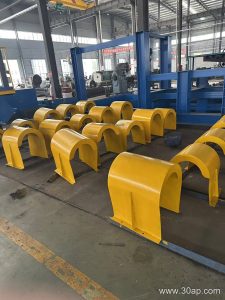
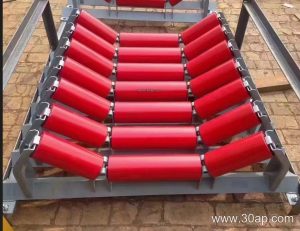
The basic frame is similar to a conventional troughing set: a single roller, a two-roller arrangement, or a three-roller trough. What changes is the roller body. Rubber rings are the most common surface form, mounted on a steel shell and held between end discs. Some designs use a thick rubber sleeve, and a few use ceramic or nylon faces where abrasion and impact occur together. Bearing seats are usually reinforced because the shock load travels through the shaft as well as the shell.
Common roller diameters for this duty include Ø89, Ø108, Ø127, Ø133, Ø159, and Ø178 mm, with larger sizes used on heavy-duty mining conveyors. Bearing sizes such as 6205, 6305, 6306, and 6308 appear in many standard buffer idler assemblies, but the bearing must be matched to the actual load and shaft design rather than chosen from the roller diameter alone.
| Reference item | Typical range | Note |
|---|---|---|
| Roller diameter | Ø89 to Ø178 mm | Selected by load and belt width |
| Belt width | B500 to B2000 mm | Buffer sets follow the same belt width |
| Trough angle | 20°, 30°, 35°, 45° | Often 35° at loading stations |
| Surface form | Rubber ring, rubber sleeve, nylon, ceramic | Rubber rings are most common |
| Roller length | About 200 mm at B500 up to about 750 mm at B2000 | Three-roller example, side rollers differ |
These figures are common references, not fixed pairings. A B1000 conveyor, for instance, may use 380 mm rollers in a three-roller trough, but the final length depends on the trough angle and the frame design.
Where It Fits on the Conveyor
The impact resistant idler sits in the impact zone, usually a group of three to five buffer sets placed under the loading chute. The first sets take the direct drop, and the following sets steady the belt before it returns to standard carrying idlers. In an underground coal mining conveyor or a tunnel mucking line, the same layout protects the belt from sharp rock. In a cement plant, the buffer zone often appears where clinker leaves the cooler; in a power plant coal yard, it appears below the transfer tower.
The belt itself matters here. A heavy-duty mining conveyor belt, an abrasion resistant conveyor belt, or a steel cord conveyor belt can tolerate more impact than a light fabric core belt, but none of them should be asked to absorb a drop that the idler group could cushion. Matching the buffer idler to the belt grade is part of the selection work.
Selection Points for Buyers
- Drop height and lump size: the main inputs. Higher drops and larger lumps call for thicker rubber rings and more buffer sets.
- Belt width and trough angle: keep the idler set consistent with the existing frame, whether B800, B1200, or B1800.
- Roller diameter and bearing: check the shaft load and the frame opening rather than assuming a size from the belt alone.
- Sealing: dust and fines are constant at loading points, so labyrinth seals and good grease retention matter as much as the rubber surface.
- Spacing: buffer sets are normally placed closer together than normal carrying idlers, then followed by a transition to standard troughing.
A buyer should also confirm whether the supplier offers replacement rubber rings, since the rings wear faster than the shell and can be changed without scrapping the whole roller. Spare rings, end discs, and bearing housings are practical items to keep on hand in a busy quarry or port terminal.
Maintenance and Comparison
Inspection is mostly visual: look for worn or missing rings, rubber dust under the frame, and a belt that tracks poorly after the loading point. A seized bearing shows up as a hot shell or a polished shaft end. Because the impact resistant idler works alongside troughing idlers, V-return idlers, and self-aligning idlers, a maintenance walk should cover the whole station, not just the buffer sets.
Compared with a standard carrying idler, the buffer version costs more per piece but reduces belt damage and downtime at the transfer point. That comparison is the reason it exists; it is not a substitute for the drive pulley, tail pulley, or bend pulley, and it does not replace the conveyor bracket or frame that holds it. For anyone running an ore conveyor, a crusher discharge belt, or a ship loading line, the impact resistant idler is a small component with a direct effect on belt life.