What a Conveyor Idler Frame Does on the Line
A conveyor idler frame is the steel structure that holds the idler rollers in position under and along the conveyor belt. It carries the weight of the belt, the material on it, and the rollers themselves, then transfers that load into the conveyor stringer or main frame. Without a properly aligned frame, even good rollers wear unevenly and the belt starts to wander.
The frame is not a pulley and should not be confused with one. Drive pulleys, tail pulleys, and bend pulleys transmit motion or change belt direction; the idler frame simply supports the carrying and return strands. In a typical stone crushing line or cement plant, hundreds of these frames sit in a row, and their geometry decides how smoothly the belt tracks.
How the Frame Is Built
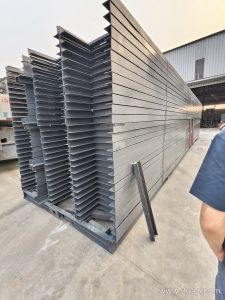
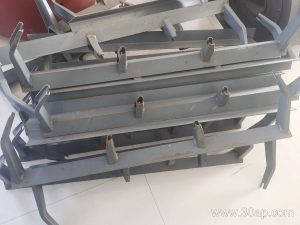
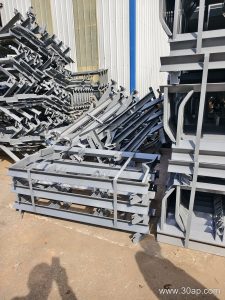
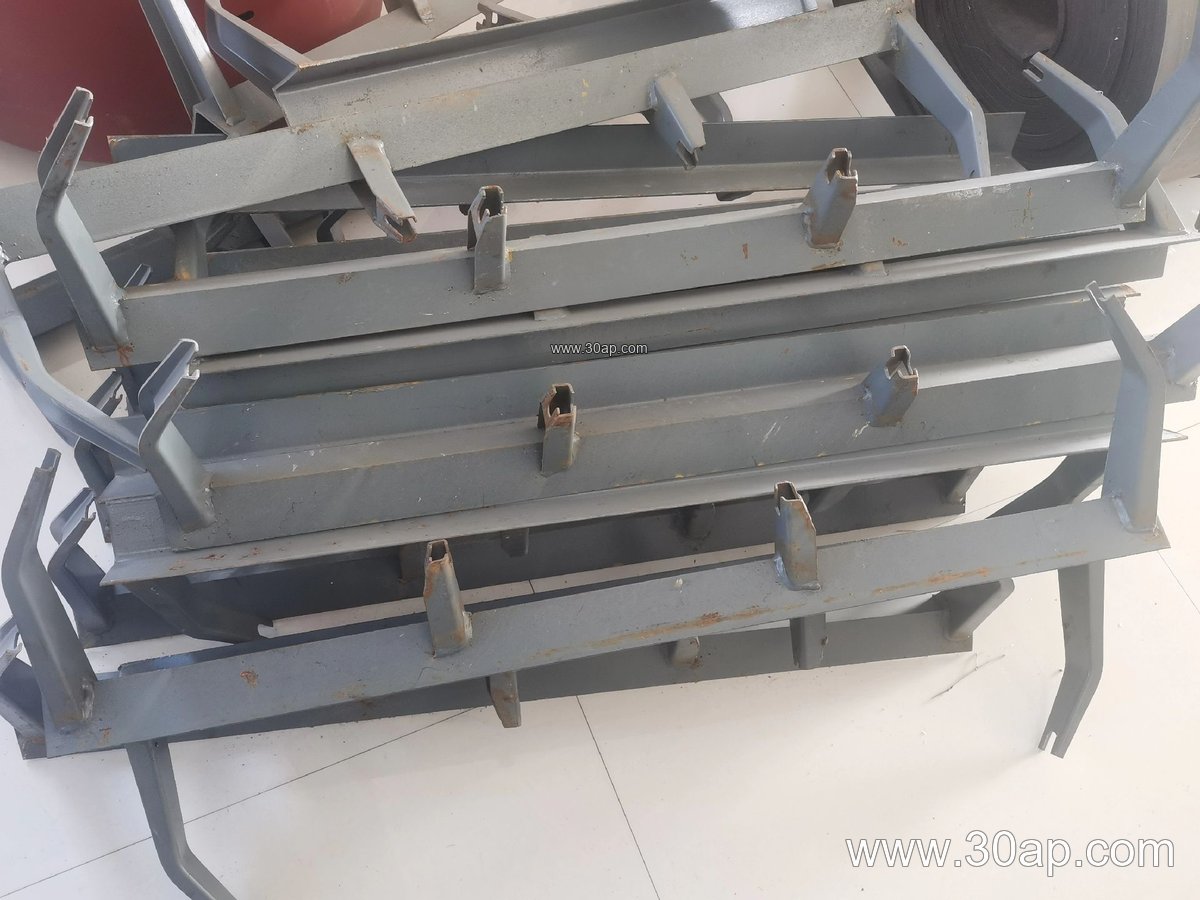
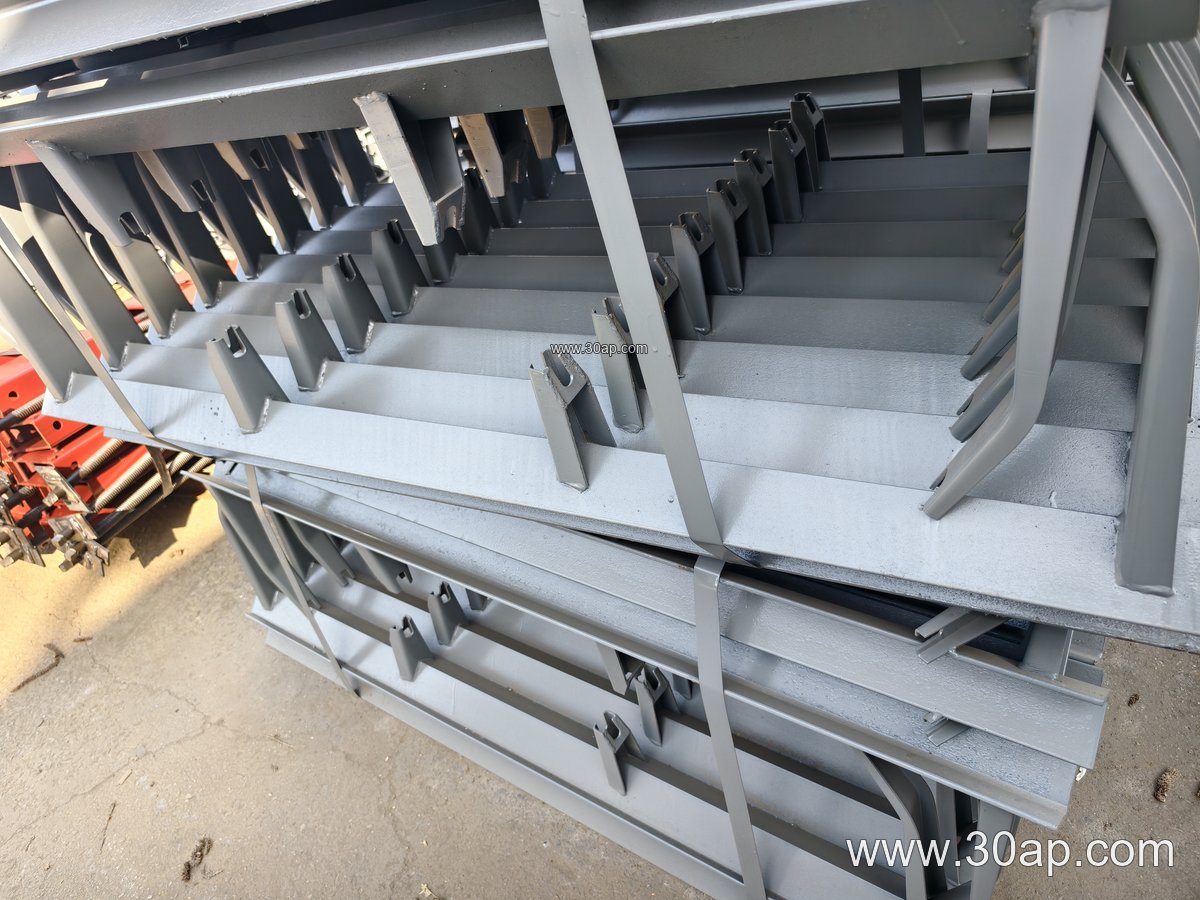
Most frames are fabricated from angle steel, channel steel, or folded steel plate. The crossbeam is cut to suit the belt width, drilled for the roller shafts, and welded to end brackets that bolt onto the conveyor structure. A conveyor bracket at each end keeps the frame square to the belt path.
Common construction details include:
- Welded or bolted crossbeam with slotted holes for fine adjustment
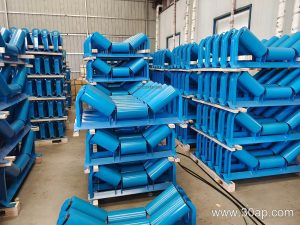
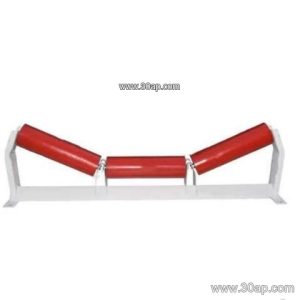
- Troughing frames with two or three roller seats set at a fixed or adjustable angle
- Return frames carrying a single flat roller or a V-shaped pair
- Impact frames with rubber-covered seats for loading points
Surface treatment is usually painting or hot-dip galvanizing, depending on how corrosive the site is. A coal washing plant and a port terminal will often choose different finishes for the same basic frame.
Frame Types and Where They Sit
Troughing frames form the carrying side and are the most common type. They may be fixed at one trough angle or adjustable across a range, which helps when a belt needs a gentler transition near the tail. Transition frames are placed close to the pulleys so the belt opens gradually from flat to troughed instead of folding sharply.
On the return side, a flat return frame supports the empty belt, while a V-return frame helps center it and shed loose material. Self-aligning frames with slightly forward-tilted rollers are used where belt wander is a recurring problem. Impact frames sit below the loading chute, and spiral or garland frames suit lines where shock loads or sticky material are expected.
One useful comparison: a self-aligning frame corrects tracking, while a standard fixed frame does not. Neither replaces the other, and many conveyors use both along the same run.
Matching Frames to Belt Width, Trough Angle, and Roller Diameter
Frame selection starts with the belt width, then the trough angle, then the roller diameter. These three values interact, but they are not locked into single combinations. A B800 belt may run at 30 or 35 degrees with Ø108 rollers, while a wider B1200 line might use 45 degrees and Ø133. Larger diameters are common on high-tonnage lines where belt speed and load are higher.
Reference values often seen in design sheets:
- Belt width range: B500, B650, B800, B1000, B1200, B1400, B1600, B1800, B2000
- Trough angles: 20, 30, 35, and 45 degrees; adjustable frames can move between these
- Roller diameters: Ø89, Ø108, Ø133, Ø159, Ø194
- Forward tilt on self-aligning frames: usually about 1.5 to 2 degrees
Installation hole spacing and crossbeam length change with belt width and trough angle, so they are determined by design rather than fixed numbers. Buyers should ask for a drawing that shows the mounting dimensions for their specific stringer.
Where These Frames Are Used
You will find idler frames in almost any bulk handling circuit. In a limestone quarry or aggregate plant, they carry crushed rock from the crusher to the screening deck. In a power plant coal yard, they support the belt that feeds the boiler house. Other common sites include iron ore mines, sintering plants, fertilizer granulation lines, and grain silos.
The belt itself often dictates the frame duty. An abrasion resistant conveyor belt running at high speed needs stable, well-aligned frames to avoid edge damage. A flame retardant belt in an underground coal mine needs frames that are easy to inspect and replace in confined spaces. Where a steel cord belt is used on a long overland route, frame alignment becomes even more critical because the belt has little tolerance for misalignment.
What Buyers Should Check Before Ordering
A frame that looks simple can still cause problems if a few details are missed. Confirm the belt width first, then the roller diameter and shaft ends, because the seats must accept the roller you plan to use. Check the trough angle and whether it needs to be fixed or adjustable. Ask how the frame attaches to the stringer: bolt holes, hook, or clamp.
Also consider the environment. A wet coal plant may need galvanized frames, while a cement kiln area may call for heat-tolerant components nearby. Finally, request a dimensional drawing and confirm that the frame will accept your chosen idler roller and conveyor pulley layout without interference.