What the Bracket Actually Does
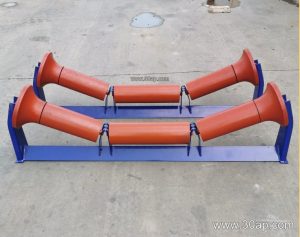
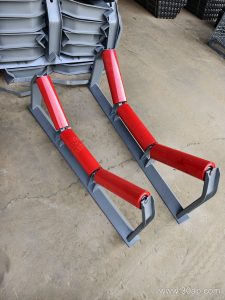
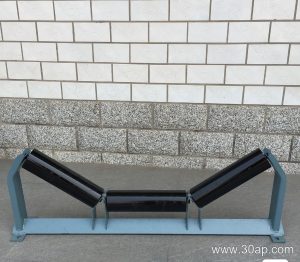
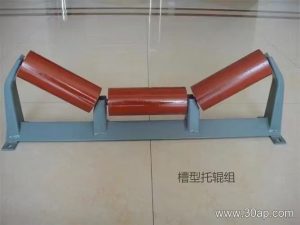
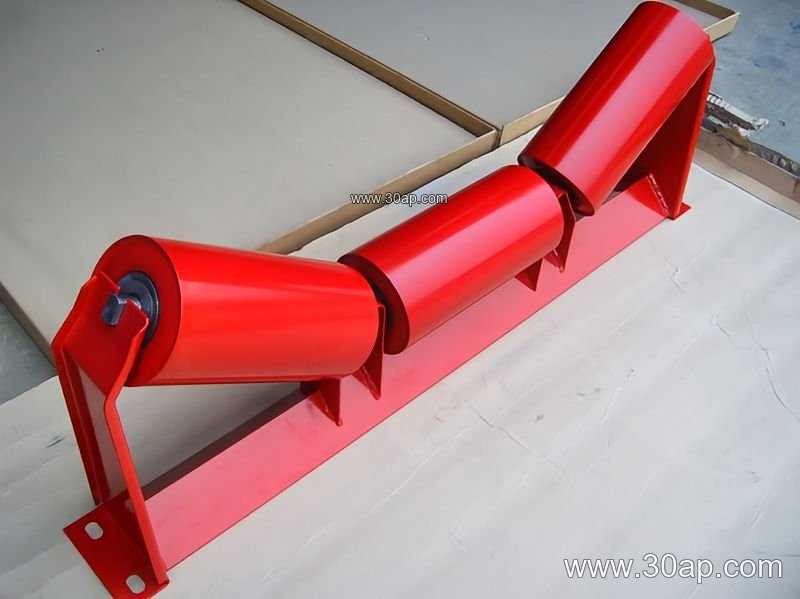
A conveyor idler bracket is the mounting hardware that holds each idler roller at the correct position and angle under the belt. It does not carry the load itself; it transfers the load from the roller shaft into the conveyor frame. On a typical troughed run, the bracket sets the three-roll arrangement that gives the belt its trough shape, so the bracket’s geometry directly affects belt tracking, material spillage, and roller life. In a quarry or a coal handling line, a loose or misaligned bracket is often the real cause of a belt that wanders to one side.
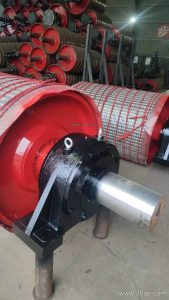
The bracket is also called a conveyor idler frame or idler support bracket, and the two names describe the same part. It should not be confused with a conveyor bracket used for other frame fittings, nor with the drive, tail, or bend pulleys, which are separate components with their own mountings.
Construction and Materials
Most brackets are fabricated from angle steel, channel steel, or folded steel plate, then drilled or punched for the roller shaft. The common forms are:
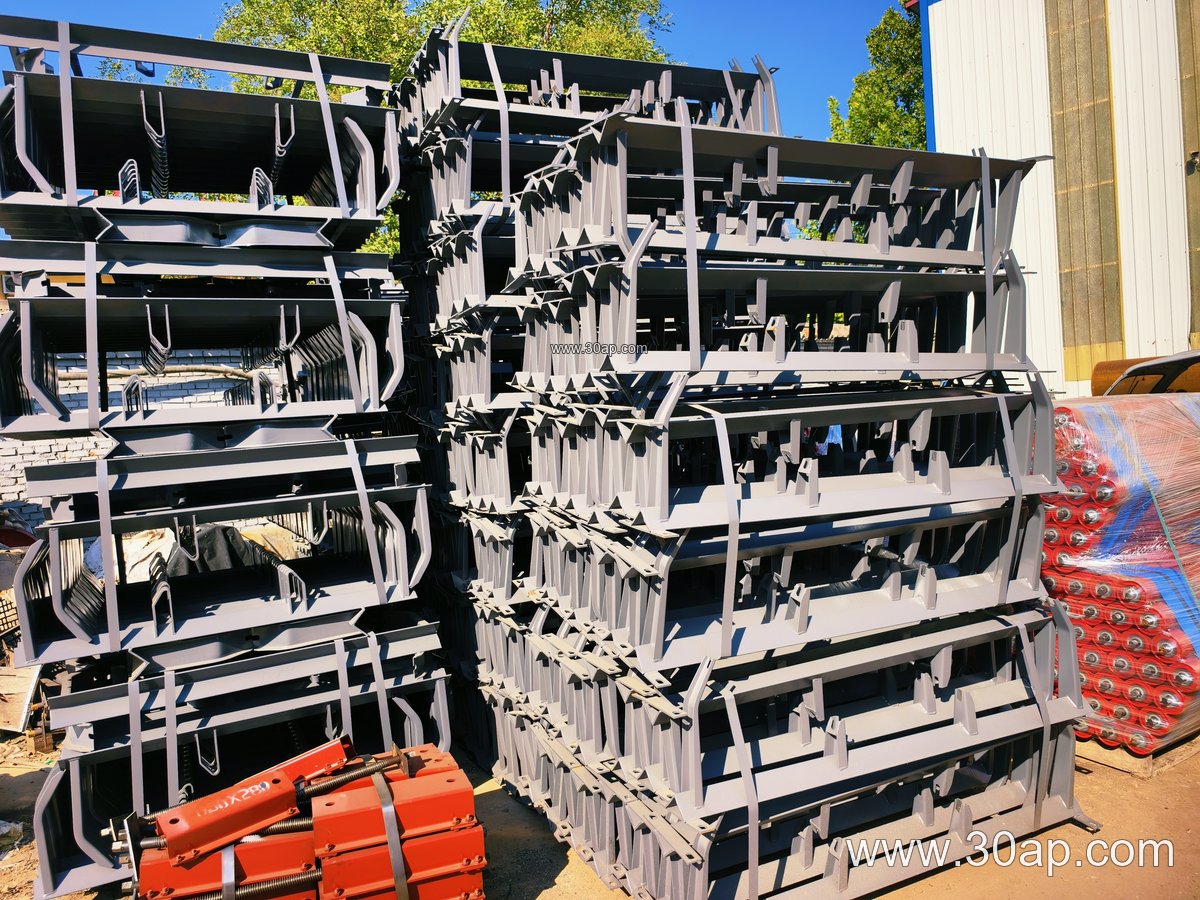
- Trough bracket (carrying side), usually with two or three roll positions
- Transition bracket, placed near the head or tail to ease the belt from flat to troughed
- Return bracket and V-return bracket for the empty strand
- Impact bracket, fitted with cushion rollers under the loading point
- Self-aligning bracket and forward-leaning bracket for tracking control
- Adjustable bracket, where the trough angle can be changed on site
Adjustable designs usually cover trough angles of 20, 30, 35, and 45 degrees. Forward-leaning brackets commonly sit at about 1.5 to 2 degrees. The mounting hole spacing and crossbeam length change with belt width and trough angle, so they are set by design rather than by a single universal figure.
Matching Bracket, Roller, and Belt Width
Belt width, trough angle, and roller diameter are chosen together, but not in a fixed one-to-one pattern. A B800 frame might run at 30 or 35 degrees with Ø89 or Ø108 rollers depending on load and speed; a B1200 line in a cement plant often uses 35 or 45 degrees with Ø133 rollers; a B650 unit may stay at 30 degrees with Ø89. The table below shows typical reference combinations, not mandatory pairings.
| Belt width | Common trough angle | Typical roller diameter | Usual bracket form |
|---|---|---|---|
| B500 / B650 | 20–30 degrees | Ø89 | Trough, return |
| B800 / B1000 | 30–35 degrees | Ø89 / Ø108 | Trough, transition, impact |
| B1200 / B1400 | 35–45 degrees | Ø108 / Ø133 | Trough, V-return, self-aligning |
| B1600 / B1800 | 35–45 degrees | Ø133 / Ø159 | Heavy trough, impact |
| B2000 / B2200 | 35–45 degrees | Ø159 / Ø194 | Heavy trough, adjustable |
Heavier belts place more demand on the frame. A steel cord belt or a thick multi-ply fabric core belt carrying iron ore needs a stiffer bracket and a larger shaft than a light fabric belt on the same width. This is why the roller and bracket are selected as a set, together with the belt specification.
Where It Is Used
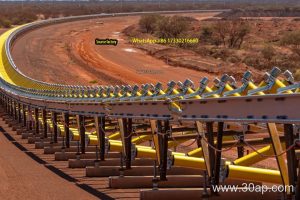
Brackets appear wherever a belt conveyor runs: limestone and iron ore mines, coal preparation plants, cement kilns and clinker lines, power station coal yards, sand and gravel pits, crushing and screening circuits, and port shiploading systems. In a coal mining conveyor, flame retardant and anti-static properties matter for the belt, while the bracket must resist vibration and dust build-up. In a cement plant, abrasive clinker calls for sturdy impact brackets at the transfer points.
The bracket works together with the idler roller, the conveyor belt, and the conveyor pulley at each end. A well-built frame keeps the roller square to the belt, which reduces edge wear on abrasion resistant or heat resistant belts and helps the belt train correctly through the whole run.
Buyer Checklist
- Confirm belt width, trough angle, and roller diameter before ordering; do not assume one width fixes one angle.
- Check the shaft size and mounting hole spacing against the rollers you already stock.
- Decide between fixed and adjustable brackets: adjustable ones simplify angle changes but need correct locking.
- Specify the material and finish for wet, dusty, or corrosive sites.
- For loading zones, order impact brackets with cushion rollers rather than standard trough frames.
- Ask for the crossbeam length and hole pattern drawing so the frame fits the existing stringers.
Good brackets are simple parts, but they set the foundation for straight running and long roller life on any belt conveyor.