What a Self-Cleaning Idler Does
A self-cleaning idler is a conveyor idler roller built to shed material that would otherwise stick to a standard roller surface. Sticky loads such as damp coal, clay-bearing limestone, cement raw meal, and wet sand tend to build up on a smooth steel roll. That buildup changes the roll diameter, causes belt tracking drift, and throws the conveyor belt offline. The self-cleaning idler roller addresses this by changing the roll surface or geometry so carried material cannot easily adhere.
It is still an idler roller, not a conveyor pulley. Drive pulleys, tail pulleys, and bend pulleys transmit or redirect belt tension and are not interchangeable with idlers. A self-cleaning idler supports the belt and rotates with it.
How the Cleaning Action Is Built In
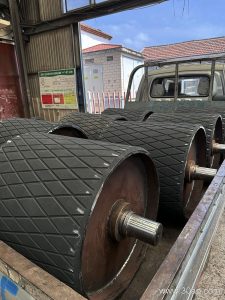
Most designs use one of two approaches. The spiral idler uses a helically wound steel flight welded to the shell, which pushes material toward the belt edges as the roller turns. The disc or comb design uses spaced discs or rings along the shaft, leaving open gaps that drop fines instead of packing them. Rubber-disc versions combine a steel core with flexible rubber rings, which flex free of sticky fines and also absorb some impact.
Shell materials vary. Plain steel is common for abrasive but dry service; nylon and ceramic-faced rolls resist wear and release some materials more readily; rubber rings suit wet, sticky, and high-impact positions. Bearing protection matters as much as the surface, because fine dust entering the seal is what kills most idlers. Common bearing sizes in this class include 6204, 6205, 6305, 6306, 6308, and 6310, matched to the shaft and load by the manufacturer rather than fixed to one roll diameter.
Where It Fits on the Conveyor
Self-cleaning idlers are usually placed on the carrying side where the belt first receives the load, and on the return side where fines cling to the belt cover. In a coal wash plant, a spiral return idler under the belt helps drop damp fines before they wrap a standard flat return roller. In a cement plant or a limestone quarry, a rubber-disc self-cleaning idler at a transfer point reduces buildup without the belt slap that a plain roll can cause.
On a gravel and aggregate line, the same roll type is often used after a screen where the belt carries damp sand. In a power station coal yard, self-cleaning idlers reduce the labor needed to scrape rollers during the rainy season.
Common Sizes and Configurations
Roll diameter and belt width are selected together with the conveyor design, not by a single rule. The table below shows typical reference values; side rolls and center rolls in a three-roll trough set can differ.
| Belt width | Typical roll length, three-roll trough (reference) |
|---|---|
| B500 | about 200 mm |
| B650 | about 250 mm |
| B800 | about 315 mm |
| B1000 | about 380 mm |
| B1200 | about 465 mm |
| B1400 | about 530 mm |
| B1600 | about 600 mm |
| B1800 | about 670 mm |
| B2000 | about 750 mm |
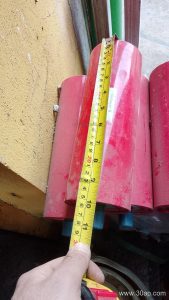
Common roll diameters run from Ø63 and Ø76 for light duty up to Ø159, Ø178, Ø194, and Ø219 for heavy conveyor service. Trough angles are usually 20, 30, 35, or 45 degrees. A self-cleaning roll can be supplied as a single roll, a two-roll set, or a three-roll trough set, and it mounts on the same conveyor bracket as a standard idler of matching dimensions.
Buyer Checklist
- Confirm the material: sticky fines, wet coal, or dry abrasive rock each point to a different shell and seal choice.
- Match the mounting dimensions to the existing conveyor bracket so the replacement drops in without frame modification.
- Check the bearing and seal class for dust and moisture, since cleaning the surface is only half the job.
- Ask whether the roll is balanced for the belt speed; an unbalanced spiral roll can vibrate at high speed.
- Keep spare rolls for transfer points, where buildup returns fastest.
A self-cleaning idler does not replace good belt cleaning, but it reduces the frequency of manual scraping and the tracking problems that follow material buildup on the roll surface.