What the Grooves Are For
A herringbone grooved lagged pulley is a conveyor pulley whose rubber or ceramic lagging carries a V-shaped pattern of grooves meeting at the center of the shell. The rubber layer raises friction between the pulley face and the conveyor belt; the herringbone pattern gives water, fine dust and loose material a path to escape sideways instead of being trapped under the belt. That combination matters most on drives that see wet or muddy conditions, where a plain smooth lagging can slip even when the wrap angle is generous.
The product is also called a herringbone rubber lagged conveyor pulley drum, and both names describe the same component. It remains a drive pulley or another specified position in the conveyor, not a substitute for a tail, bend or take-up pulley. Grooving is a surface treatment, not a change of duty.
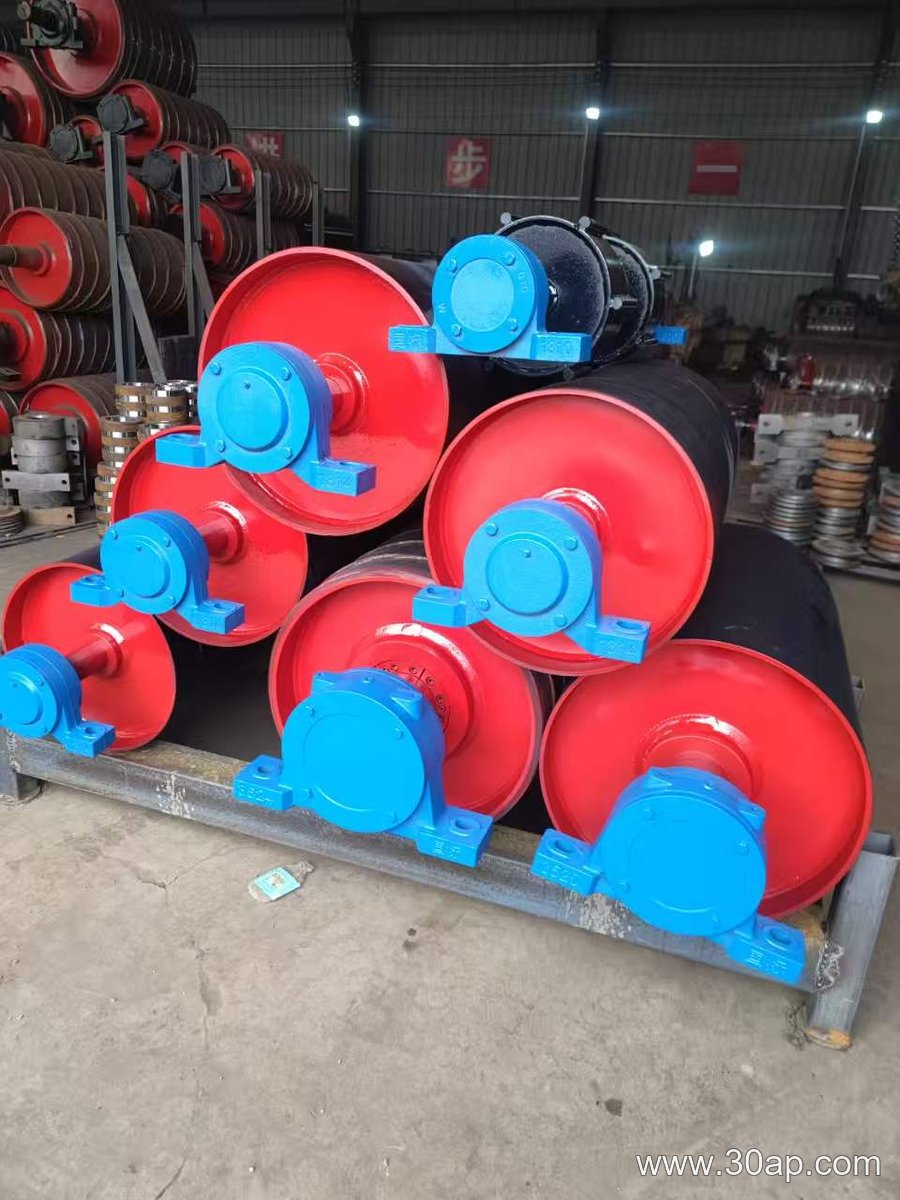
How It Is Built
The shell is usually a steel tube or rolled plate, machined at the ends and welded to the hub and shaft assembly. Lagging is bonded to the machined face in one of several ways: hot vulcanized rubber, cold bonded rubber, or ceramic tiles set in a rubber matrix. The herringbone grooves are cut or molded after bonding, or formed during vulcanization in a patterned mold.
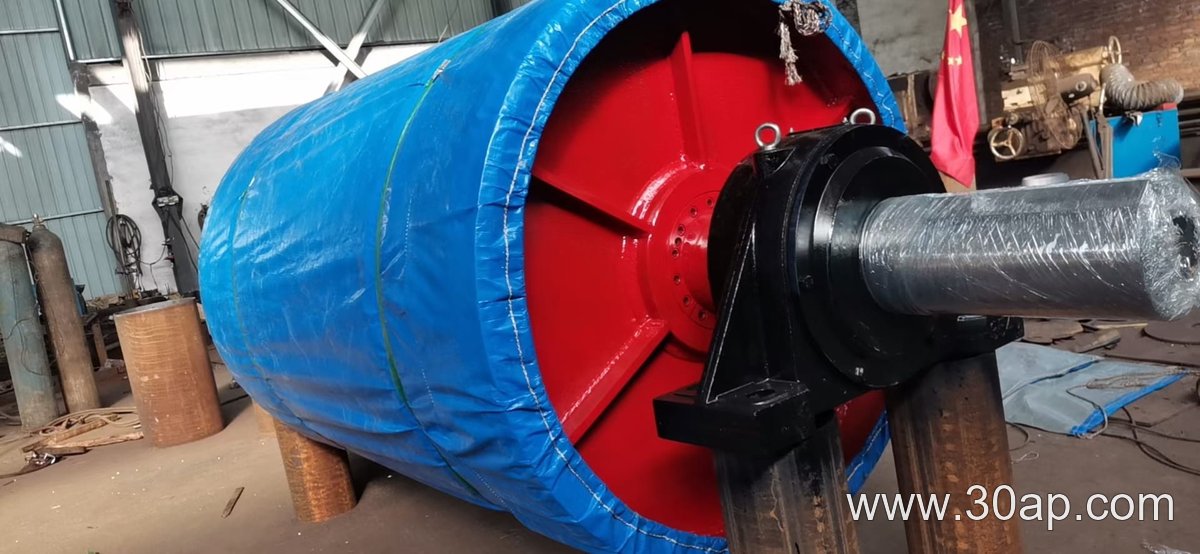
Groove depth and pitch depend on the belt width and the expected loading. A shallow pattern with a wide pitch is common on light-duty lines, while deeper, closer grooves are chosen for wet or abrasive service. The V usually points in the direction of belt travel so that water is pushed outward from the center line as the pulley turns. Chevron and diamond patterns do a similar job; herringbone is often preferred where the belt must center itself, because the two halves of the V meet symmetrically at the middle of the face.
Where It Fits on a Conveyor
The most common position is the drive or head pulley, where torque has to pass from the shell to the belt. It can also appear on a tension or snub position when the designer wants extra grip without adding a second drive. It is not a replacement for a tail pulley or a bend pulley; those positions have their own loads and tracking roles.
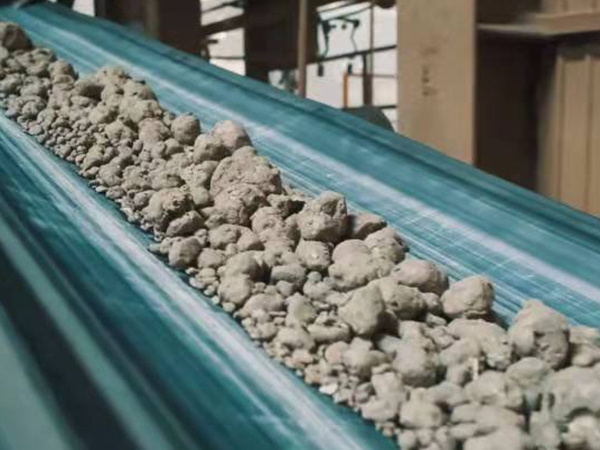
Mining and quarry work is a typical setting: crushed stone, iron ore and copper ore all arrive at the head end with water and fines. A coal preparation plant and a port bulk terminal face the same problem, since belts there often run damp or in sea air. In a cement plant, clinker dust is dry but very fine, and it can polish a smooth lagging until the drive loses grip. A herringbone lagged drum keeps a working surface under those conditions and helps the belt stay centered on the face.
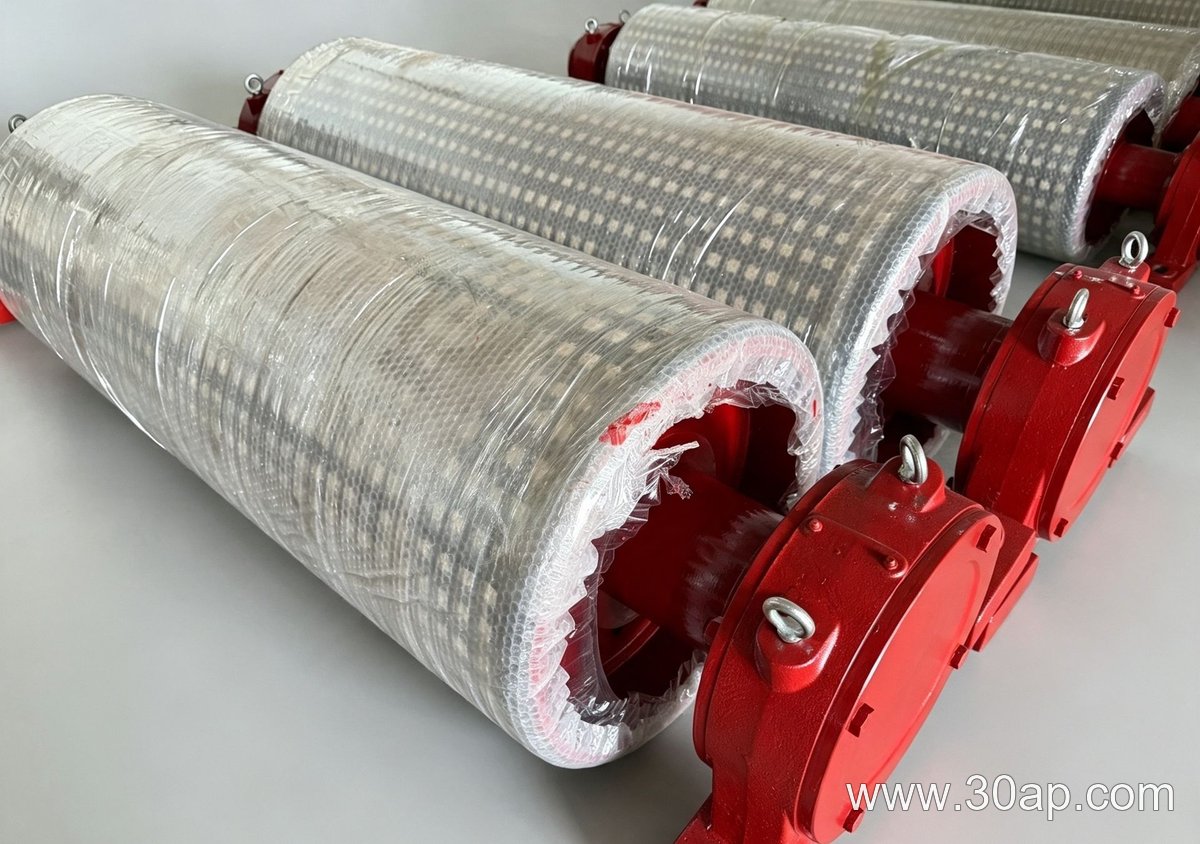
Matching Belt Width, Diameter and Shaft
Belt width, pulley diameter and shaft diameter are separate design decisions. The face width is normally a little wider than the belt, so a B800 belt commonly runs on a pulley face around 950 mm, and a B1200 belt on a face near 1400 mm. Diameter is set by the required wrap, belt tension and the space available; a B800 drive might use Ø500, Ø630 or Ø800 depending on the torque and the belt construction. There is no rule that one belt width can only match one diameter.
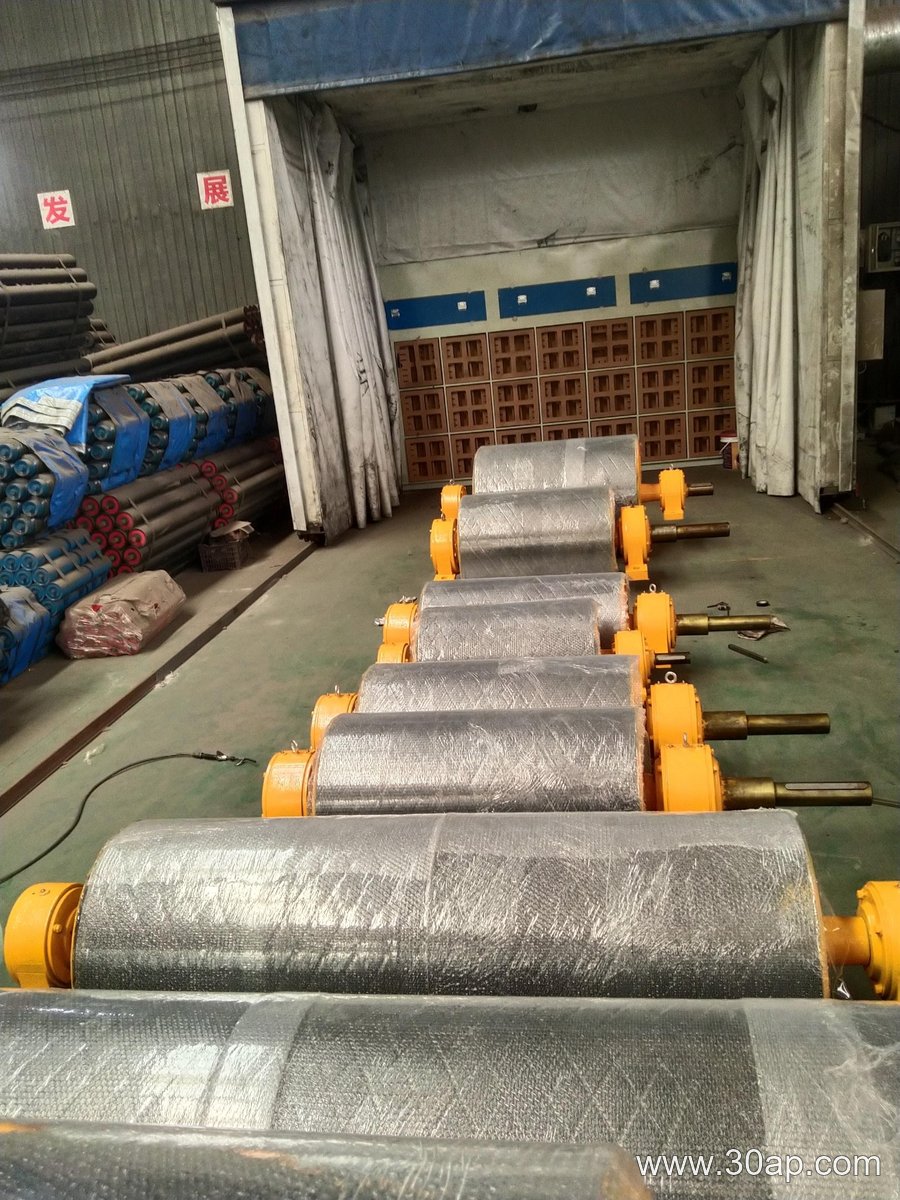
Shaft diameter follows torque and bearing loads, not belt width alone. Common values include Ø50, Ø60, Ø70, Ø80, Ø90, Ø100, Ø120, Ø140, Ø160, Ø180 and Ø200, but the final size comes from the drive calculation. The table below shows representative combinations, not fixed catalogue pairings.
| Belt width | Typical face width | Example diameter | Example shaft |
|---|---|---|---|
| B500 | about 600 mm | Ø320 or Ø400 | Ø60 to Ø80 |
| B650 | about 750 mm | Ø400 or Ø500 | Ø70 to Ø90 |
| B800 | about 950 mm | Ø500 or Ø630 | Ø80 to Ø100 |
| B1000 | about 1150 mm | Ø630 or Ø800 | Ø90 to Ø120 |
| B1200 | about 1400 mm | Ø800 or Ø1000 | Ø100 to Ø140 |
| B1400 | about 1600 mm | Ø800 or Ø1000 | Ø120 to Ø160 |
| B1600 | about 1800 mm | Ø1000 or Ø1250 | Ø140 to Ø180 |
Lagging thickness is often 8, 10, 12, 15 or 20 mm. A thicker layer wears longer and absorbs more shock, but it also increases the pulley’s outside diameter and should be allowed for in the belt path.
Buying Points
- State the duty: drive, tail, tension or bend. A herringbone lagged drum is normally selected for a drive or grip-critical position.
- Give belt width, belt speed, motor power and the required wrap angle, so the diameter and shaft can be calculated rather than guessed.
- Choose the lagging material for the environment. Rubber suits wet, gritty service; ceramic inserts help where abrasion is severe and slipping must be avoided.
- Confirm the groove pattern direction relative to belt travel, and check that the pulley face is wide enough to keep the belt supported.
- Check balance, runout and the fit between shaft, hub and bearing housing, and make sure the conveyor bracket and bearing centres match the new drum.
- Inspect the bond line after delivery. A loose edge or a void under the rubber will shorten lagging life, especially on a wet drive pulley.
Keep the belt reasonably clean and the pulley face free of packed material. A herringbone groove only works while the channels stay open; once they fill with hardened fines, grip falls back toward that of a smooth drum. Regular inspection of lagging wear, groove depth and belt tracking is usually enough to keep the drive pulling as designed.