What a Rubber Lagged Pulley Does
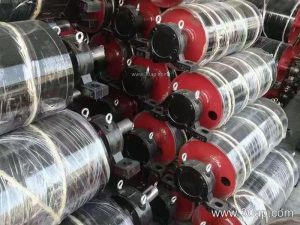
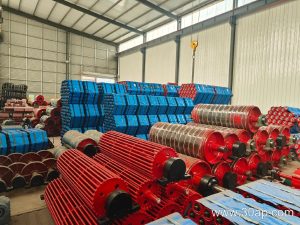
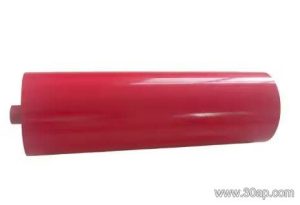
A rubber lagged pulley is a conveyor pulley whose shell is covered with a rubber layer to improve grip on the conveyor belt and protect the pulley surface from wear. This covered pulley is often the drive pulley at the head of a conveyor, but the same construction can be applied to a tail pulley or a bend pulley when extra traction or abrasion resistance is needed. The rubber lagging is not a substitute for correct belt tension; it works with the belt to reduce slip under load.
In quarry and aggregate lines, a rubber lagged pulley helps keep the belt tracking steadily when stone dust and fines are present. In coal mining and cement plants, the lagging also shields the pulley shell from gritty material that would otherwise polish or groove a bare steel surface. The result is a pulley that holds its shape and grip longer between maintenance windows.
How the Lagging Is Built
The rubber layer is bonded to the pulley shell in several common ways. Cold-bonded rubber lagging uses an adhesive system applied in the workshop or on site. Hot-vulcanized lagging is cured under heat and pressure for a stronger bond, which suits heavy-duty mining conveyor belts and high-torque drives. Cast rubber lagging is molded directly onto the shell with a pattern already formed. The surface may be plain, diamond, herringbone, or ceramic-studded, and the thickness commonly falls in the 8 mm to 20 mm range depending on the duty.
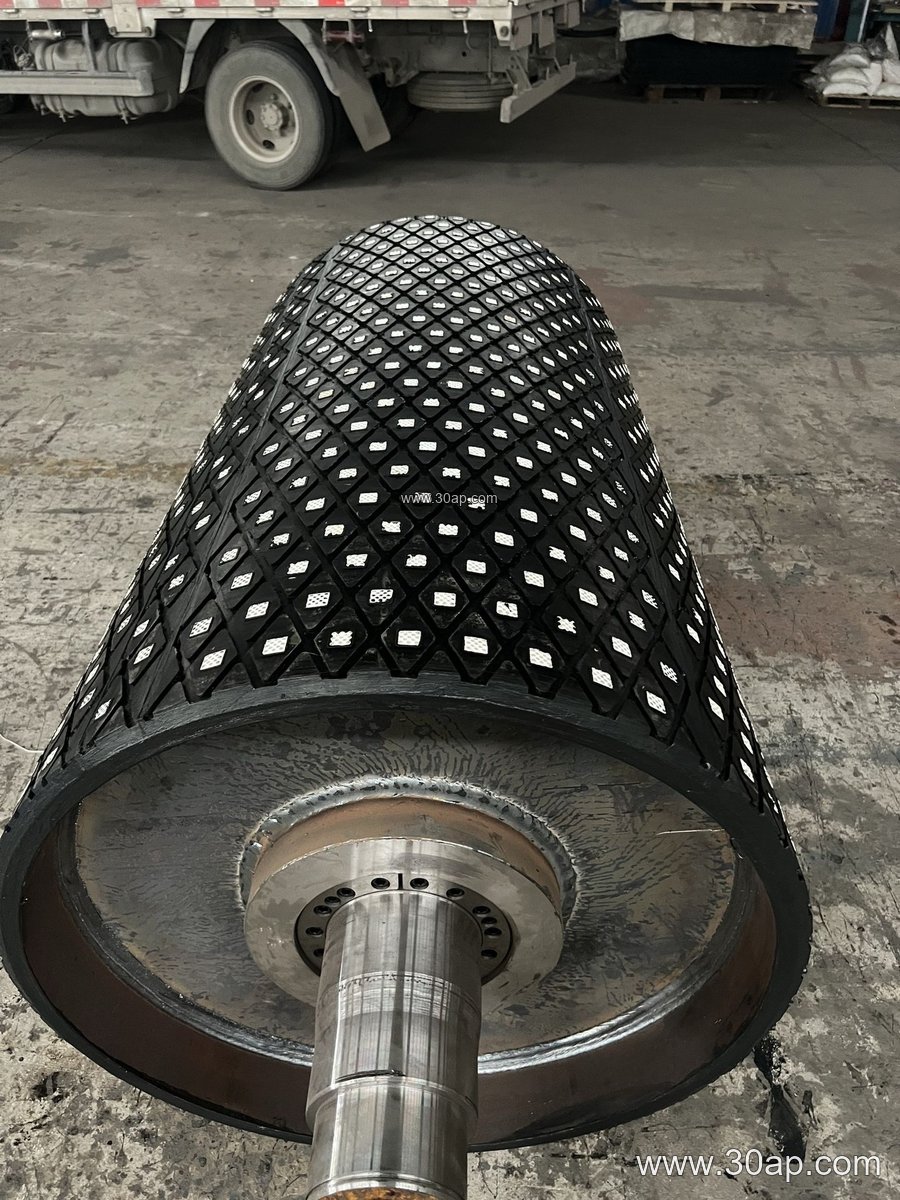
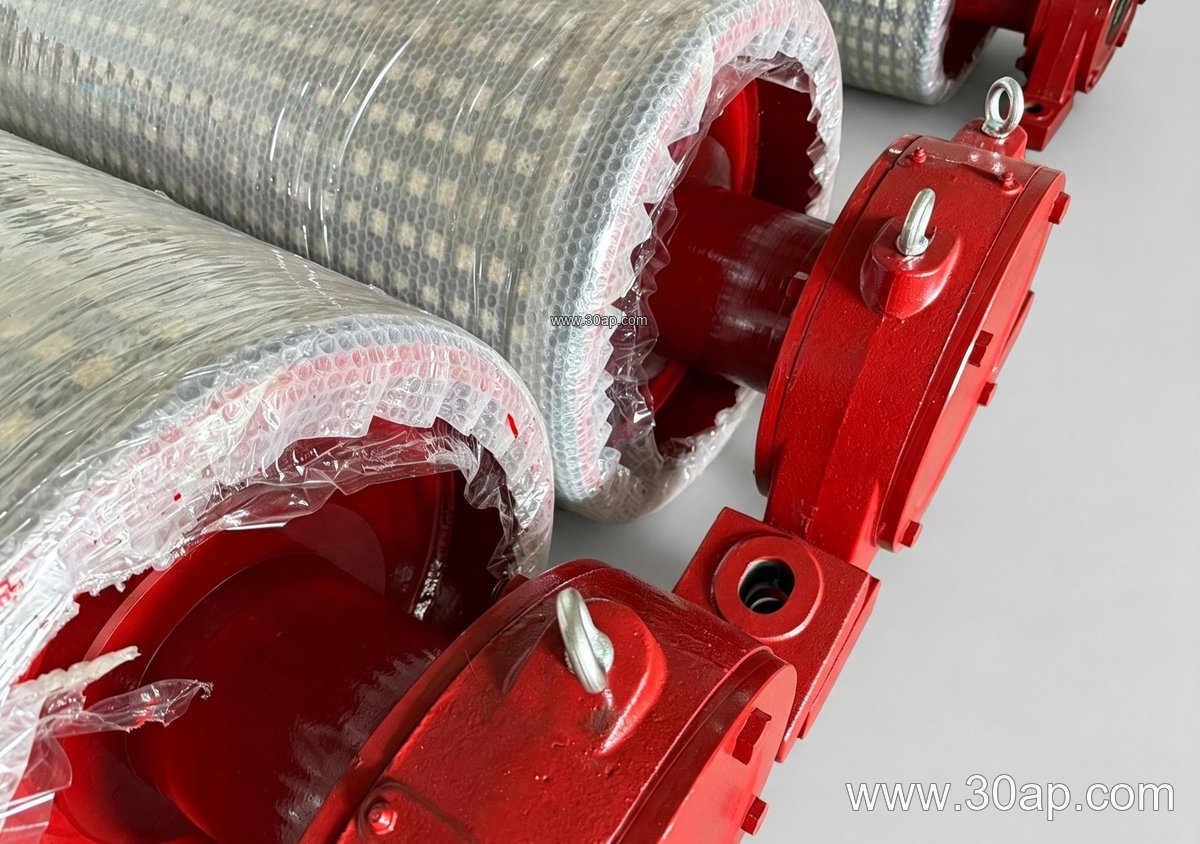
A typical assembly includes the pulley shell, end discs, shaft, bearing housings, and the lagging. The shaft diameter is sized by torque and load, not by belt width alone. Common shaft sizes include Ø80, Ø100, Ø120, Ø140, and Ø160, but the final value should come from the drive calculation. The pulley face width is usually somewhat wider than the belt, for example a B800 belt often runs on a pulley face around 950 mm, while a B1200 belt may use a face near 1400 mm. These are reference proportions, not fixed pairings.
Where It Fits on the Conveyor
On a drive pulley, the rubber lagging raises the friction coefficient between pulley and belt, which allows a lower wrap angle or a smaller pulley diameter for the same power. On a tail pulley, lagging can reduce belt slip during start-up and protect the shell from material build-up. On a bend pulley, a thin rubber cover may be used to damp vibration and extend shell life. The same product is not interchangeable with an idler roller, which supports the belt from below and does not transmit drive torque.
In a port bulk terminal or a power plant coal yard, a rubber lagged drive pulley is often paired with an abrasion resistant conveyor belt and a set of conveyor brackets that keep the pulley aligned. The lagging pattern matters: diamond lagging sheds water and fines, while ceramic lagging is chosen where slip risk is high and the belt is thick and stiff. For a steel cord conveyor belt running at high tension, the pulley lagging must be matched to the belt cover grade so that neither surface wears the other prematurely.
Buyer Checklist
- Confirm the pulley role: drive, tail, or bend. A drive pulley needs grip; a tail pulley needs wear resistance and self-cleaning behavior.
- Specify belt width and pulley face width together. A B650 belt commonly runs with a face near 750 mm, and a B1000 belt with a face near 1150 mm, but the designer should confirm the final combination.
- Choose lagging thickness and pattern for the duty. 10 mm diamond lagging suits many general duties; 15 mm or 20 mm ceramic lagging may be specified for high-torque drives in mining and cement service.
- Check shaft diameter and bearing size against the actual torque and radial load. Do not infer a shaft size from belt width alone.
- Match the lagging rubber to the environment: oil resistant grade near gearboxes, heat resistant grade near clinker or sinter, and anti-static grade in coal mining conveyor systems.
Finally, ask for the bonding method and the surface pattern in writing. A pulley with well-bonded rubber lagging and a correctly sized shaft will outlast a bare pulley in most abrasive bulk handling plants, from a limestone quarry to a fertilizer granulation line.