What an EP Fabric Core Conveyor Belt Is
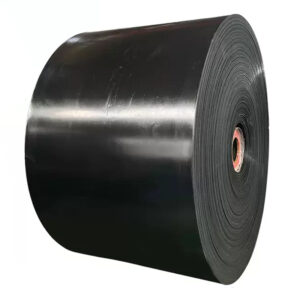
An EP Fabric Core Conveyor Belt is a rubber conveyor belt built around a carcass of polyester warp yarns and nylon weft yarns, commonly written as EP or PN. The carcass gives the belt its tensile strength and its ability to handle repeated flexing, while the rubber covers protect the fabric from abrasion, moisture, heat, oils and other service conditions. In many plants the same product is simply called an EP conveyor belt or an EP rubber conveyor belt, and those names refer to the same construction rather than to different belt families.
The fabric core is what separates this product from a Steel Cord Conveyor Belt, where steel cables carry the tension, and from an NN Conveyor Belt, which uses nylon in both warp and weft. EP carcass design tends to offer low elongation and good troughability, which is why it appears widely on long overland runs and on inclined conveyors in mines, quarries, cement works, power stations and ports.
How the Belt Is Built
A typical construction is a multi-ply fabric core with rubber covers on both faces. The plies are bonded together and to the covers through calendering and vulcanization, and the number of plies is matched to the required strength. A Multi-Ply Fabric Core Conveyor Belt usually has two to six plies, depending on the duty. Cover thickness is usually quoted as top plus bottom, for example 4+2 mm, 5+2 mm, 6+2 mm or 8+3 mm for heavier work.
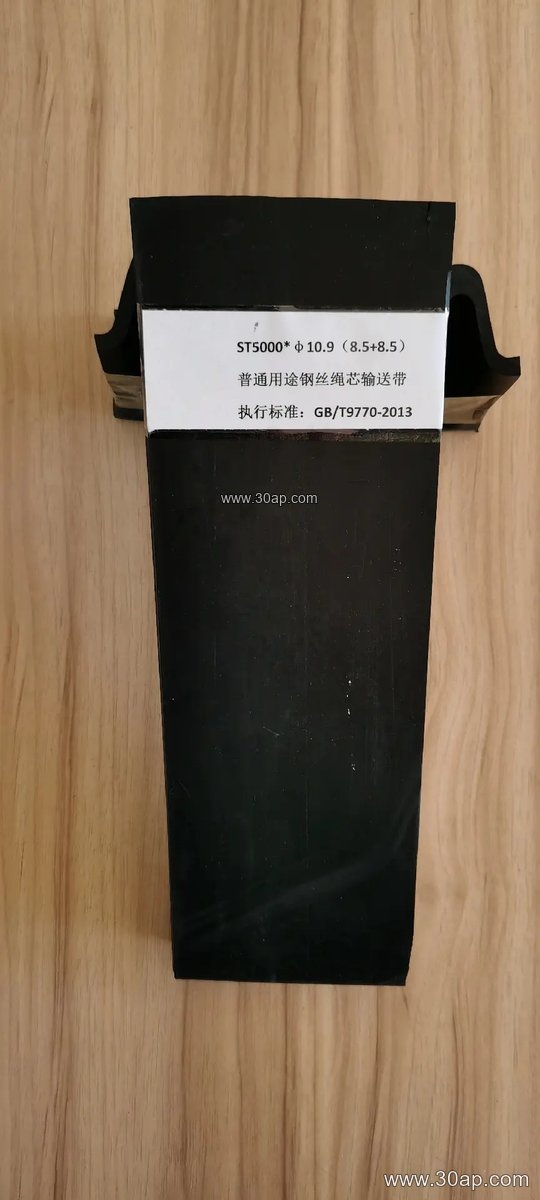
Edge construction also matters. Cut edges are common for general service, while moulded edges help resist edge fraying in wet or abrasive conditions. Buyers should confirm the edge type, the cover grade and the ply count before ordering, because two belts with the same strength rating can still differ in cover compound and service life.
Common Strength Grades and Dimensions
EP belts are usually ordered by nominal tensile strength per unit width, expressed as a grade number. The table below shows common grades; these are reference values and actual belt design should follow the conveyor calculation and the manufacturer’s data.
| Grade | Typical Use |
|---|---|
| EP200 / EP315 | Light to medium duty, short conveyors, aggregate and sand plants |
| EP400 / EP500 | General bulk handling, cement and power plant lines |
| EP630 / EP800 | Medium to heavy duty mining and quarry conveyors |
| EP1000 / EP1250 | Heavy-duty main haulage, long inclines |
| EP1600 / EP2000 | High-tension trunks and large tonnage systems |
Widths commonly range from B500 and B650 up to B1800 and B2000, with B800, B1000, B1200 and B1400 being frequent choices in crushing and screening circuits. Belt width must be selected together with the conveyor pulley and idler roller arrangement, not by itself. A wider belt does not automatically mean a larger drive pulley, and shaft diameter is determined by the conveyor design rather than by belt width alone.
Where It Fits in the Plant
You will see this belt on primary and secondary crusher discharge lines, overland conveyors at quarries, coal handling systems, clinker and limestone transport in cement plants, and bulk terminals. In a Coal Mining Conveyor Belt installation, flame retardant and anti-static grades are often specified for underground use, while a Heat Resistant Conveyor Belt grade may be needed for clinker or sinter. An Abrasion Resistant Conveyor Belt cover is common where sharp rock and ore cause rapid wear.
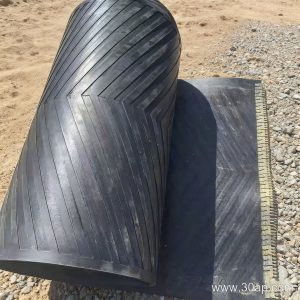
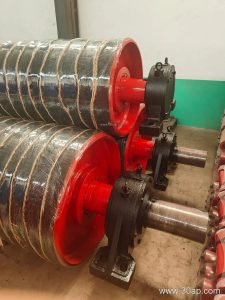
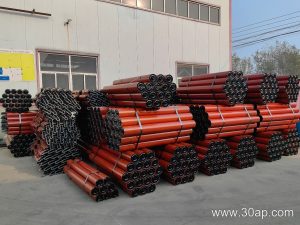
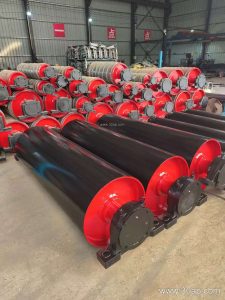
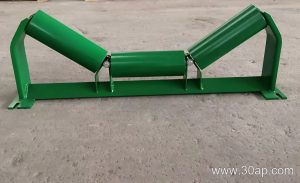
Related equipment works with the belt rather than replacing it: conveyor pulleys at the drive, tail and bend positions, idler rollers supporting the carrying and return strands, and conveyor brackets holding the structure together. For steep inclines, a Chevron Conveyor Belt or a Corrugated Sidewall Conveyor Belt may be considered instead of a smooth EP belt, and for enclosed routes a Pipe Conveyor Belt is a separate design choice.
Selection and Maintenance Notes
- Check the required tensile grade against the actual working tension, including start-up and braking loads.
- Match the cover compound to the material: abrasive rock, hot clinker, oily scrap or cold outdoor service each call for a different cover.
- Confirm ply count, cover thickness and edge type, and ask for the belt data sheet rather than relying on a grade number alone.
- Keep pulleys and idler rollers aligned and turning freely; a seized roller can damage the cover quickly.
- Track belt tension and splice condition regularly, since most failures begin at the joint or at the edge.
For buyers comparing offers, the useful questions are simple: what carcass, how many plies, which cover grade, what edge, and what splice method is recommended. A belt that matches the conveyor duty will usually outperform a heavier but poorly matched one. More product information for bulk handling equipment can be reviewed at gsdconveyorbelt.com, and site-specific selections should always be confirmed with the conveyor designer.