What a High Wear-Resistant Ceramic Pulley Is
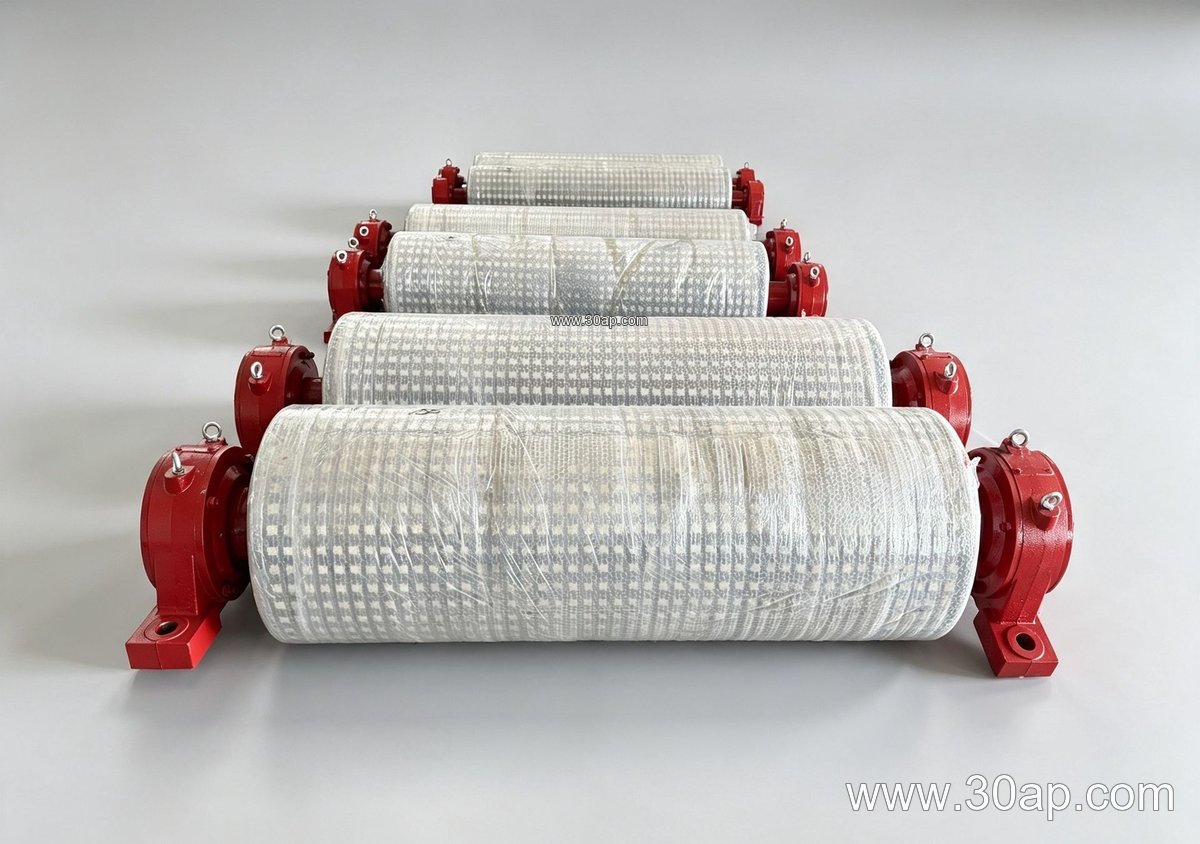
A high wear-resistant ceramic pulley is a conveyor pulley whose shell is fitted with ceramic tiles or a ceramic-rubber composite lagging to resist abrasion at the belt contact surface. It is not a separate pulley family with its own drive logic; it is a wear-protection choice applied to a standard conveyor pulley, most often a drive pulley where slip and abrasion are highest. In limestone quarries, sinter plants and aggregate lines, this ceramic-faced version is frequently chosen where ordinary rubber lagging wears through too quickly.
Buyers sometimes ask for it by its equivalent name, ceramic lagged pulley or ceramic lagging conveyor pulley. Those terms describe the same product. The ceramic elements are the wear surface; the pulley body, shaft and bearing housing remain conventional.
How the Ceramic Surface Is Built
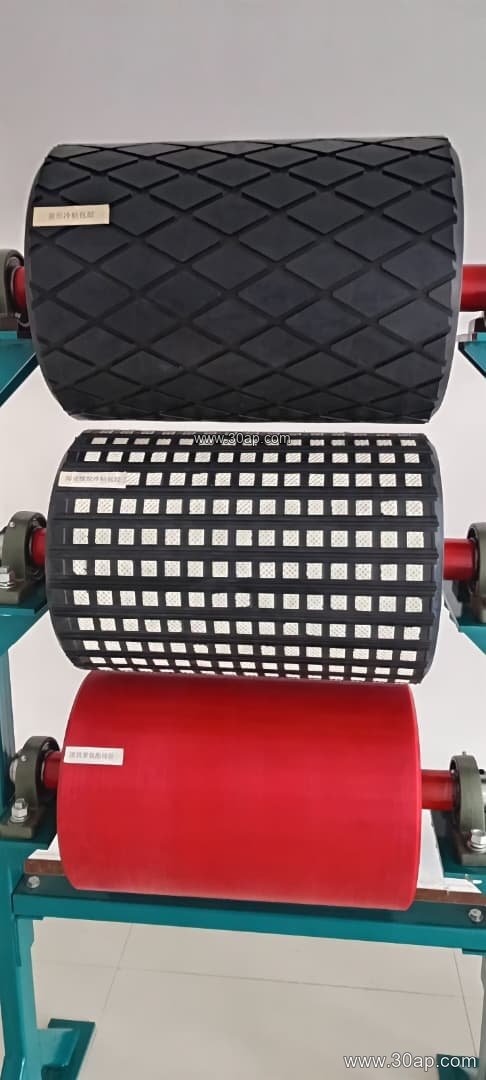
The shell is usually a steel tube machined to the required diameter, then covered with a rubber or polymer bonding layer into which ceramic tiles are embedded. Tile patterns vary: square tiles, hexagonal tiles and grooved or dimpled forms are common. Some designs leave small gaps between tiles to improve water and fines drainage and to give the belt edge somewhere to bite.
Thickness is normally quoted for the complete lagging, not the ceramic alone. Common lagging thicknesses are 8, 10, 12, 15 and 20 mm. The ceramic layer itself is much thinner, and the rubber beneath provides cushioning and bond strength. A high wear-resistant ceramic pulley used on a heavy-duty mining conveyor belt should be specified with the duty, not just the tile pattern, in mind.
- Shell material: carbon steel tube, machined and balanced
- Lagging: ceramic tile set in rubber or polymer matrix
- Typical thickness: 8 to 20 mm total lagging
- Common shaft diameters: Ø50 to Ø200 mm, sized by torque and load
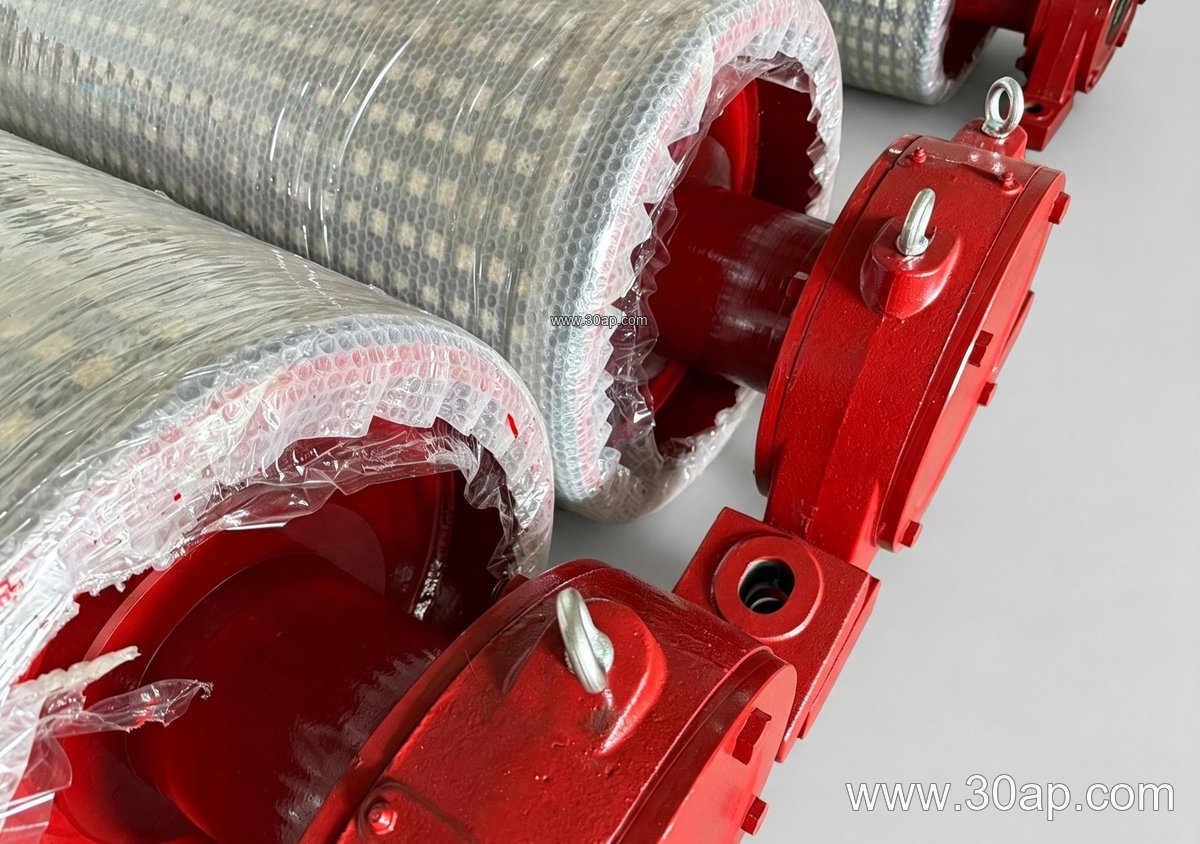
- Bearing housings and locking assemblies matched to the pulley design
Where It Fits in a Conveyor
The most common position is the drive pulley at the head of the conveyor, where the belt wraps the shell under tension and any slip quickly damages rubber. A ceramic-faced drive pulley keeps grip longer in wet or dusty conditions and reduces the frequent relagging that interrupts production. In a coal preparation plant or a power plant coal yard, that downtime is often the real cost.
The same wear-resistant surface can be applied to a tail pulley or a bend pulley, but the reason differs. On a tail pulley the ceramic facing mainly resists abrasion from fines carried on the return side of the belt; on a bend pulley it protects against sliding wear where wrap angle is small. Drive, tail and bend pulleys are not interchangeable in function, so the position should be stated when ordering. A high wear-resistant ceramic pulley at the head end is not a substitute for a properly tensioned belt or a correctly specified take-up.
Matching Pulley, Belt and Support Equipment
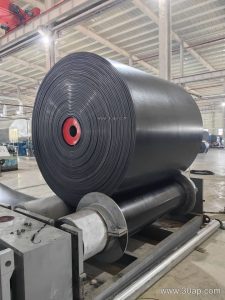
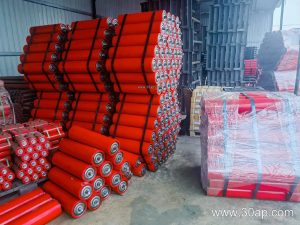
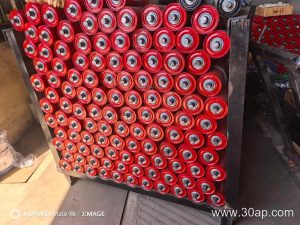
The pulley does not work alone. A ceramic lagged drive pulley is typically paired with an abrasion resistant conveyor belt or a heavy-duty mining conveyor belt, depending on the material. In a quarry handling crushed stone, a multi-ply fabric core belt such as an EP conveyor belt or NN conveyor belt often runs over the same pulleys, while long overland lines may use a steel cord conveyor belt. The supporting conveyor idler roller and conveyor bracket set the belt line and affect how evenly the belt seats on the shell.
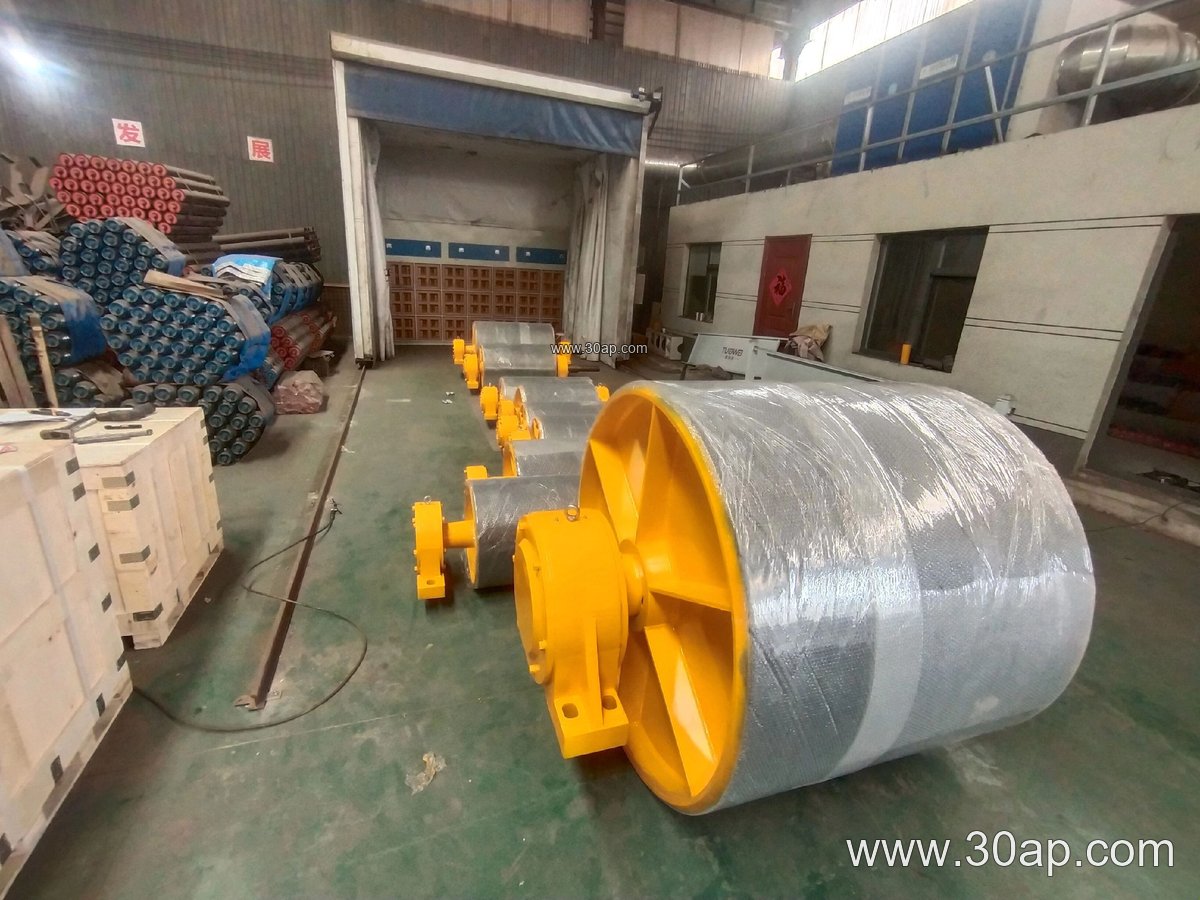
When specifying, provide belt width, belt type and tension so the pulley can be matched properly. Common belt widths include B500, B650, B800, B1000, B1200, B1400 and B1600. The shell face is usually wider than the belt; for example, a B800 belt commonly runs on a shell about 950 mm wide, and a B1200 belt on roughly 1400 mm. Diameter is chosen from wrap angle, belt speed and torque, so a B1200 belt might use Ø800 or Ø1000 depending on the drive design. There is no fixed rule that one belt width pairs with one diameter, and shaft diameter must be calculated from load rather than copied from a belt width.
Reference Dimensions for Early Planning
The values below are typical reference ranges, not a supply promise. Final dimensions follow the conveyor design.
| Belt width | Typical shell face width | Common pulley diameters |
|---|---|---|
| B500 | about 600 mm | Ø250, Ø315, Ø400 |
| B650 | about 750 mm | Ø315, Ø400, Ø500 |
| B800 | about 950 mm | Ø400, Ø500, Ø630 |
| B1000 | about 1150 mm | Ø500, Ø630, Ø800 |
| B1200 | about 1400 mm | Ø630, Ø800, Ø1000 |
| B1400 | about 1600 mm | Ø800, Ø1000, Ø1250 |
| B1600 | about 1800 mm | Ø1000, Ø1250, Ø1400 |
Shaft diameters commonly range from Ø80 to Ø160 mm on these sizes, but the correct value comes from torque, radial load and bearing selection.
What a Buyer Should Check
- Confirm the pulley position: drive, tail or bend, since duty and wrap differ.
- State belt width, belt type and operating tension, not just the pulley diameter.
- Ask for the ceramic tile pattern and total lagging thickness.
- Check that the shaft diameter is calculated for the actual torque and load.
- Confirm balancing, bearing type and locking assembly details.
- Plan inspection of tile bond and edge wear during scheduled stops.
A high wear-resistant ceramic pulley is a practical upgrade where abrasion and slip shorten lagging life, but it still depends on correct sizing and a well-aligned belt path. Matching it to the conveyor belt, idler roller and conveyor bracket layout is what delivers the expected service life.