What a Four-Roll Idler Bracket Does
A four-roll idler bracket is the support frame that carries four idler rollers under a loaded conveyor belt. Instead of the usual three-roll trough set, the four-roll arrangement spreads the belt over a wider contact arc, which suits wide belts and heavy bulk streams where the material column is deep and the belt needs gentler support. In a quarry, a coal preparation plant or a power station coal yard, this bracket helps keep the belt profile stable between the head and tail of the line, so the conveyor belt tracks better and the load sits more evenly across its width.
It is a structural part, not a rotating part. The rollers do the turning; the bracket sets their positions, angles and spacing.
How the Bracket Is Built
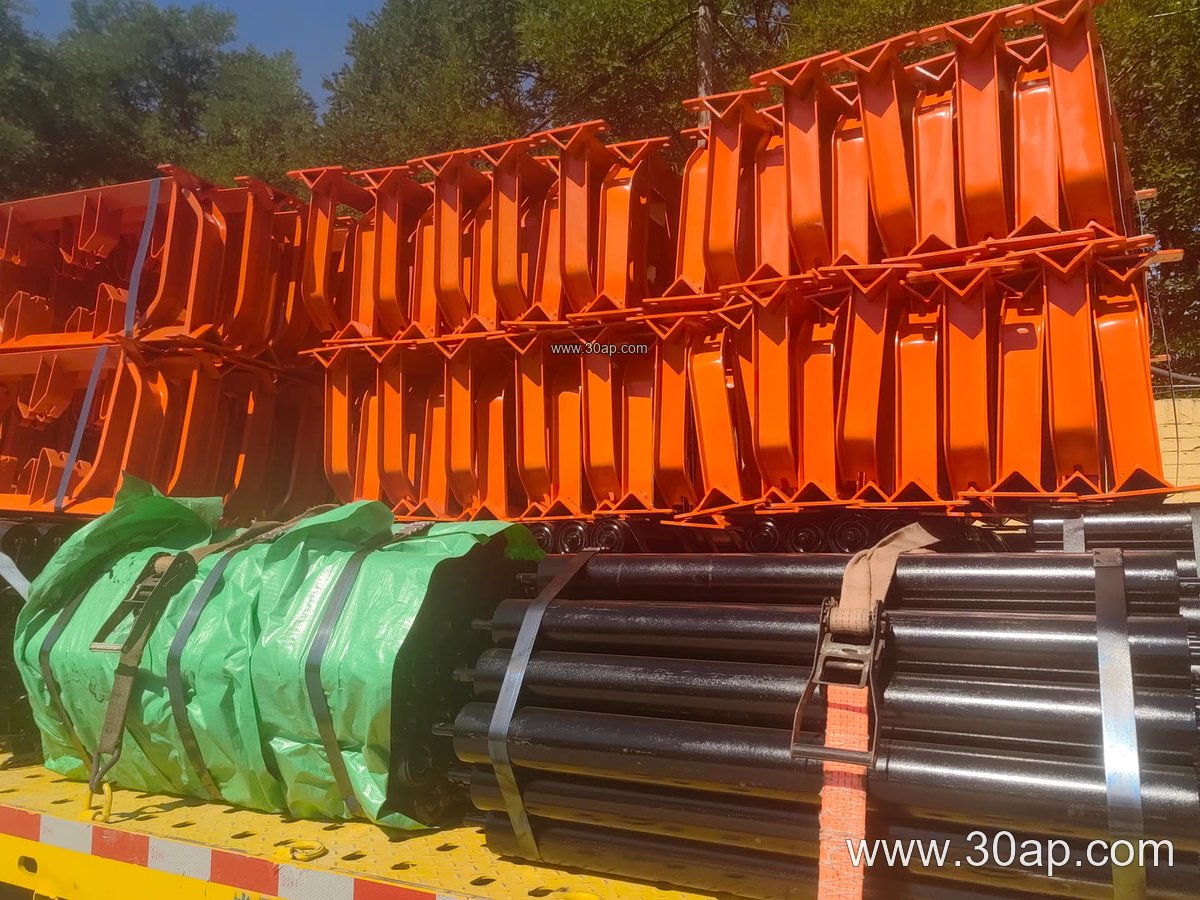
Most four-roll idler brackets are fabricated from angle steel, channel steel or folded steel plate. The cross beam spans the conveyor frame, and two end supports carry the outer rolls while a central saddle holds the two inner rolls. Welded gussets and bolted clamps keep the assembly rigid under vibration.
- Cross beam sized to the belt width and trough geometry
- End brackets with slots or stepped holes for roll positioning
- Central saddle for the two inner idler rollers
- Mounting feet or hook plates matched to the stringer
- Optional adjustment range for trough angle and roll alignment
Because the four rolls share the load, each roll can be smaller in diameter than a single-roll design would require, and the belt is supported at more points. That is one reason this frame appears on wide, high-capacity lines where a standard trough set would leave a long unsupported span.
Where It Fits on the Conveyor
The bracket is normally used on the carrying side, in the loading and transport zones. It is not a substitute for a drive pulley, tail pulley or bend pulley; those are separate components that transmit power or change belt direction. The bracket only supports the belt and its material load.
Typical placements include:
- Receiving zones below a crusher or screen, where impact and load depth are high
- Long overland runs in a limestone mine or iron ore operation
- Coal handling lines in a washing plant or power station
- Wide-belt transfer points at a port or bulk terminal
In these places the frame works together with the idler roller set and the conveyor bracket system that ties the whole line to the stringers.
Matching Belt Width, Trough Angle and Roll Diameter
Selection starts with the belt width and the required trough angle. Common belt widths include B800, B1000, B1200, B1400 and B1600, and common trough angles are 20, 30, 35 and 45 degrees. Roll diameters such as Ø89, Ø108, Ø133 and Ø159 are frequently used, but the right pairing depends on load, belt stiffness and speed rather than on width alone. A B1200 belt at 45 degrees with Ø133 rolls is a plausible combination, and so is a B800 frame at 35 degrees with Ø108 rolls; neither is a fixed rule.
| Parameter | Common Range | Note |
|---|---|---|
| Belt width | B500 to B2200 | Frame length follows width |
| Trough angle | 20°, 30°, 35°, 45° | Adjustable frames cover several angles |
| Roll diameter | Ø89, Ø108, Ø133, Ø159, Ø194 | Chosen by load and speed |
| Material | Angle steel, channel steel, folded plate | Depends on duty |
| Mounting | Bolted or hooked | Hole spacing set by design |
Mounting hole spacing and beam length change with width and angle, so they should be confirmed against the conveyor drawing rather than assumed.
Fixed or Adjustable
A fixed four-roll idler bracket holds one trough angle for life. An adjustable version lets maintenance staff fine-tune the angle between the common settings and correct small misalignments after belt stretch or frame settling. Adjustable frames are useful during commissioning, while fixed frames are simpler and cheaper for a line that is already tuned.
For comparison, a three-roll trough set is lighter and more common on narrow belts, but it gives fewer support points. A four-roll frame is the better choice when the belt is wide, the material is heavy, or the load profile needs extra stability.
Buyer Checklist
- Confirm belt width, trough angle and roll diameter as a set, not in isolation
- Check the stringer spacing and mounting hole pattern
- Ask whether the frame is fixed or adjustable
- Match steel thickness and welding to the duty cycle
- Confirm the frame suits the belt type, whether an EP conveyor belt, a steel cord conveyor belt or a flame retardant belt for underground work
A well-matched bracket keeps the belt supported and the rollers square, which reduces edge wear and tracking problems over the life of the line.