What Conveyor Bracket Fabrication Covers
Conveyor bracket fabrication is the manufacturing of the steel frames that hold idler rollers in position along a conveyor line. In a quarry, a cement plant or a power plant coal yard, the belt may run for hundreds of meters, and every few meters a set of brackets carries the rollers that shape and support it. The work involves cutting, drilling, bending and welding angle, channel or folded plate into frames that match the belt width, trough angle and roller diameter specified for each section of the conveyor.
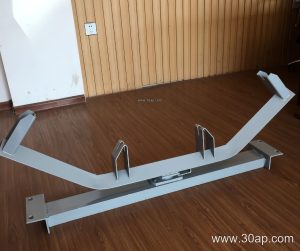
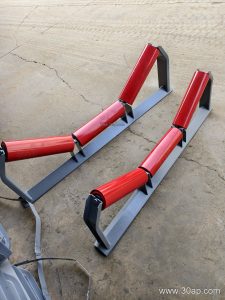
The term is often used loosely for the whole idler support assembly, but fabrication itself refers to the metalwork: the cross beams, the end brackets that bolt to the conveyor stringer, the mounting slots for the rollers, and the connecting plates that set the trough angle. Good fabrication keeps roller spacing consistent, so the conveyor belt runs on an even surface instead of dipping between supports.
How the Frames Are Built
Most workshop drawings start from three inputs: belt width, trough angle and roller diameter. From these, the fabricator works out the cross beam length, the mounting hole positions and the height of the side brackets. Common materials are angle steel for light frames, channel steel for heavier loads, and folded steel plate where a clean profile or extra stiffness is needed.
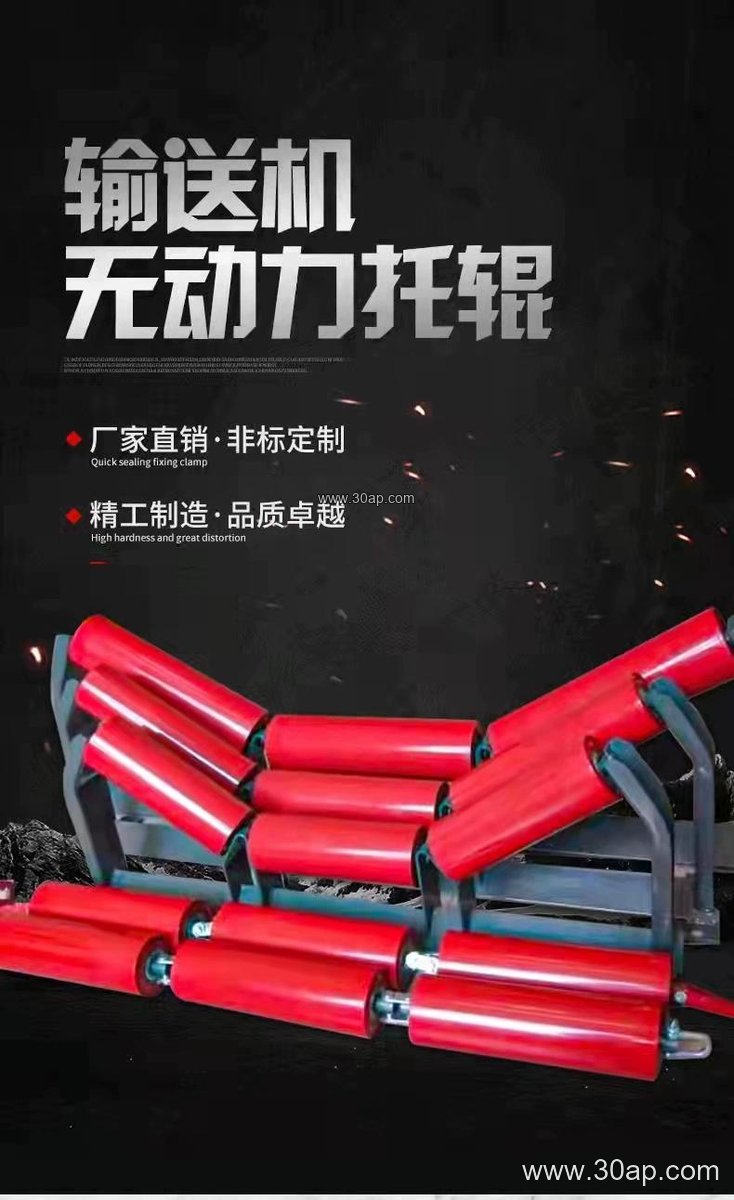
Fabrication usually follows a simple sequence. Beams are cut to length, holes are drilled or punched on a jig so that matching frames stay interchangeable, side brackets are bent to the required angle, and the assembly is welded or bolted. Welds on load-bearing joints should be continuous and dressed where they contact the roller shaft. A trial fit with an idler roller before painting catches misalignment early, which is cheaper than correcting it on site.
Types and Where They Sit
Fabricated brackets are not one product. The table below shows common frame types and their typical position on a conveyor.
- Trough bracket (carrying side): supports two or three rollers at a set trough angle, usually 20, 30, 35 or 45 degrees.
- Transition bracket: placed near a conveyor pulley to ease the belt from flat to troughed profile.
- Return bracket: carries the empty belt, either flat or in a V shape.
- Impact bracket: reinforced frame under the loading point, often fitted with cushion rollers.
- Self-aligning bracket: pivots to correct belt drift; forward-leaning versions are common on the carrying side.
Reference combinations
| Belt width | Trough angle | Roller diameter | Typical frame material |
|---|---|---|---|
| B500 | 20–30 degrees | Ø89 | Angle steel |
| B650 | 30 degrees | Ø89 / Ø108 | Angle steel |
| B800 | 35 degrees | Ø108 | Channel steel |
| B1000 | 35–45 degrees | Ø108 / Ø133 | Channel steel |
| B1200 | 45 degrees | Ø133 | Channel or folded plate |
| B1400 | 35–45 degrees | Ø133 / Ø159 | Folded plate |
| B1600 | 35–45 degrees | Ø159 | Folded plate |
| B1800–B2000 | 35–45 degrees | Ø159 / Ø194 | Heavy channel or plate |
These are reference values, not fixed pairings. Hole spacing and beam length change with belt width and trough angle, and the final frame dimensions are set by design.
Where Fabricated Brackets Are Used
In a coal washing plant, flame retardant and anti-static belting is common, and the frames must be robust enough for wet, dusty conditions. In an iron ore or copper ore operation, heavy-duty mining conveyor belts and large rollers put more load on each bracket, so channel steel or folded plate frames are usual. Aggregate and sand plants tend to use lighter angle-steel frames because the belt widths are moderate and the duty is intermittent.
Fabricated frames also matter where the belt itself is specialized. A pipe conveyor belt needs closely spaced, accurately aligned supports to hold its round shape, while a corrugated sidewall belt needs frames that clear the cleats. In a cement plant, heat resistant conveyor belts on clinker lines may call for brackets positioned to keep rollers away from the hottest zone.
What Buyers Should Check
- Confirm the belt width, trough angle and roller diameter before ordering; a frame drilled for Ø108 will not accept Ø133 without modification.
- Ask whether frames are welded or bolted, and whether mounting holes are jig-drilled for interchangeability.
- Check the finish: primer or hot-dip galvanizing suits outdoor quarries, while painted frames are common indoors.
- For adjustable brackets, confirm the range covers the trough angles you may use, often 20 to 45 degrees.
- Order spare frames for transition and impact zones, where damage is most likely.
Well-made support frames are a small part of the conveyor cost, but they decide how evenly the belt and rollers wear. Matching fabrication to the actual belt width, angle and roller size is the simplest way to avoid early replacement.