What a Conveyor Support Bracket Does on a Belt Conveyor
A conveyor support bracket is the structural interface between the idler roller and the conveyor frame. It holds each roller at the correct height, angle and spacing so the conveyor belt keeps its trough shape and runs without excessive sag. In a quarry, a coal washing plant or a cement kiln feed line, these brackets carry the weight of the belt, the material and the roller itself, shift after shift. The bracket is not a wear part in the same sense as a roller, but a weak or misaligned one will shorten roller life and disturb belt tracking.
Engineers often call the same component a conveyor bracket, idler support bracket or roller support bracket. These names describe the same product: the fixed or adjustable seat that positions a conveyor idler roller on the frame. Drive pulleys, tail pulleys and bend pulleys are separate components with different duties and should not be confused with this frame hardware.
How the Bracket Is Built
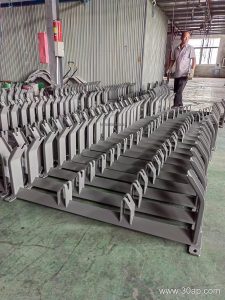
Most conveyor support brackets are fabricated from angle steel, channel steel or folded steel plate. The material choice follows the load and the environment: a dusty aggregate line may use a heavier folded plate, while a light-duty packing line may use a simple angle section. Typical features include:
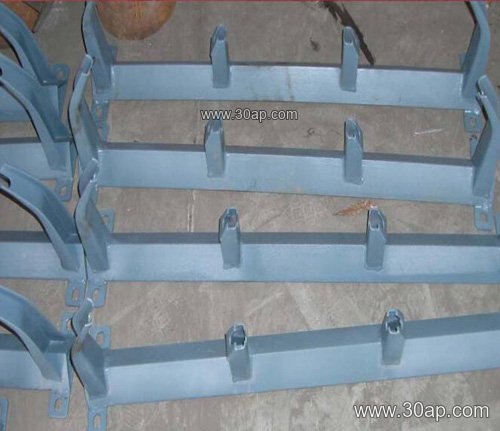
- Mounting slots or holes that accept the roller shaft or the roller frame
- A trough angle formed by the bracket geometry, often 20, 30, 35 or 45 degrees
- Reinforcing ribs or gussets where the bracket meets the main frame beam
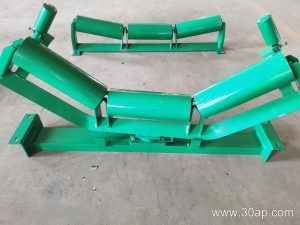
- Adjustable versions with slotted fixings that allow the trough angle to be changed within a range
Installation hole spacing and crossbeam length change with belt width and trough angle, so they are determined by design rather than taken as a universal number.
Common Types and Where They Sit
The type of bracket follows its position along the conveyor. Carry-side brackets hold the upper rollers that form the trough; return-side brackets hold the lower rollers that support the empty belt. A few common forms are listed below.
| Type | Typical position | Notes |
|---|---|---|
| Trough bracket | Carry side | Sets the trough angle for the belt |
| Transition bracket | Near head or tail pulley | Guides the belt from flat to troughed |
| Return bracket | Return side | Supports the empty belt |
| V-return bracket | Return side | Helps center the return belt |
| Impact bracket | Load point | Holds impact rollers under the chute |
| Self-aligning bracket | Carry or return side | Allows small lateral correction |
| Adjustable bracket | Carry side | Trough angle can be set on site |
A fixed bracket is welded or bolted at one angle, while an adjustable bracket lets maintenance staff fine-tune the trough angle between the common values. Neither type replaces a pulley; each has its own job on the frame.
Matching Bracket, Belt Width and Roller Diameter
Belt width and roller diameter are related through the bracket, but they are not locked one-to-one. A B800 conveyor might run with 30-degree troughing and Ø108 rollers, while a B1200 line in a power plant coal yard may use 35 or 45 degrees with Ø133 rollers. A B650 feeder in a sand and gravel plant often works with 30 degrees and Ø89 rollers. These are common combinations, not mandatory rules.
| Belt width | Common trough angle | Common roller diameter |
|---|---|---|
| B500 | 20–30 degrees | Ø89 |
| B650 | 30 degrees | Ø89–Ø108 |
| B800 | 30–35 degrees | Ø108 |
| B1000 | 35 degrees | Ø108–Ø133 |
| B1200 | 35–45 degrees | Ø133 |
| B1400 | 35–45 degrees | Ø133–Ø159 |
| B1600 | 35–45 degrees | Ø159 |
| B1800–B2200 | 35–45 degrees | Ø159–Ø194 |
These values are reference data for early planning. Final selection should follow the belt tension, material load, roller spacing and frame design.
Buyer Checklist Before Ordering
Before requesting a quotation, confirm the belt width, the required trough angle and the roller diameter. State whether the bracket is for the carry side or the return side, and whether a fixed or adjustable version is needed. Check the frame beam size and the existing hole pattern, because a bracket that does not match the frame will need rework on site. For dusty or wet locations such as a limestone quarry or a fertilizer store, ask about the surface treatment and steel thickness. Finally, confirm that the bracket suits the chosen idler roller and conveyor pulley layout, so the belt runs centered from the start.