What the Conveyor Belt Support Frame Does on a Working Conveyor
On any conveyor line, the belt needs more than just head and tail pulleys to keep moving. The conveyor belt support frame is the structural backbone that holds the idler rollers in the correct position along the carrying and return sides of the belt. In a quarry, cement plant, or coal handling system, these frames determine whether the belt tracks straight, whether material stays centered, and whether the roller bearings wear evenly. A well-built support frame also protects the conveyor belt from edge damage and reduces the chance of spillage at transfer points.
How a Support Frame Is Built
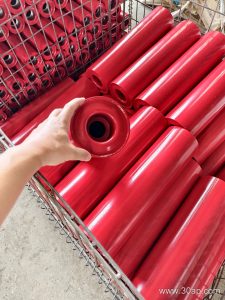
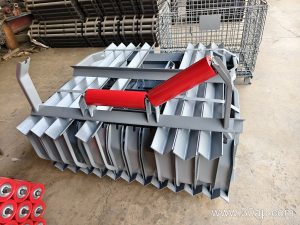
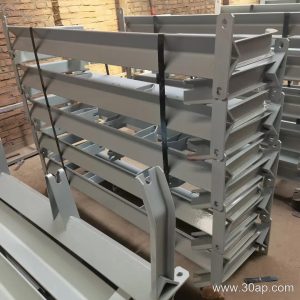
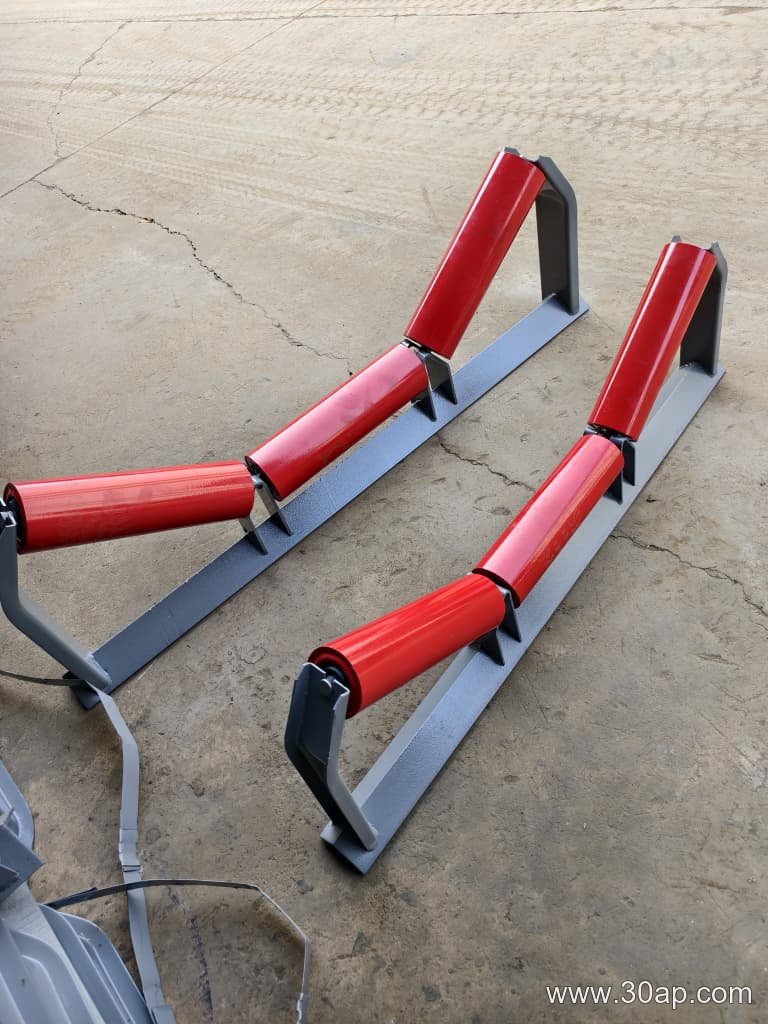
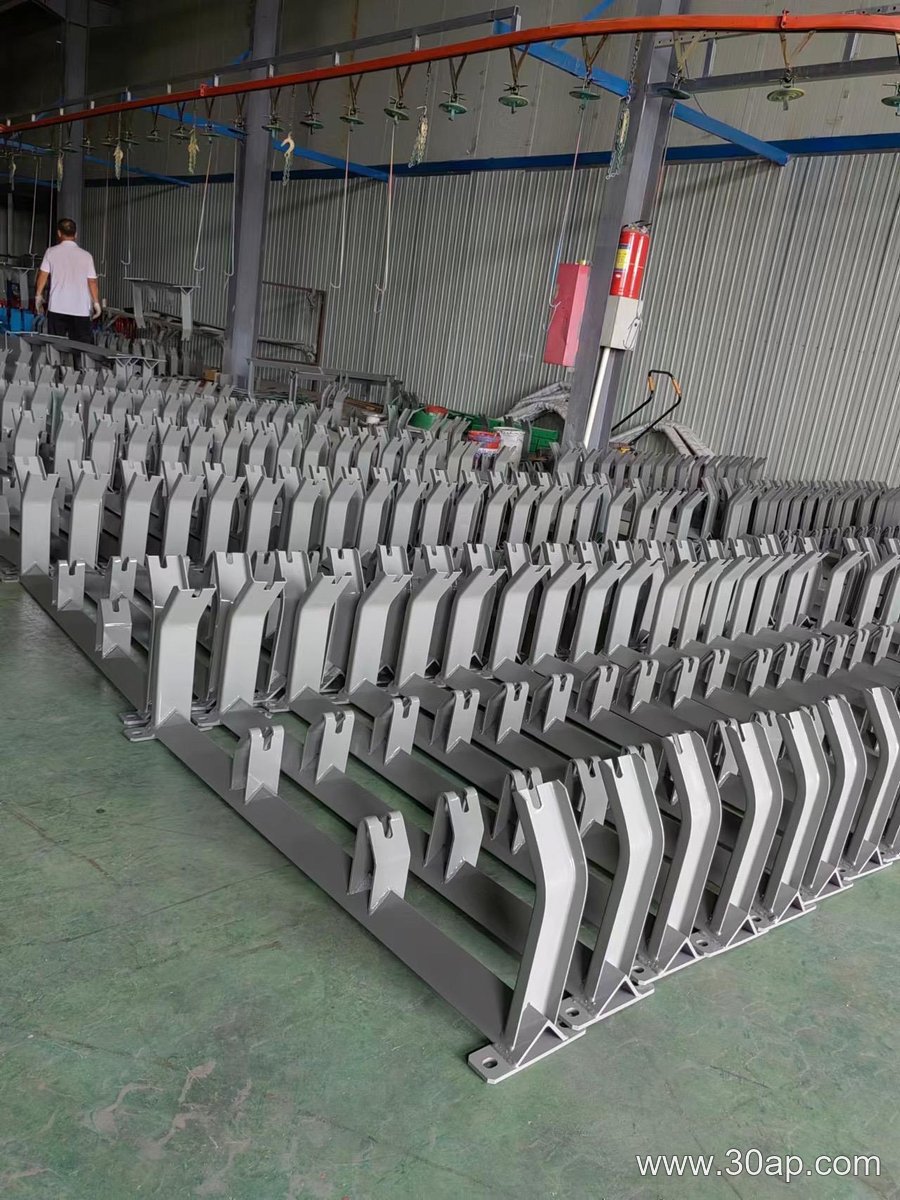
Most frames are fabricated from angle steel, channel steel, or folded steel plate. The choice depends on the load and the environment. In a crushing and screening plant, a heavier channel frame may be used for the impact zone, while a lighter folded design suits the return run. The frame typically includes mounting slots or holes for the idler roller shaft. Installation hole spacing and crossbeam length are not fixed, they change with belt width and trough angle. A common arrangement for a 35 degree trough might use a B800 frame carrying Ø89 rollers, but the same belt width can also be paired with Ø108 rollers depending on belt speed and material lump size. The frame does not dictate a single roller diameter.
Main Types You Will See
- Troughing frame: holds three rollers to form a trough, common in 20, 30, 35, or 45 degree angles.
- Transition frame: supports the belt as it changes from flat to troughed shape near the pulleys.
- Return frame: carries the empty belt, often with a V-shaped or flat roller arrangement.
- Impact frame: reinforced for loading points, often fitted with buffer rollers.
- Self-aligning frame: allows slight lateral movement to correct belt tracking.
- Adjustable frame: lets the trough angle be changed between the common angles.
For comparison, a bend pulley changes belt direction, while a troughing frame supports the belt in a straight run. They are not interchangeable parts.
Where It Fits in Different Industries
In a limestone mine or gravel pit, support frames are spaced along the entire length of the conveyor, typically every 1 to 1.5 meters on the carrying side. In a cement plant, the same frame design must handle fine, dusty material and high temperatures near the kiln feed. In a power plant coal yard, frames are often galvanized or painted to resist corrosion. The frame also appears in fertilizer handling, grain silos, and tunnel muck removal. Each site chooses frame material and roller spacing based on belt width, capacity, and maintenance access.
Key Parameters a Buyer Should Check
Before ordering, confirm the belt width, trough angle, and roller diameter. The table below shows common reference combinations, but these are examples, not fixed rules.
| Belt Width (mm) | Trough Angle (degrees) | Roller Diameter (mm) | Frame Material Example |
|---|---|---|---|
| B500 | 20 / 30 | Ø89 | Angle steel |
| B650 | 30 / 35 | Ø89 / Ø108 | Angle steel |
| B800 | 35 / 45 | Ø108 / Ø133 | Channel steel |
| B1000 | 35 / 45 | Ø108 / Ø133 / Ø159 | Channel steel |
| B1200 | 35 / 45 | Ø133 / Ø159 | Folded plate |
| B1400 | 35 / 45 | Ø159 / Ø194 | Folded plate |
| B1600 | 35 / 45 | Ø159 / Ø194 | Channel steel |
Also ask about the mounting hole pattern, the distance between roller stations, and whether the frame is fixed or adjustable. An adjustable frame can be set to 20, 30, 35, or 45 degrees, which helps when a conveyor is later modified. A forward-leaning frame, often about 1.5 to 2 degrees, can improve belt training but is not a replacement for a self-aligning frame. The frame must match the conveyor bracket and pulley arrangement, but the drive pulley and tail pulley have different functions and cannot be swapped with a support frame.
Maintenance and Selection Advice
Inspect frames for bent crossbeams, elongated mounting holes, and loose bolts. A bent frame will misalign the idler roller and cause the belt to wander. Replace damaged frames before they wear the belt edge. When selecting a support frame, consider the material being conveyed, the belt speed, and the lump size. For a sand and gravel line, a standard troughing frame with Ø108 rollers and a 35 degree angle is often enough. For a coal mine with heavy lumps, a reinforced impact frame with Ø133 or Ø159 rollers may be needed. Do not assume that one belt width only fits one roller diameter or one trough angle. The conveyor belt support frame is a flexible component, and the right choice depends on the whole conveyor design.