What an Anti-Misalignment Guide Idler Does
An anti-misalignment guide idler is a specialized roller assembly mounted on the carrying or return side of a conveyor to keep the belt centered. Unlike a standard carrying idler, it responds to lateral drift by pivoting or steering the belt back to the correct path. In quarry, cement, and power plant coal handling lines, this component reduces edge damage and spillage without requiring constant manual adjustment.
Also called a self-aligning idler or training idler, it is not a substitute for a drive pulley, tail pulley, or bend pulley. Those pulleys transmit power and change belt direction; the guide idler only corrects tracking. A typical installation pairs it with a conveyor bracket that allows rotation about a vertical axis, so the roller can angle itself when the belt touches a side roller.
Construction and Working Principle
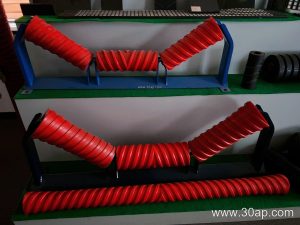
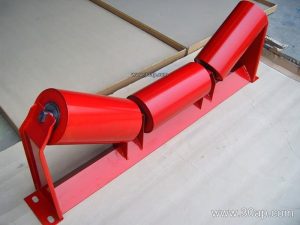
Most designs use a three-roller trough set or a two-roller V-return set. The idler frame is mounted on a swivel base. When the belt shifts to one side, it contacts a vertical guide roller or an angled side roller, creating a turning moment that skews the idler slightly. This skew generates a lateral force that nudges the belt back toward the center. Friction-type and conical self-aligning versions use different roller profiles to achieve the same correction.
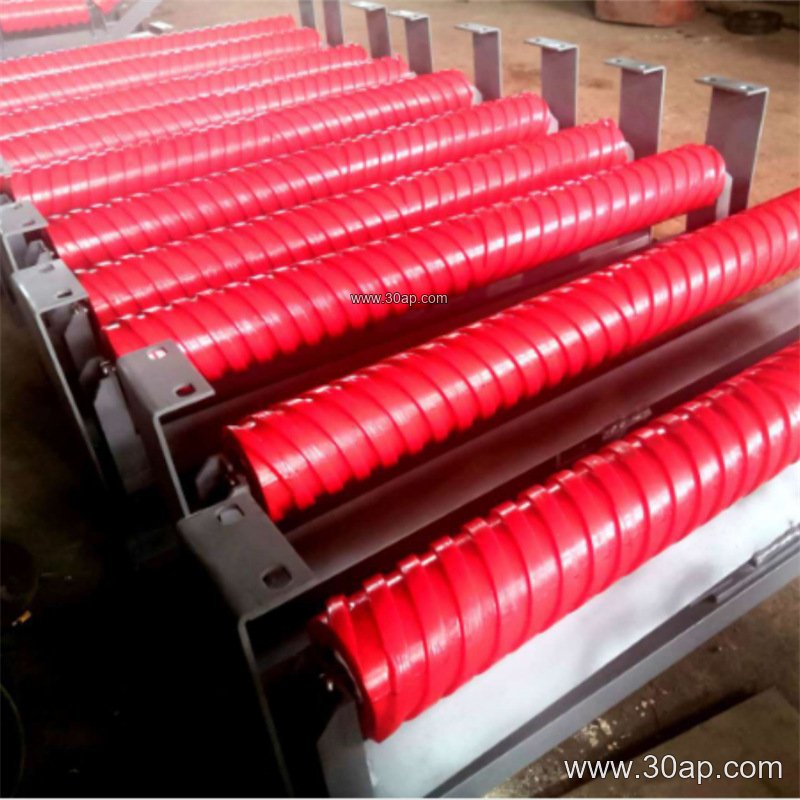
Roll diameters commonly range from Ø63 mm to Ø219 mm, with Ø89, Ø108, Ø133, and Ø159 being frequent choices for medium and heavy-duty conveyors. Bearing sizes such as 6204, 6205, 6305, 6306, 6308, and 6310 appear across the range, but no single bearing is tied to one roller diameter. Roller surface options include steel tube, nylon, ceramic, and rubber rings. Rubber rings help absorb impact at transfer points, while ceramic or nylon covers may suit abrasive or sticky materials.
Where It Fits on the Conveyor
Placement matters. A common approach is to install one anti-misalignment guide idler every 30 to 50 meters on long straight runs, and immediately after a curve or a loading point where the belt is likely to wander. On a quarry conveyor belt carrying crushed stone, a pair of self-aligning idlers before the head pulley can prevent edge wear on the return side. In a coal mining conveyor belt system, flame retardant conveyor belt grades are often paired with anti-static idlers, but the guide idler itself is selected mainly for load and belt width.
Do not confuse this unit with a transition idler or a buffer idler. A transition idler supports the belt as it changes trough angle near a pulley; a buffer idler absorbs impact under a chute. The guide idler’s role is tracking correction only.
Matching Belt Width and Roller Dimensions
Belt width and trough angle determine the roller length and frame size. The table below shows common reference values for three-roller trough sets; side rollers and center rollers can differ, and final dimensions are set by the conveyor design.
| Belt Width | Typical Roller Length (three-roll trough) | Common Trough Angle | Common Roll Diameter |
|---|---|---|---|
| B500 | 200 mm | 20°–35° | Ø63–Ø89 |
| B650 | 250 mm | 20°–35° | Ø76–Ø108 |
| B800 | 315 mm | 30°–35° | Ø89–Ø133 |
| B1000 | 380 mm | 30°–35° | Ø108–Ø159 |
| B1200 | 465 mm | 30°–45° | Ø108–Ø159 |
| B1400 | 530 mm | 30°–45° | Ø133–Ø178 |
| B1600 | 600 mm | 35°–45° | Ø133–Ø194 |
| B1800 | 670 mm | 35°–45° | Ø159–Ø219 |
| B2000 | 750 mm | 35°–45° | Ø159–Ø219 |
These are reference examples, not fixed pairings. A 1200 mm wide conveyor belt might use a Ø133 mm roller in one plant and a Ø159 mm roller in another, depending on load and speed.
Buyer Checklist
- Confirm belt width (B400 to B2400) and trough angle before selecting the frame.
- Specify whether the unit is for the carrying side or return side; V-return and flat-return versions differ.
- Check the roller surface: rubber rings for impact, ceramic for abrasion, nylon for general duty.
- Ask for the swivel base and bracket dimensions to match existing conveyor bracket spacing.
- For underground coal mining, verify flame retardant and anti-static properties of the roller and belt together.
- Consider a friction self-aligning idler for reversible belts, and a conical self-aligning type for heavy spillage zones.
For more on matching conveyor belt, idler roller, and conveyor pulley components, see the equipment notes at conveyor idler and conveyor belt pages. A well-chosen anti-misalignment guide idler extends belt life in aggregate, cement, and bulk material handling operations.