What a Take-Up Pulley Does on a Conveyor
A take-up pulley is the drum that maintains working tension in a conveyor belt. Mounted in a take-up frame or on a movable carriage, it pulls the belt taut as it stretches under load, keeping the belt seated on the drive pulley and limiting slip. Without adequate take-up travel, a belt can sag between idlers, wander off the tail pulley, or lose traction at the drive. In a quarry or a sand and gravel line, this drum is often the quiet difference between steady output and constant stoppages.
It is a distinct position on the conveyor, not a substitute for the drive pulley or the tail pulley. Those drums transmit power and redirect the belt at the ends of the structure; the take-up drum is the one that moves to absorb slack. Many conveyors use a gravity take-up tower, while others rely on a screw or hydraulic arrangement.
Construction and Surface Options
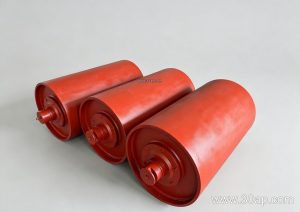
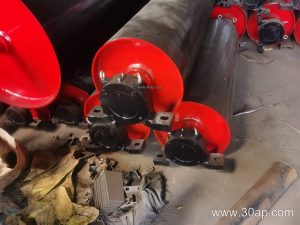
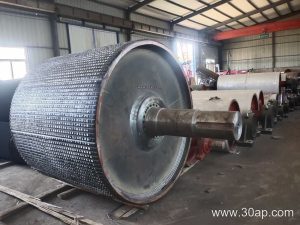
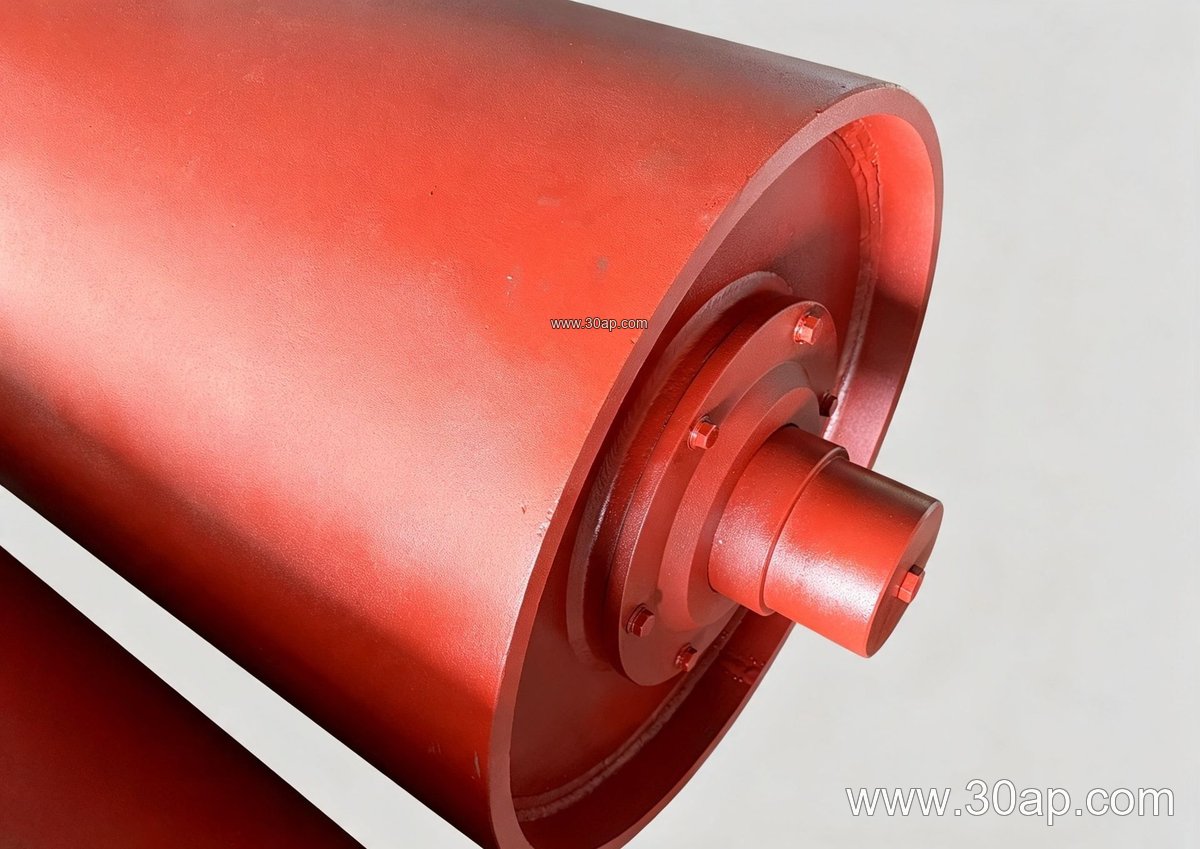
The assembly usually consists of a cylindrical shell, two end discs, a shaft, bearing housings, and a lagging surface. Shells are commonly welded steel, machined at the faces so the drum runs true. The shaft is sized by torque and radial load rather than by belt width alone, with common diameters ranging from Ø80 to Ø200 mm depending on the duty.
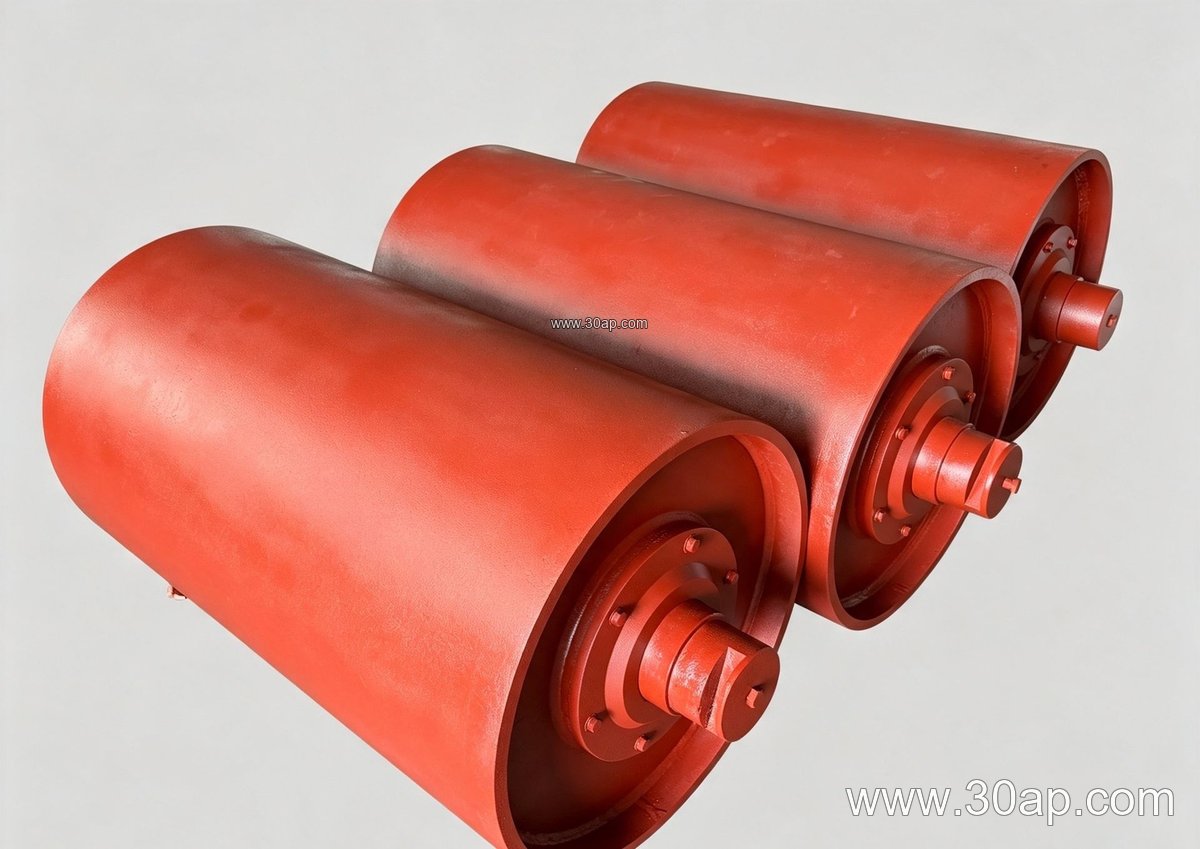
Surface treatment depends on the contact conditions. Plain finish suits some light applications, while rubber lagging improves grip and protects the shell from abrasive fines. Diamond and herringbone patterns help shed water and material in wet or dusty service. Ceramic lagging is chosen where slip and wear are severe. Lagging thickness is commonly 8, 10, 12, 15, or 20 mm, selected by the designer.
Typical Reference Dimensions
The figures below are common reference values, not fixed pairings. Face width is normally a little wider than the belt, and the diameter is set by shaft load, wrap angle, and take-up travel requirements.
| Belt Width | Typical Pulley Face Width | Common Diameter Range |
|---|---|---|
| B500 | about 600 mm | Ø250 to Ø400 |
| B650 | about 750 mm | Ø315 to Ø500 |
| B800 | about 950 mm | Ø400 to Ø630 |
| B1000 | about 1150 mm | Ø500 to Ø800 |
| B1200 | about 1400 mm | Ø630 to Ø1000 |
| B1400 | about 1600 mm | Ø800 to Ø1250 |
Shaft diameters are often in the range of Ø50 to Ø200 mm. A combination such as B1200 × Ø1000 or B800 × Ø500 appears in real installations, but no single belt width dictates one diameter. The take-up designer calculates the required tension and travel first, then chooses the drum.
Where It Fits in the Plant
In a coal handling system at a power plant, the take-up pulley is usually located near the tail or in a return run tower, where it can move freely as the belt elongates. In a cement plant clinker line, gravity take-up is common because it responds continuously to load changes. The drum works alongside the conveyor belt, the conveyor pulley set, and the idler roller string, but its role is tension, not transport.
Correct alignment with the conveyor bracket and frame matters. A take-up carriage that binds in its guides will not tension evenly, and the belt may track to one side. When the belt is an EP conveyor belt or a steel cord conveyor belt, elongation behavior differs, so the available take-up stroke should be checked against the belt’s expected stretch.
Selection and Maintenance Notes
- Confirm the required take-up travel before choosing the drum diameter and carriage length.
- Match lagging to the environment: rubber for general grip, ceramic for high wear, patterned surfaces for wet or dusty conditions.
- Check bearing selection and sealing against dust and water, especially in crushing and screening circuits.
- Inspect lagging wear, shaft keyways, and carriage guides during scheduled shutdowns.
- Keep the take-up area clear of spilled material so the drum can move through its full stroke.
Buyers should ask for the calculated tension, the expected belt elongation, and the shaft load rather than ordering by belt width alone. A take-up pulley that is too small in diameter or too short in travel will force frequent re-splicing and shorten belt life. For heavier duties, such as an abrasion resistant conveyor belt carrying ore in an iron ore plant, the drum and its lagging should be specified together with the belt tension data. Further details on matching drums to belts are available at www.example.com/take-up-pulley.