What a Guide Pulley Does on a Conveying Line
A guide pulley is a small-diameter roller mounted against the return strand or the edges of a conveyor belt to keep it tracking correctly and to steady the belt where it might lift, sway, or rub. In many plants it is also called a belt guide roller or a training roller, and the two names describe the same component. It is not a drive pulley, a tail pulley, or a bend pulley; those carry the main tension and transmit power, while the guide pulley does a narrower job: it corrects misalignment and holds the belt in position.
Because it works close to the belt surface, a guide pulley is often one of the first parts to show wear in a stone crushing line or a cement plant clinker route. Watching it is a simple way to catch tracking problems early.
How a Guide Pulley Is Built
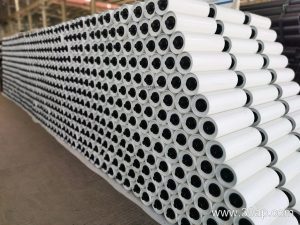
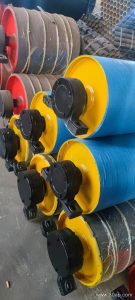
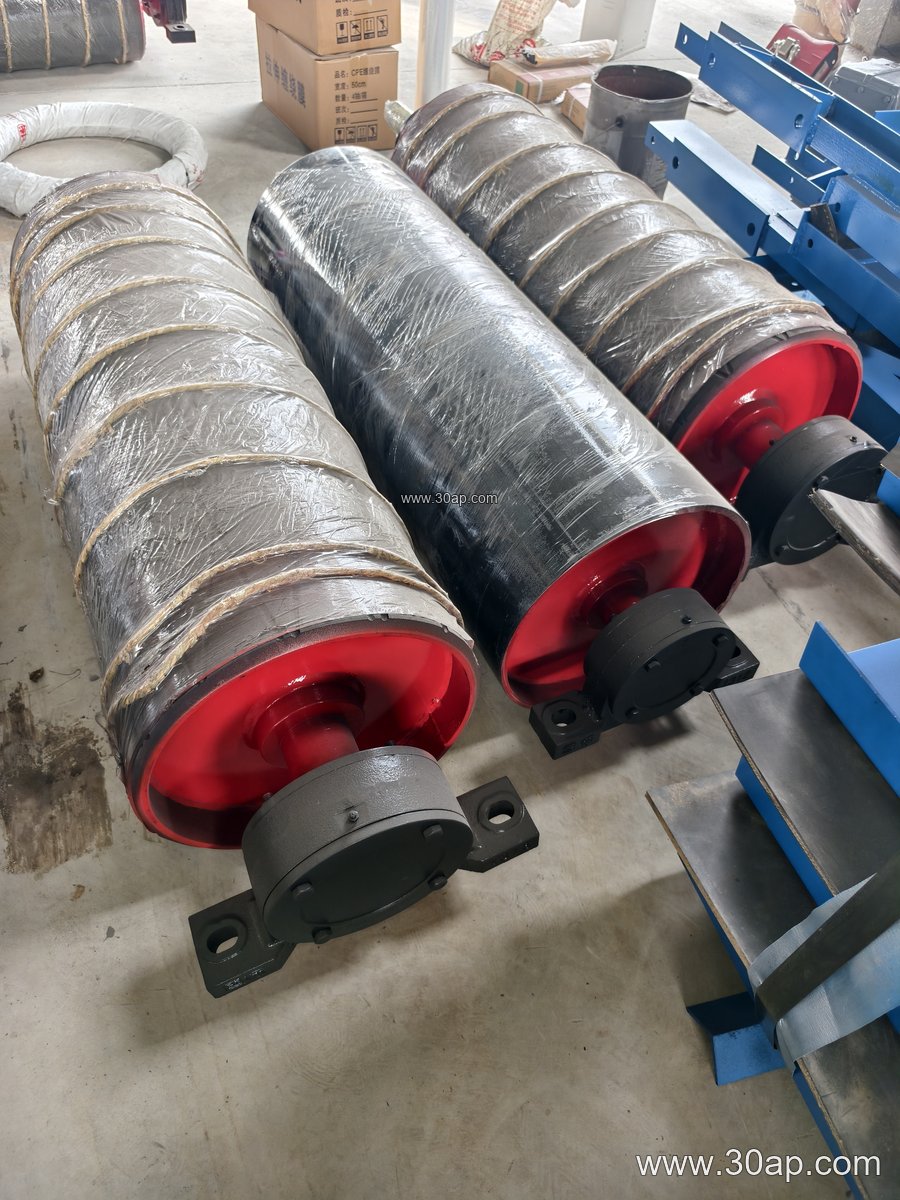
The body is usually a short steel tube with machined ends, fitted with sealed bearings in a compact housing. Small units often use a single row of bearings and a simple shaft; larger ones may have heavier shafts and removable end caps. The surface can be plain steel, rubber covered, or fitted with a polyurethane sleeve, depending on whether grip or low friction is wanted. A rubber lagging helps the roller grip the belt edge without scuffing, while a smooth sleeve suits areas where the belt should slide rather than be pulled.
Typical sizes are modest. A guide roller for a B650 or B800 belt might run Ø60 to Ø100 mm with a face length matched to the frame, while heavier frames use Ø120 to Ø160 mm shafts. These are common reference values, not fixed matches; the actual shaft and bearing are set by the load and the bracket design.
- Tube: seamless or welded steel, often painted or galvanized
- Bearing: sealed ball bearing, greased for life in many designs
- Surface: plain, rubber lagged, or polyurethane
- Mounting: fixed bracket, adjustable slide, or spring-loaded arm
Where It Fits in the Conveyor Structure
The most common position is just before the tail pulley on the return side, where the belt can wander after unloading. A second frequent position is along the carrying strand near the loading point, where off-center material pushes the belt sideways. In a coal handling system or a power plant coal yard, guide pulleys are also placed at curves and at transfer towers to stop the belt from climbing the idler frames.
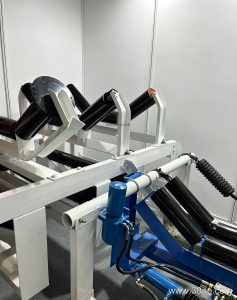
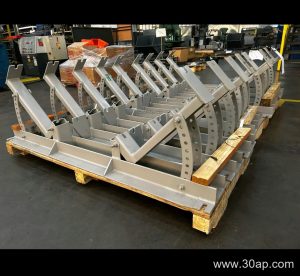
They are used together with idler roller sets and a sturdy conveyor bracket, but they do not replace the training idlers that carry the full belt load. A guide pulley touches only a narrow band, so it corrects direction rather than supporting weight. On a quarry conveyor or an aggregate line, this makes it a low-cost addition that reduces edge damage on an abrasion resistant conveyor belt.
Selection Points Buyers Should Check
Before ordering, confirm the belt width, the available space between frames, and whether the roller is fixed or adjustable. The face length is usually a little wider than the belt contact zone, and the shaft diameter should be chosen from torque and radial load, not from belt width alone. If the belt is a heavy-duty mining conveyor belt or a steel cord conveyor belt, the guide pulley should be sized for the extra stiffness and the higher edge forces.
| Parameter | Common Reference Range |
|---|---|
| Belt width served | B400 to B2000 |
| Roller diameter | Ø60, Ø76, Ø89, Ø108, Ø133, Ø159 mm |
| Shaft diameter | Ø20 to Ø60 mm, by load |
| Surface | Plain steel, rubber lagging, polyurethane |
| Bearing | Sealed ball bearing, 2RS or equivalent |
Ask for the mounting dimensions and the bracket hole pattern, because a guide roller that does not fit the frame is useless even if the roller itself is sound. Also confirm the lagging thickness if rubber is specified; 8 to 12 mm is common for this light-duty role.
Installation and Maintenance Notes
Set the guide pulley so it contacts the belt lightly. Too much pressure bends the belt edge and wears the lagging quickly; too little and the belt ignores it. After installation, run the empty belt and check tracking before loading. Re-check after the first shift, since new belts stretch and settle.
Inspect the roller every few weeks in dusty service such as a limestone mine or a sand and gravel plant. Seized bearings flatten the roller and can cut the belt. Replace the unit when the sleeve is worn through or the bearing turns roughly. Keep a spare guide pulley on hand for critical lines, and note that it works alongside the conveyor pulley and conveyor belt rather than replacing either.
For lines handling sticky or wet material, a smooth guide roller is easier to clean than a lagged one. For long overland runs with a fabric core conveyor belt, an adjustable bracket lets maintenance staff fine-tune the belt path without changing parts.