What a Diamond Grooved Lagged Pulley Does
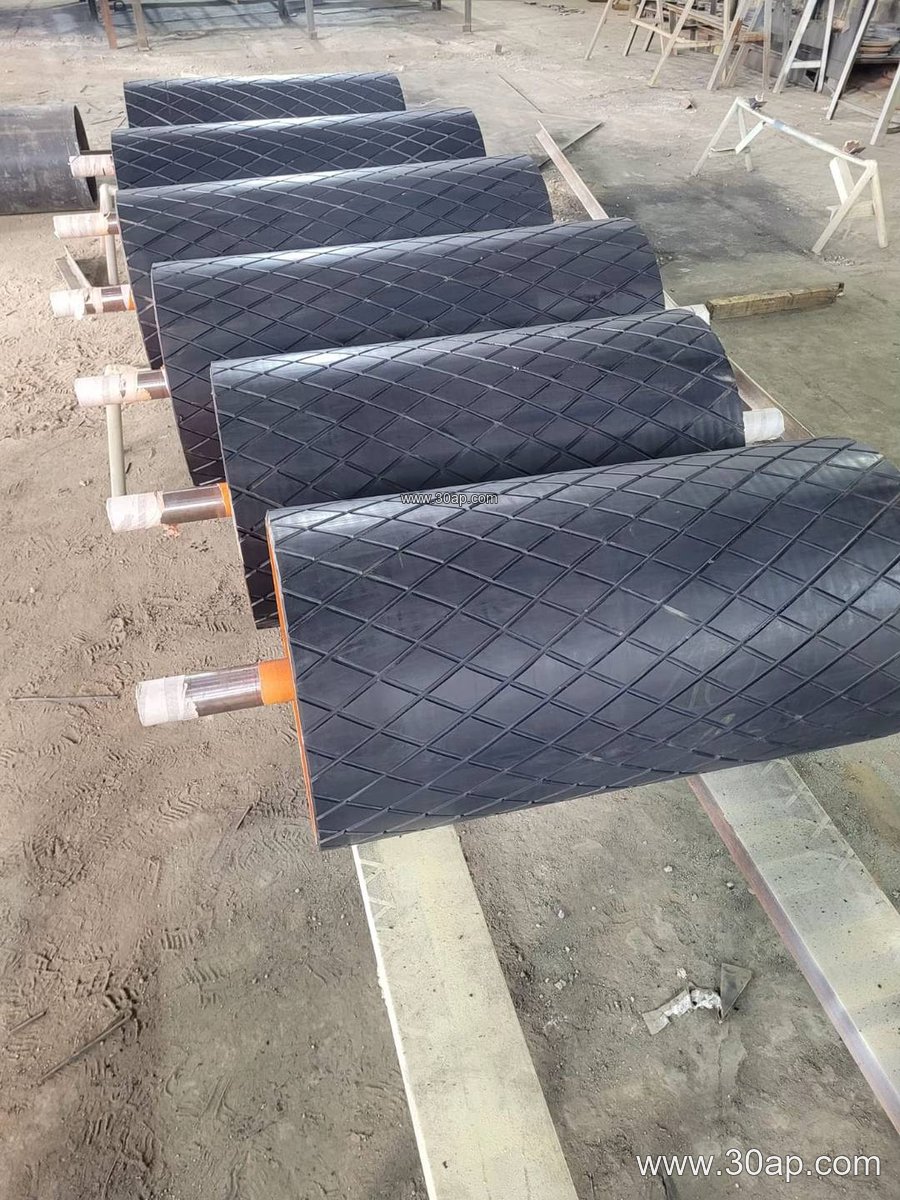
A diamond grooved lagged pulley is a conveyor pulley whose shell is covered with a rubber lagging cut into a diamond pattern. The diamond grooves work like small drainage channels: water, fine dust and slurry are pushed out from under the belt as it wraps the pulley, so the rubber tread can keep a firm grip. This is the same product often called a diamond rubber lagged pulley or diamond-pattern lagged drum, and the subtype qualifiers matter — it is a pulley, not a roller, and it is not the same as a bend pulley or a tail pulley.
In a stone crushing line or a cement plant clinker transport section, belt slip is expensive. A diamond grooved lagged pulley is usually chosen for the drive position, where torque has to pass from the shell to the conveyor belt with minimum loss.
How the Lagging Is Built
The pulley body is a welded steel drum with end discs and a shaft. The lagging is applied to the shell surface in one of three common ways: hot vulcanized rubber, cold bonded rubber, or cast rubber. Diamond grooving is then cut or molded into the surface. Common lagging thicknesses are 8, 10, 12, 15 and 20 mm, with 10 to 15 mm typical for medium-duty drives.
- Shell: rolled steel, machined for balance
- Lagging: rubber sheet, diamond pattern, ends chamfered
- Shaft: keyed or shrink-fitted, sized by torque and load
- Bearings and housing: matched to the conveyor bracket
The diamond pattern is not only about grip. The grooves also help the lagging flex slightly as the belt enters and leaves the wrap, which reduces edge stress on the belt.
Where It Fits in a Conveyor
The most common location is the drive or head position. A drive pulley with diamond lagging transmits power to a heavy-duty mining conveyor belt carrying ore or coal. The same surface form can be used on a tension pulley in a long overland system, but a bend pulley is a different duty and normally runs with plain or lightly lagged surface.
Typical sites include:
- Quarries and aggregate plants moving crushed rock
- Coal washing plants and underground coal mining conveyors
- Cement plants handling clinker and raw meal
- Power plant coal handling systems
Where the belt carries wet or sticky material, the diamond grooves help keep the pulley face clean. On a chevron conveyor belt or a corrugated sidewall conveyor belt, the pulley face is usually plain or lightly lagged because the belt profile needs a flat wrap.
Matching Pulley Size to Belt Width
Pulley face width is normally a little wider than the belt. Common combinations include B800 × Ø500, B1200 × Ø1000 and B1400 × Ø800. These are reference pairings, not fixed rules — a wider belt does not automatically require one specific diameter, and shaft diameter is determined by torque and bearing load, not by belt width alone.
| Belt width | Typical pulley face width | Common diameter range |
|---|---|---|
| B500 | about 600 mm | Ø250 – Ø400 |
| B650 | about 750 mm | Ø315 – Ø500 |
| B800 | about 950 mm | Ø400 – Ø630 |
| B1000 | about 1150 mm | Ø500 – Ø800 |
| B1200 | about 1400 mm | Ø630 – Ø1000 |
| B1400 | about 1600 mm | Ø800 – Ø1250 |
| B1600 | about 1800 mm | Ø1000 – Ø1400 |
Common shaft diameters run from Ø50 to Ø200, again selected by calculation. A B1200 drive pulley on an EP conveyor belt in a port bulk terminal may use a larger shaft than the same width in a light aggregate line.
Buyer Checklist
Before ordering, confirm the pulley position (drive, tail, tension or bend), the belt type and width, the lagging thickness and hardness, and the shaft and bearing arrangement. Ask whether the diamond grooving is hot vulcanized or cold bonded, since the bonding method affects service life. Check that the pulley face width leaves enough clearance for the conveyor bracket and that the lagging ends are chamfered to avoid belt edge damage.
For abrasive duties such as iron ore or copper ore, a thicker lagging and a harder rubber compound are common. For flame retardant conveyor belt installations in underground coal mining, the lagging compound should be matched to the fire safety requirements of the system. Where oil or chemicals are present, confirm rubber compatibility before delivery.
Finally, keep spare lagging sheets and a wear record. Diamond grooved lagged pulleys wear gradually at the groove edges, and early replacement of the lagging protects both the pulley shell and the belt.