What a Lower Return Idler Does
A lower return idler is the roller that carries the empty side of a conveyor belt on its way back to the tail. After the belt has discharged its load, it sags under its own weight unless something supports it. That support comes from the return idler roller mounted on the lower frame, often called a flat return roller or simply a return roller. On a long overland conveyor at a quarry or a coal handling line at a power plant, these rollers repeat every few metres and quietly define how smoothly the belt tracks.
The return run is not a copy of the carrying run. There is no material pressing the belt down, so the loads are lighter but the belt is more prone to misalignment and edge wear. A well-chosen return idler keeps the belt centred, limits sag between supports, and protects the splice from repeated flexing.
Construction and Common Forms
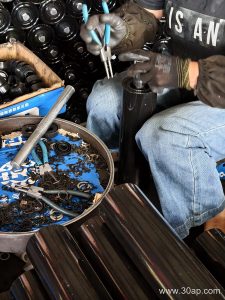
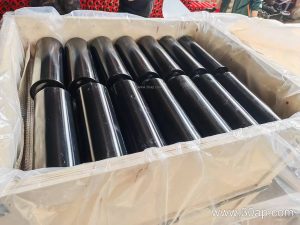
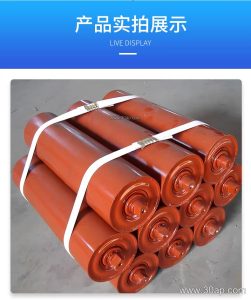
Most return idlers share the same basic build: a steel tube shell, a shaft, sealed bearings at each end, and a bracket or frame that fixes the roller to the conveyor structure. The shell may be plain steel, nylon-coated, or fitted with rubber discs. Bearing sizes commonly run from 6204 and 6205 on smaller rollers up to 6308 or 6310 on heavier duty units, matched to the shaft and load rather than to belt width alone.
Several forms appear in practice, and the choice depends on the belt and the duty:
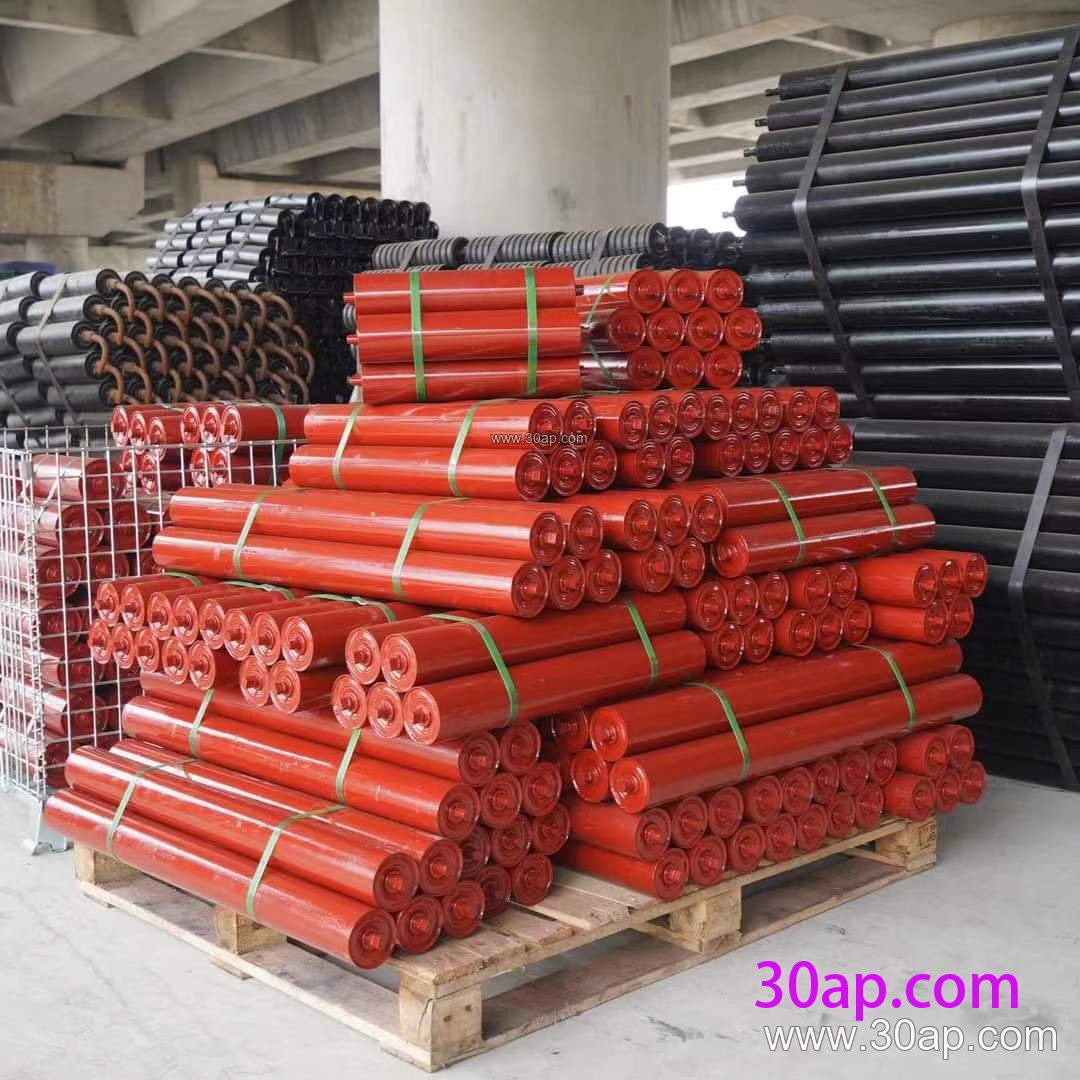
- Flat return idler – a single straight roller under the centre of the belt, the most common arrangement.
- V-type return idler – two rollers set in a shallow V, which helps centre the belt and shed stray material.
- Spiral or helical return roller – a shell with a spiral profile that guides fines away from the belt edge and reduces build-up.
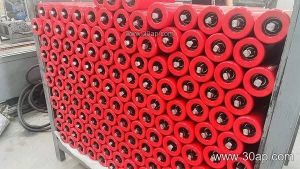
- Rubber-disc return roller – rubber rings on the shell for quieter running and better grip on the return belt.
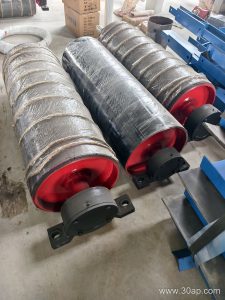
These are variants of the same lower return idler family, not replacements for carrying idlers or for a conveyor pulley. A drive pulley, tail pulley, or bend pulley does a different job entirely and cannot be swapped for a return roller.
Typical Sizes and Reference Data
Roller diameter and belt width are selected together with the conveyor design, not by a fixed rule. The table below gives common reference values; actual dimensions follow the belt width, frame, and load case agreed with the supplier.
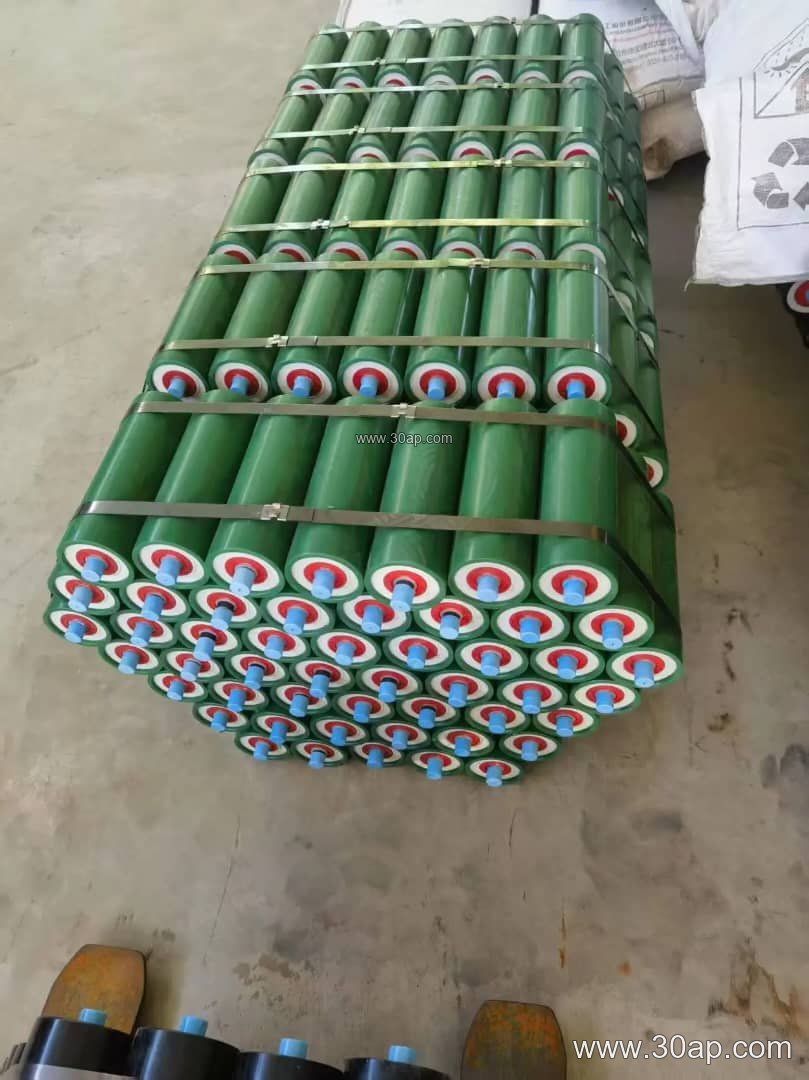
| Reference item | Common values |
|---|---|
| Roller diameter | Ø63, Ø76, Ø89, Ø102, Ø108, Ø127, Ø133, Ø159, Ø178, Ø194, Ø219 mm |
| Belt width | B400, B500, B650, B800, B1000, B1200, B1400, B1600, B1800, B2000, B2200, B2400 |
| Bearing | 6204, 6205, 6305, 6306, 6308, 6310 |
| Shell surface | steel tube, nylon, ceramic, rubber rings |
Roller length changes with belt width and with the return arrangement. For a three-roll carrying set, common roll lengths are roughly 200 mm at B500, 250 mm at B650, 315 mm at B800, 380 mm at B1000, 465 mm at B1200, 530 mm at B1400, 600 mm at B1600, 670 mm at B1800, and 750 mm at B2000. These are examples only; side rolls and centre rolls differ, and a return roller is ordered to its own length. No single belt width locks in one pulley diameter or one shaft size.
Where It Fits on Site
Return idlers show up wherever a belt conveyor runs long enough to need support on the empty strand. In a limestone quarry, they sit under the main haulage conveyor between the head and the tail. In a cement plant, they carry the return belt on clinker and raw-material lines. In a coal-fired power station, they keep the return strand stable through transfer towers. In a sand and gravel plant, a V-type or spiral return roller often earns its place because spillage is constant. The same hardware serves a crushing and screening circuit, a steel mill sinter line, or a port loading system.
What Buyers Should Check
Before ordering, confirm the belt width and the return frame spacing, since these set the roller length and the load per roller. Check the shaft diameter and bearing seat against the existing conveyor bracket, because a roller that does not fit the bracket stalls the whole replacement. Ask about sealing: dust and water ingress are the usual reasons a return idler roller fails early, especially in washdown or dusty service.
Also decide whether a flat roller is enough or whether the belt needs a V-type or spiral form for centring and cleaning. Compare shell thickness and bearing class rather than price alone, and keep a small stock of the most-used sizes so a failed unit does not stop the line. Finally, confirm that the roller is balanced and turns freely by hand before installation; a return idler that drags will wear the belt edge and waste power.