What a Five-Roll Idler Bracket Does
A five-roll idler bracket is the steel support assembly that holds five idler rollers under a conveyor belt, forming a deep trough that keeps material centred on the belt. It is a frame-level component rather than a roller itself: the bracket carries the shafts, sets the trough angle, and transfers the load into the conveyor stringers. In a quarry, a coal washing plant, or a cement kiln feed line, this kind of bracket is chosen where the belt is wide and the material load is heavy, because spreading the load across five rollers reduces the stress on any single idler roller and limits belt sag between supports.
The accurate equivalent name for the same product is a five-roller troughing idler bracket or five-roll troughing frame. These terms describe one bracket type and can be used interchangeably in specifications. They are not the same as a drive pulley, tail pulley, or bend pulley, which are drum components at the ends and corners of the conveyor, and they do not replace two-roll or three-roll troughing brackets.
How the Bracket Is Built
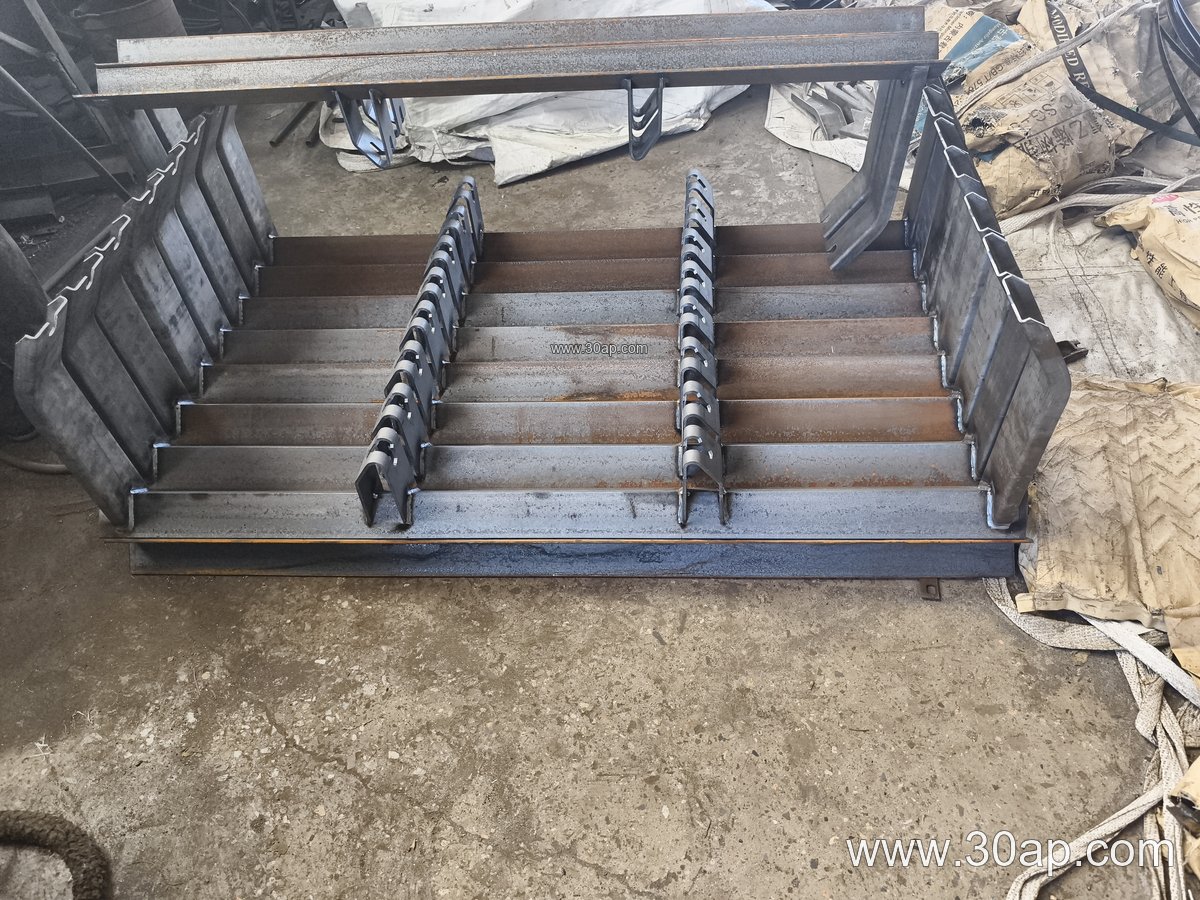
Most five-roll idler brackets are fabricated from angle steel, channel steel, or folded steel plate, then welded into a rigid crossbeam with mounting pads or slots for each roller shaft. The centre roll usually sits flat or slightly raised, and the two outer pairs are set at an angle so the belt curls into a deep U shape. A typical arrangement uses a trough angle in the range of 20 to 45 degrees, with the outer rolls carrying most of the material load.
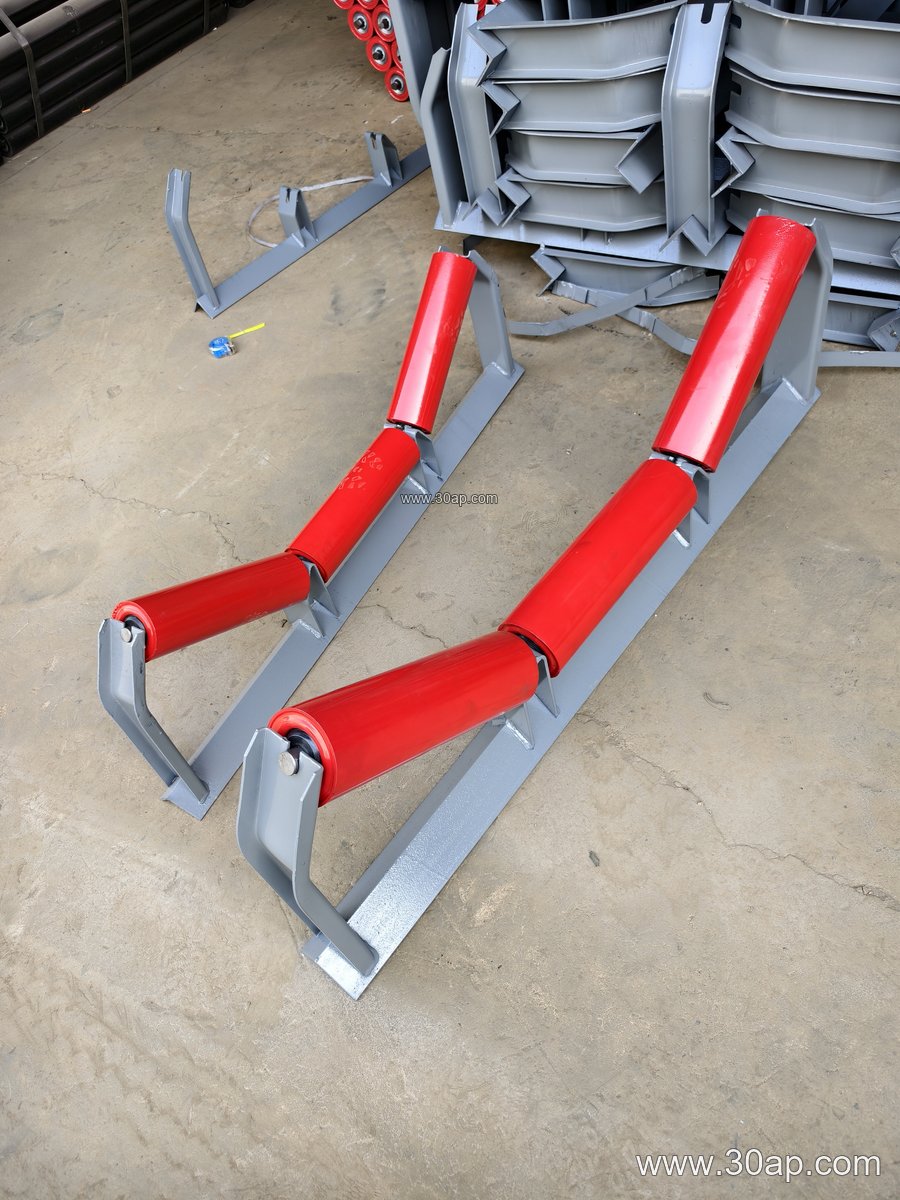
Because the belt wraps over five rollers, the bracket has more mounting positions than a three-roll frame, so the hole spacing and crossbeam length are determined by belt width, trough angle, and roller diameter together. They should not be treated as fixed figures. The frame may be a fixed welded design or an adjustable bracket that allows the trough angle to be changed on site.
Typical Reference Dimensions
The table below gives common reference ranges, not universal specifications or supply promises. Final dimensions are confirmed by the conveyor design.
| Parameter | Common reference values |
|---|---|
| Belt width | B800, B1000, B1200, B1400, B1600, B1800, B2000 |
| Trough angle | 30 degrees, 35 degrees, 45 degrees (adjustable brackets cover a range) |
| Roller diameter | Ø108, Ø133, Ø159, Ø194 |
| Frame material | Angle steel, channel steel, folded steel plate |
| Mounting | Bolted pads or slots; hole spacing set by design |
A combination such as B1200, 35 degrees, Ø133 is a plausible reference set for a heavy troughing station, but other combinations are equally valid. The belt width does not dictate a single trough angle or roller diameter, and shaft diameter must be calculated from the actual load, not guessed from belt width.
Where It Fits on the Conveyor
The five-roll bracket belongs to the carrying side of the conveyor, in the troughing section between the tail pulley and the head drive pulley. It is used on high-capacity lines in iron ore mines, limestone quarries, coal preparation plants, power station coal handling, and sinter plants, where a deep trough improves material retention and reduces spillage. It is not used at the drive pulley, tail pulley, or bend pulley positions, where the belt must run flat or wrap a drum.
On the return side, a V-return bracket or flat return bracket is the normal choice; a five-roll troughing bracket is not a substitute for those return support types. Likewise, a buffer bracket at a loading point and a self-aligning bracket in a tracking problem area serve different purposes and should be selected separately.
Selection and Installation Notes
- Match the bracket to the conveyor belt width and to the idler roller diameter actually specified for the line.
- Check the trough angle against the material angle of repose; a deeper trough helps in a quarry or a coal yard but may increase belt edge stress.
- Confirm mounting hole spacing and crossbeam length with the stringer layout before ordering.
- Use an adjustable five-roll bracket where the trough angle may need tuning after commissioning.
- Inspect welds, shaft seats, and bolt torque during routine maintenance, and replace a bracket that shows cracking or serious corrosion.
For a buyer, the key questions are simple: what belt width and roller diameter the line uses, what trough angle the material needs, whether the frame must be fixed or adjustable, and how the bracket will bolt to the existing conveyor bracket supports. Clear answers to these points keep the five-roll idler bracket matched to the rest of the conveyor, from the conveyor belt and idler roller set to the conveyor pulley at each end.