What a Custom Idler Really Means
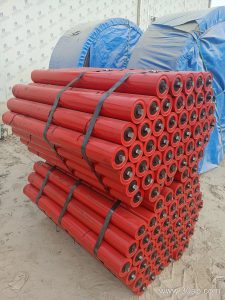
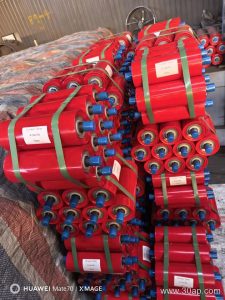
A custom idler is a conveyor idler roller manufactured to match a specific installation rather than pulled from a standard stock list. The product is still a rotating cylinder that supports the conveyor belt, but the dimensions, shaft ends, bearing arrangement, surface treatment, and mounting details are chosen to fit an existing structure or a particular material handling duty. In everyday language, people also call this a made-to-order idler roller or a tailor-made carrying roller. The name changes, the function does not: it keeps the belt running smoothly while carrying the load between the head and tail of the conveyor.
Buyers usually ask for a custom idler when a standard unit almost fits but not quite. The frame holes may be spaced differently, the belt width may sit outside common ranges, or the material may be abrasive, sticky, or hot enough that a general-purpose roller wears out too quickly. In those situations, the idler is treated as an engineered component rather than a commodity part.
How a Custom Idler Is Put Together
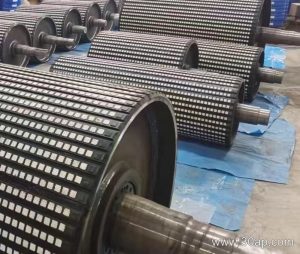
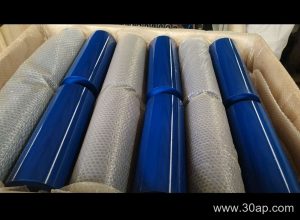
The basic anatomy is straightforward. A steel tube forms the roller shell, and pressed or machined end caps hold the bearings. A shaft runs through the center, and the bearing housing is sealed against dust and moisture. The tube can be left as bare steel, coated with nylon, covered with rubber rings, or fitted with ceramic tiles when abrasion is severe. Each of these choices changes how the roller behaves in service.
Bearing selection is part of the customization. Common sizes include 6204, 6205, 6305, 6306, 6308, and 6310, but the bearing is matched to the load, speed, and shaft diameter of the application, not to the belt width alone. A wider belt does not automatically mean a larger bearing, and a given bearing number is not tied to one roller diameter. The shaft, housing, and seal are designed as a set.
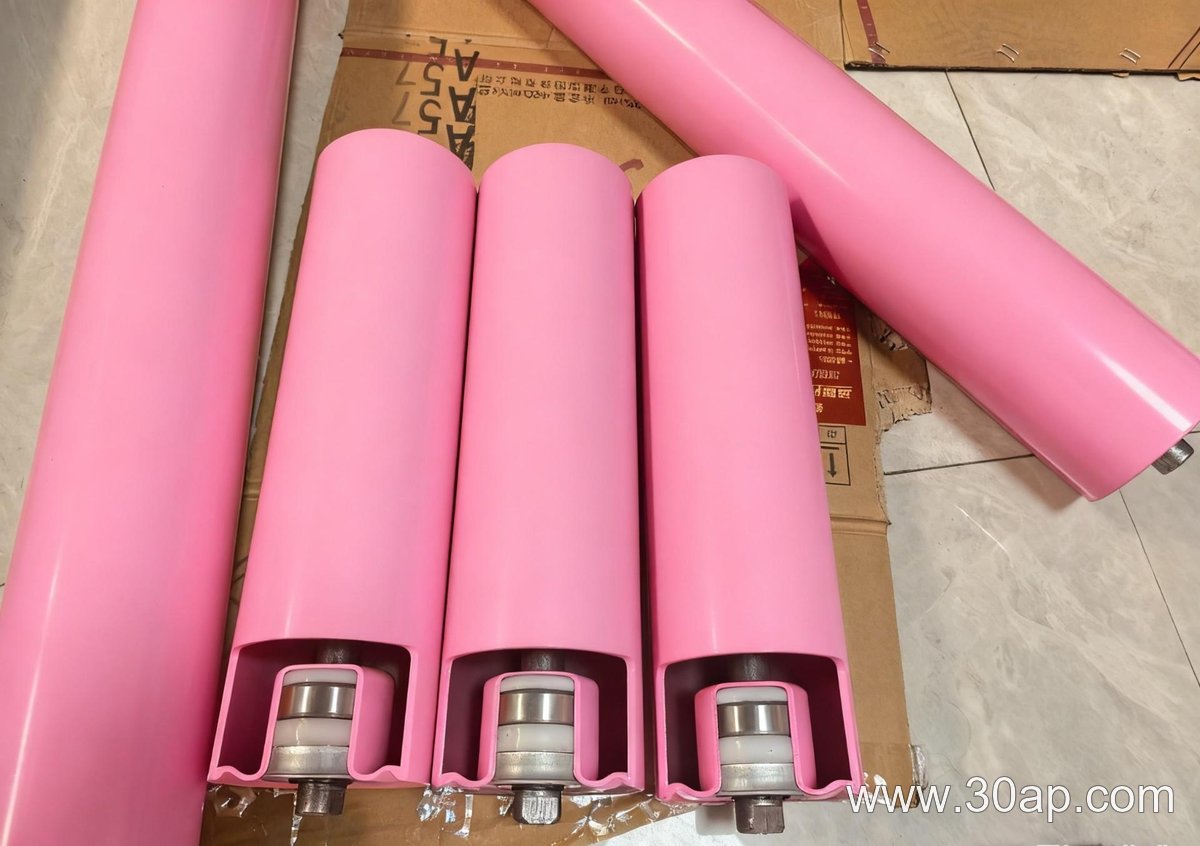
Roller length is another variable. On a three-roll troughing set, the side rollers and the center roller can differ in length. As a rough reference, common roller lengths for three-roll troughing sets are around 200 mm for B500, 250 mm for B650, 315 mm for B800, 380 mm for B1000, 465 mm for B1200, 530 mm for B1400, 600 mm for B1600, 670 mm for B1800, and 750 mm for B2000. These are examples only. The actual length depends on belt width, trough angle, and the geometry of the idler set.
Types and Where They Fit
Custom idlers are not a single shape. The same made-to-order approach applies to carrying idlers, return idlers, impact idlers, self-aligning idlers, and spiral rollers. A troughing idler set may be single-roll, two-roll, or three-roll, with trough angles commonly around 20, 30, 35, or 45 degrees. A forward tilt of about 1.5 to 2 degrees is sometimes used on carrying rolls to help steer the belt, and this detail is often specified when a custom set is ordered.
Return idlers may be flat or V-shaped, and impact idlers use rubber rings to absorb the fall of lumpy material. Spiral rollers are chosen where sticky material tends to build up on the shell. Self-aligning types, including friction and tapered versions, are used where the belt tends to wander. Each of these is a different subtype, and one should not be ordered as a substitute for another. A drive pulley, tail pulley, or bend pulley is a different component entirely and is not interchangeable with an idler roller.
Where Custom Idlers Are Used
These rollers appear wherever a conveyor belt needs reliable support. In a quarry or sand and gravel line, abrasive rock dust punishes ordinary rollers, so sealed bearings and thick-walled tubes are common. In a coal handling plant or a power station coal yard, the idler must cope with fine dust and occasional wet conditions. In a cement plant, the material can be hot and gritty, which pushes the design toward heat-resistant seals and heavier construction.
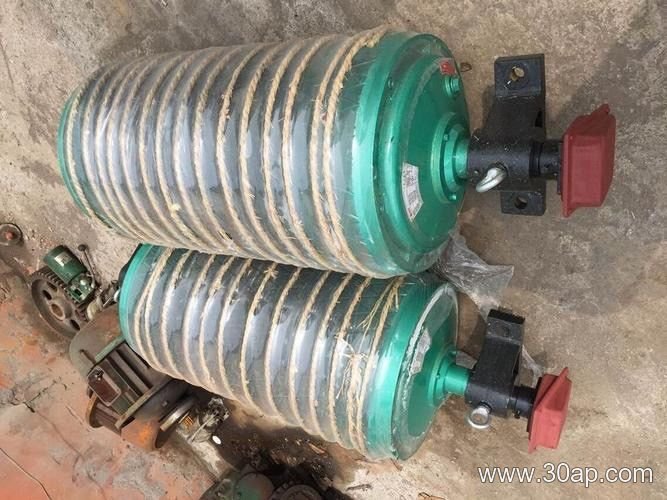
Other settings include fertilizer plants, grain handling, and concrete batching. In each case, the custom idler is specified around the local conditions rather than a generic catalog rating.
What a Buyer Should Know Before Ordering
The first step is to record the existing installation. Belt width, trough angle, roller diameter, roller length, shaft diameter, and the distance between mounting holes all matter. The conveyor bracket or frame connection determines how the shaft ends must be machined. If the idler sits in a retrofit, the mounting dimensions are often the hardest constraint.
Next, describe the duty. Is the material sharp, sticky, hot, or wet? Is the belt running fast or slow? Is the idler on the carrying side, the return side, or at a loading point? These answers guide the choice of shell material, surface form, bearing size, and seal type. A nylon shell may reduce buildup, while a rubber-covered impact roller absorbs shock at the transfer point.
Finally, avoid treating any single dimension as a universal rule. A B800 belt does not require one fixed roller diameter, and a 108 mm roller is not reserved for one belt width. The correct combination comes from the conveyor design. A custom idler is successful when it fits the frame, matches the belt, and survives the material it handles.