What an Impact Idler Does at the Loading Point
An impact idler is the cushioning roller set placed directly beneath the chute or transfer point where material first lands on the conveyor belt. Its job is simple to describe and hard to overstate: absorb the energy of falling rock, ore, clinker or aggregate before that energy reaches the belt carcass. In a quarry, a limestone mine or a crushing and screening line, the drop height and lump size at the transfer point dictate how much punishment the belt takes. A standard carrying idler in that position would transfer the shock straight into the belt cover and fabric, so a cushioning roller assembly is used instead.
The same logic applies in a coal handling plant, a cement plant or a power plant coal yard, where wet or sticky material may fall in heavy slugs rather than a steady stream. Plants running an abrasion resistant conveyor belt or a heavy-duty mining conveyor belt still benefit from cushioning at the load zone, because cover compound resists wear but does not absorb impact energy on its own.
How the Roller Is Built
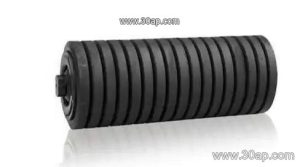
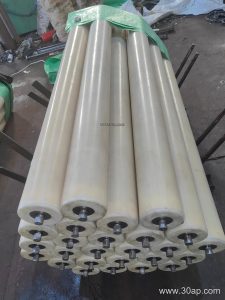
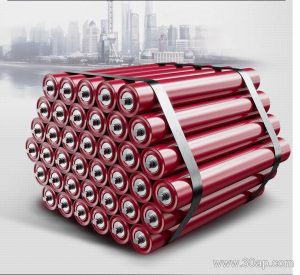
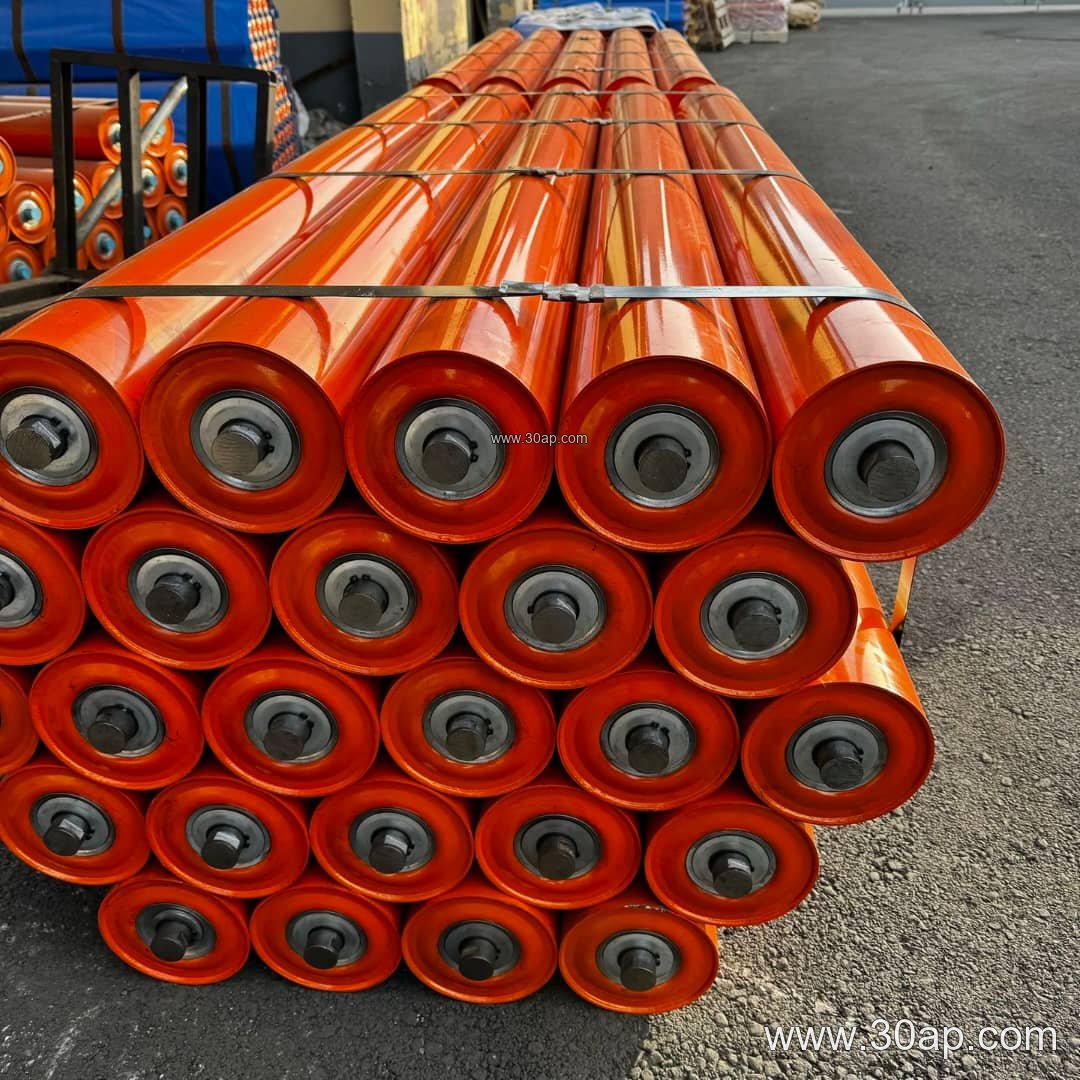
The distinguishing feature is the resilient surface. Instead of a bare steel shell, the roller carries a series of rubber rings, discs or a rubber-covered sleeve mounted along the shaft. These rings compress under load and spring back, spreading the strike over a longer time and a wider area of belt. The shaft, bearing housing and end seals follow the same general pattern as other idler rollers, with labyrinth or multi-stage seals protecting the bearing from dust and fines.
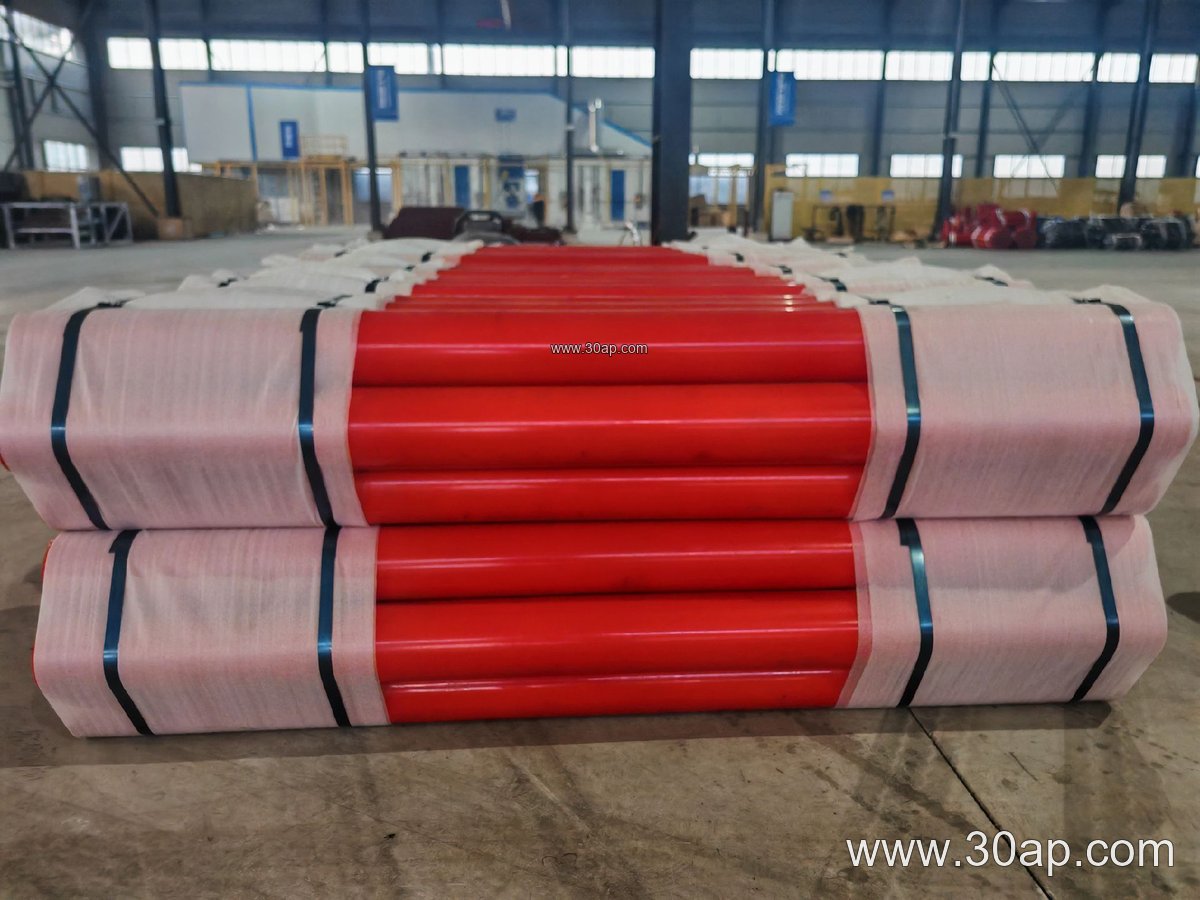
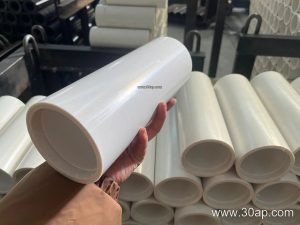
Common roller diameters for this duty include Ø89, Ø108, Ø127, Ø133, Ø159 and Ø178 mm, with larger sizes used where lumps are heavy. Bearings such as 6205, 6305, 6306 or 6308 appear in many designs, but bearing selection should follow the actual load calculation rather than a fixed rule. Roll face options include rubber rings, rubber sleeves and, for lighter shock, nylon or ceramic-faced variants; steel tube shells remain the structural base.
Frames, Angles and Belt Width
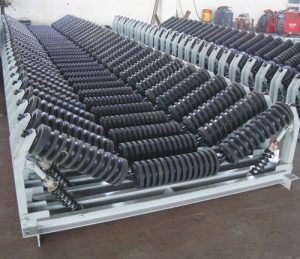
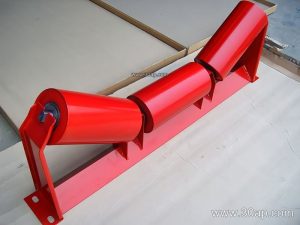
Cushioning sets are usually supplied as two-roll or three-roll troughing assemblies, and sometimes as single rolls under narrow belts. Trough angles of 20, 30, 35 and 45 degrees are typical, with 35 degrees common on bulk handling lines. Roll length changes with belt width and trough angle; for a three-roll troughing set, approximate roll lengths of 200 mm at B500, 250 mm at B650, 315 mm at B800, 380 mm at B1000, 465 mm at B1200, 530 mm at B1400 and 600 mm at B1600 are often quoted as examples, though side rolls and centre rolls can differ and final dimensions are set by design.
| Reference item | Typical range |
|---|---|
| Roller diameter | Ø89 to Ø178 mm (larger where needed) |
| Belt width | B500 to B1800 mm and beyond |
| Trough angle | 20°, 30°, 35°, 45° |
| Roll surface | Rubber rings, rubber sleeve, nylon, ceramic |
| Bearing examples | 6205, 6305, 6306, 6308 |
| Assembly form | Single roll, two-roll, three-roll troughing |
These figures are reference data, not a universal match table. A wide belt does not automatically fix a shaft diameter, and one belt width can be served by more than one pulley or roller size depending on load and trough geometry.
Where It Fits on the Conveyor
The cushioning set sits in the carrying run at the transfer chute, often with a short transition to standard troughing idlers on either side. Downstream, the belt may pass over a conveyor pulley at the head end, return through V-type or flat return idlers, and run past a conveyor bracket every few metres. Skirted conveyor belts and corrugated sidewall conveyor belts are frequently used at the same transfer points, and the cushioning rollers must be positioned so the skirt rubber or sidewall clears the roll ends.
In a copper ore or iron ore concentrator, a steel cord conveyor belt may carry the main load while a fabric core belt handles the shorter transfer conveyors; both benefit from impact absorption where the ore drops. In a sand and gravel pit, an EP conveyor belt or NN conveyor belt on the primary feed often sees the worst shock, and a cushioning set there protects the splice zone as well as the cover.
Buyer Checklist
- Confirm lump size, drop height and throughput at the load point; these drive roll diameter and ring hardness.
- Match the assembly to belt width and trough angle, and check that the roll ends clear skirt rubber or sidewalls.
- Ask about seal design and bearing grade, since fines ingress is the usual cause of premature seizure.
- Check mounting dimensions against the existing conveyor bracket and frame spacing before ordering.
- Consider a short transition of standard troughing idlers after the cushioning zone to avoid a step in belt support.
- Keep spare rubber rings or sleeves on site; replacing rings is faster than changing a complete roller.
For related equipment, buyers often review the conveyor belt specification, the conveyor pulley at the drive and tail, and the idler roller layout together, since load-zone performance depends on how all three interact. Further details on impact idler sizes and matching conveyor components are available at www.example.com/impact-idler and www.example.com/conveyor-roller.