What a Heavy-Duty Ceramic Lagged Pulley Is
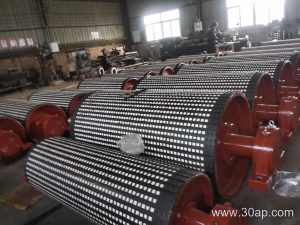
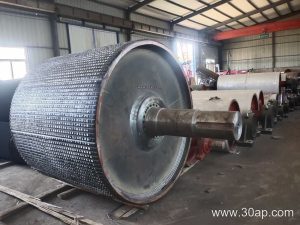
A heavy-duty ceramic lagged pulley is a conveyor pulley whose shell is covered with ceramic tiles set in a tough rubber or polymer backing. The ceramic studs sit slightly proud of the backing, so the belt grips on many small, hard contact points instead of one smooth rubber surface. This makes it a practical choice wherever the drive pulley has to transmit high torque while the belt is wet, dusty or carrying abrasive material. In a stone crushing line or a cement plant clinker circuit, that combination is common.
The product is also called a ceramic lagged conveyor pulley or ceramic-covered drum pulley. These are simply other names for the same item. It is normally a drive pulley, though the same lagging can appear on a tail or bend position when slip and wear justify it. Drive, tail and bend pulleys serve different duties and should not be treated as interchangeable.
How the Ceramic Surface Is Built
The pulley body is usually a welded steel shell with end discs and a shaft, machined so the lagging sits true. The covering is applied in one of two main ways: tiles bonded into a rubber sheet that is then vulcanised or cold-bonded to the shell, or tiles set directly into a castable polymer layer. Tile shape matters. Square, rectangular and hexagonal ceramics are all used, and some designs leave small channels between tiles so water and fines can escape rather than forming a slippery film.
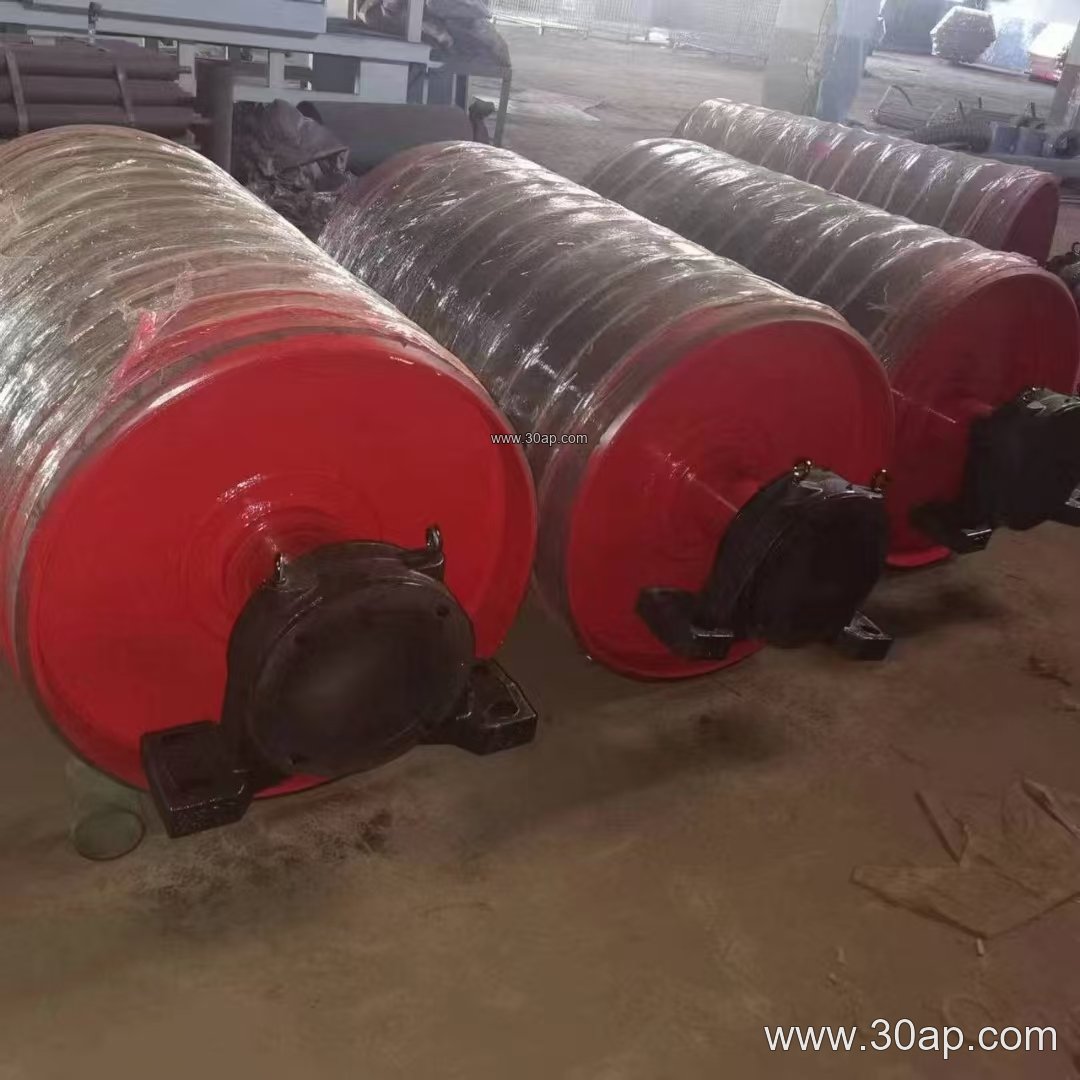
Typical lagging thicknesses are 8, 10, 12, 15 and 20 mm, with the ceramic layer usually a fraction of that total. Thicker lagging suits larger diameters and heavier belt tension. The shell width normally exceeds the belt width so the belt is fully supported across its face. Common combinations include B800 x Ø500, B1200 x Ø1000 and B1400 x Ø800, but belt width does not fix one diameter; the diameter follows shaft load, wrap angle and belt tension, and shaft size is set by torque rather than by belt width alone.
Where It Earns Its Place
The strongest case for ceramic lagging is a drive point on a conveyor that runs in the open or in a damp, gritty environment. A quarry conveyor belt carrying wet stone, a coal mining conveyor belt in a wash plant, or a power plant coal conveyor after a dust suppression spray are all situations where plain rubber can polish and lose grip. The ceramic studs keep biting into the belt cover and resist the polishing that rubber suffers over time.
The same logic applies on a heavy-duty mining conveyor belt in an iron ore or copper ore circuit, where the belt may be a steel cord conveyor belt carrying large tonnage. Here the drive pulley is often large, perhaps Ø1250 or Ø1400, and the ceramic surface helps transfer power without excessive belt tension. In a sand and aggregate plant, a ceramic lagged pulley on the head drive can outlast several rubber-lagged replacements, though it should be matched to the belt cover so the ceramic does not chew a soft belt surface.
Matching the Pulley to the Belt and the Duty
Ceramic lagging is aggressive. It works best with abrasion resistant conveyor belt covers of reasonable hardness and thickness. On a thin or very soft cover, the studs may wear the belt faster than they help. Buyers should state the belt type, whether it is an EP conveyor belt, an NN conveyor belt, a multi-ply fabric core belt or a steel cord belt, plus the belt width, pulley diameter, shaft size and expected wrap angle.
Application also decides the subtype. A drive or head pulley needs the highest friction coefficient. A tail pulley with a screw take-up may need ceramic only if the belt is wet and the take-up travel is limited. A bend pulley usually needs less grip and a smoother face. A snub or pressure pulley rarely needs ceramic at all, since it is not transmitting torque.
Buyer Checklist
- Confirm the pulley role: drive, tail, bend, take-up or snub, since the duty differs.
- Give belt width, pulley face width and diameter as a set, not as isolated figures.
- State the conveyor belt construction and cover grade so lagging hardness can be matched.
- Ask about tile pattern, tile height and bonding method, not just lagging thickness.
- Check shaft diameter and bearing size against actual torque and load.
- Plan inspection intervals; ceramic tiles can chip if the belt has a splice fault or trapped debris.
Ceramic lagging is not a universal upgrade. It is a targeted fix for slip, wear and wet conditions at a pulley that has to grip. Used on the right duty with the right belt, it protects both the pulley and the conveyor belt; on the wrong duty it simply adds cost and belt wear. For more conveyor pulley and belt information, see https://www.jsmsconveyor.com/conveyor-pulley and https://www.jsmsconveyor.com/heavy-duty-conveyor-belt.