What a Q235 Conveyor Bracket Does
A Q235 conveyor bracket is the steel frame that holds the idler roller in position under or beside a conveyor belt. In a quarry, a cement plant, or a power plant coal yard, the belt may run hundreds of meters, and every roller needs a stable seat. The bracket provides that seat, sets the trough angle of the carrying idlers, and keeps the roller axis square to the belt line. Because Q235 is a common structural carbon steel, the bracket is easy to form, weld, and drill, which keeps fabrication straightforward for conveyor makers and maintenance workshops.
The same part is often called a Q235 belt conveyor bracket or a Q235 idler support frame. Those names describe the same product; they are not different equipment categories. The bracket supports idlers, while the conveyor pulley drives or redirects the belt elsewhere on the machine.
How the Bracket Is Built
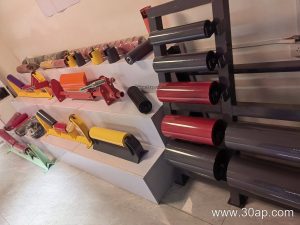
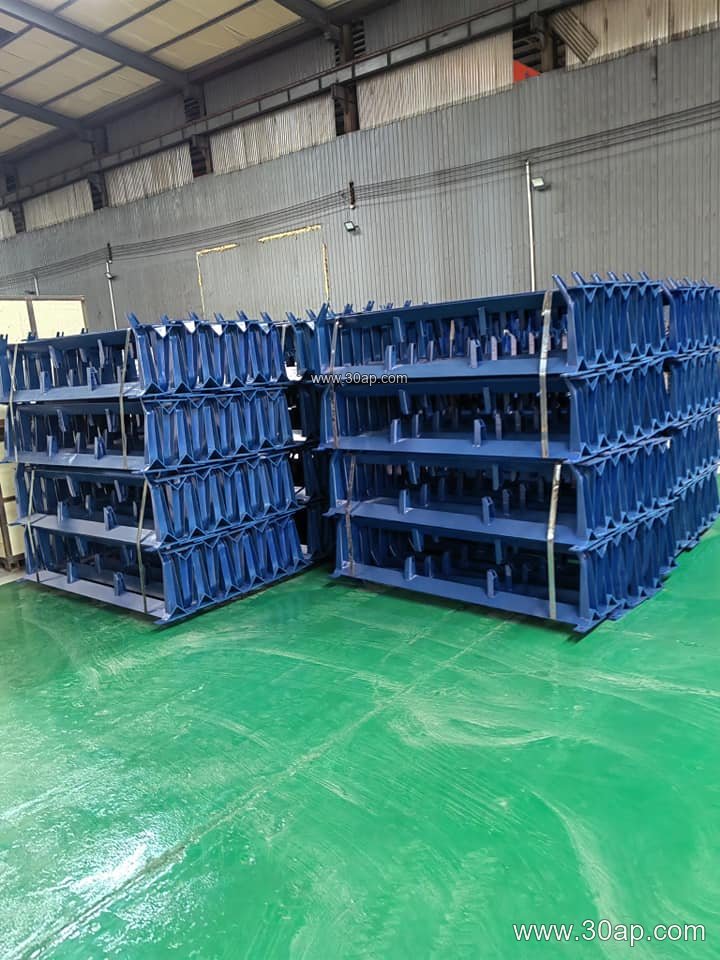
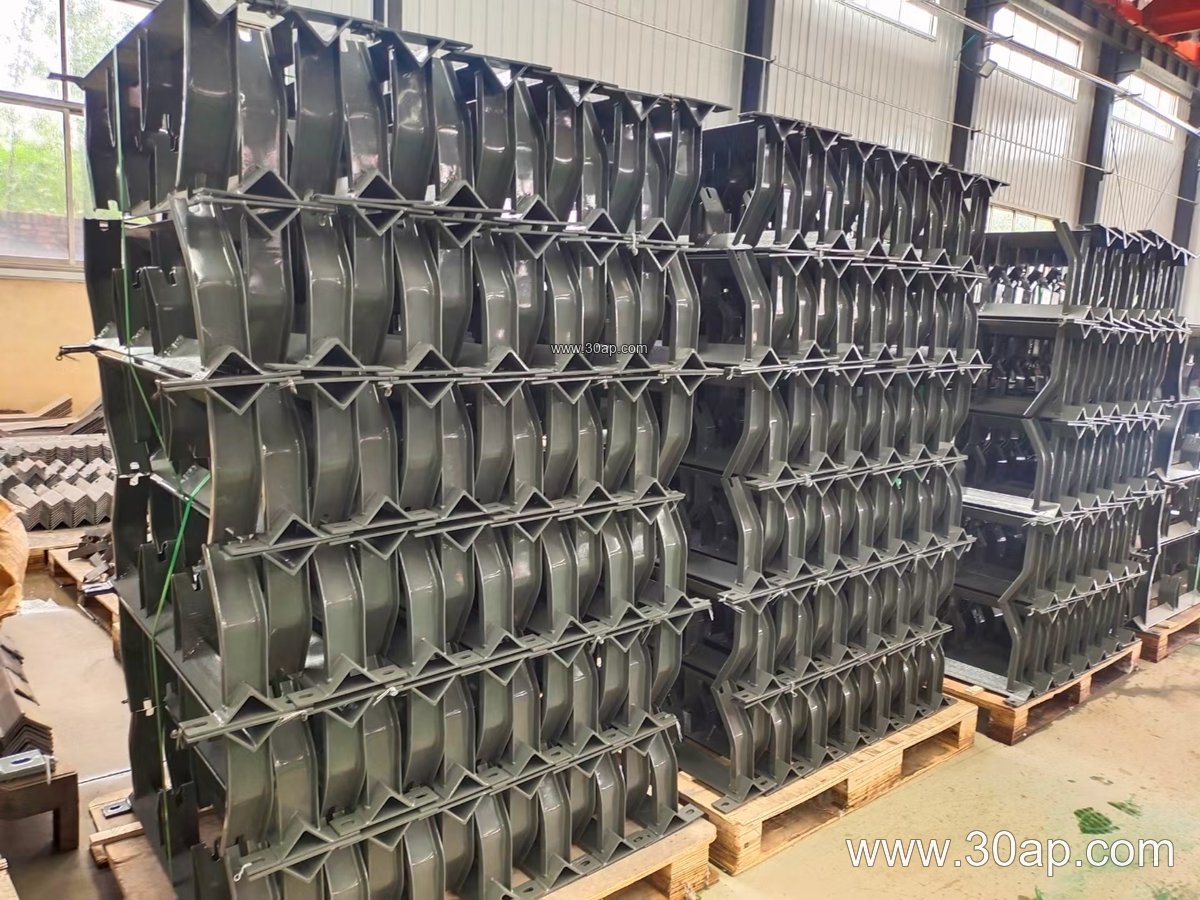
Most Q235 conveyor brackets are made from angle steel, channel steel, or bent steel plate. A carrying bracket usually has two inclined arms that position the side rollers and a center roller, forming a trough. A return bracket is flatter and holds the lower rollers that support the empty belt. Fabricators cut, punch, and weld the pieces, then apply paint or another coating for corrosion protection.
- Angle steel brackets suit lighter frames and simple bolted assemblies.
- Channel steel brackets give stiffness on wider belts and heavy loads.
- Bent plate brackets reduce welding and can form smooth transitions.
Installation hole spacing and crossbeam length usually change with belt width and trough angle, so they are confirmed by design rather than treated as a single fixed number. A bracket for B800 is not the same as one for B1600, even when both use the same steel grade.
Common Types and Where They Sit
The carrying bracket, or upper trough bracket, sits on the load side and sets the trough shape. A transition bracket is placed near a conveyor pulley to guide the belt gradually from flat to troughed. Return brackets and V-return brackets support the belt on its way back. Impact brackets are used below a loading point, and self-aligning brackets help correct belt drift. Adjustable brackets let maintenance staff change the trough angle between common settings such as 20, 30, 35, and 45 degrees.
For comparison, a forward-leaning bracket tilts the idlers by roughly 1.5 to 2 degrees to help center the belt. That is a different function from a bend pulley, which changes belt direction. Each subtype has its own place, and none should be swapped for another without checking the conveyor design.
Matching Brackets to Belt and Roller Size
Belt width, trough angle, and roller diameter are chosen together. The table below shows common reference combinations; actual selection depends on load, speed, and frame design.
| Belt width | Common trough angle | Common roller diameter | Typical use |
|---|---|---|---|
| B500 | 20° or 30° | Ø89 | Small aggregate or sand lines |
| B650 | 30° | Ø89 or Ø108 | Crushing and screening plants |
| B800 | 35° | Ø108 | Coal handling, cement raw material |
| B1000 | 35° or 45° | Ø108 or Ø133 | Iron ore and power plant coal lines |
| B1200 | 35° or 45° | Ø133 | Heavy bulk material transport |
| B1400 | 45° | Ø133 or Ø159 | Large quarry and port conveyors |
| B1600 | 45° | Ø159 | High-capacity mining duty |
| B1800 to B2200 | 35° to 45° | Ø159 or Ø194 | Wide belt systems |
No single belt width forces one trough angle or one roller diameter. A B1200 conveyor may use 35 degrees with Ø133 rollers in one plant and 45 degrees with the same roller size in another. Bracket height and hole positions follow the final combination.
On the belt side, the choice of cover and carcass also matters. A rubber conveyor belt, an EP conveyor belt, or a steel cord conveyor belt each has different stiffness and tracking behavior, which affects how the bracket and idlers should be aligned. In a coal mine, a flame retardant conveyor belt is often specified, and the bracket frame must still hold the rollers firmly under continuous load.
Buyer Checklist
Before ordering Q235 conveyor brackets, confirm the belt width, trough angle, roller diameter, mounting hole pattern, and frame material. Ask whether the bracket is fixed or adjustable, and whether it is for carrying, return, impact, or transition duty. Check the coating or paint system for the site conditions, especially in wet or dusty plants. For a coke plant or a cement kiln area, heat and dust may call for heavier sections and careful roller spacing.
At www.cndctop.com, buyers often compare bracket drawings with the idler roller and conveyor pulley layout before placing an order. A simple cross-check of belt line, bracket center height, and roller shaft ends prevents most installation problems. Keep spare brackets for the loading zone, where impact and wear are highest, and inspect welds and bolt holes during scheduled shutdowns.