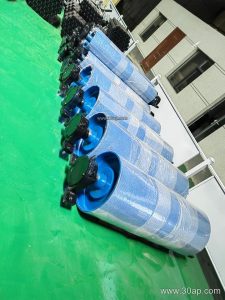
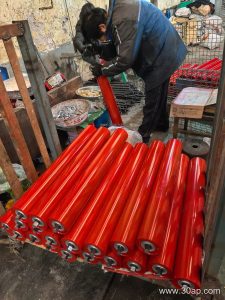
What the Loading Point Impact Idler Does
Where a conveyor belt first receives material, the belt takes a beating. A loading point impact idler is the support roller installed directly beneath that receiving zone to absorb the drop energy and keep the belt from sagging into the frame. In practice this component is often called an impact roller or buffer idler, and it belongs to the same family as the cushion rollers used at transfer chutes. Its job is narrow but critical: soften the landing, protect the carcass, and keep the belt tracking straight as the load settles.
The difference from a standard carrying idler is not cosmetic. A troughing idler is built to support a steady load; an impact idler is built to survive repeated shock. In a quarry, a limestone mine or a crusher discharge, the falling rock can carry far more energy than the steady stream that follows, so the roller under the chute needs a compliant surface and a stiffer bearing arrangement.
How the Roller Is Built
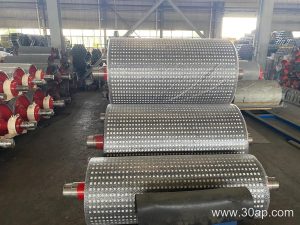
Most designs start with a steel tube shell, then add a shock-absorbing layer. Common surface forms include rubber rings, rubber discs or a continuous rubber sleeve, and some plants use nylon or ceramic-faced rollers where abrasion is severe and impact is moderate. The rubber rings are usually spaced along the shell so the belt is supported at several points rather than one hard line.
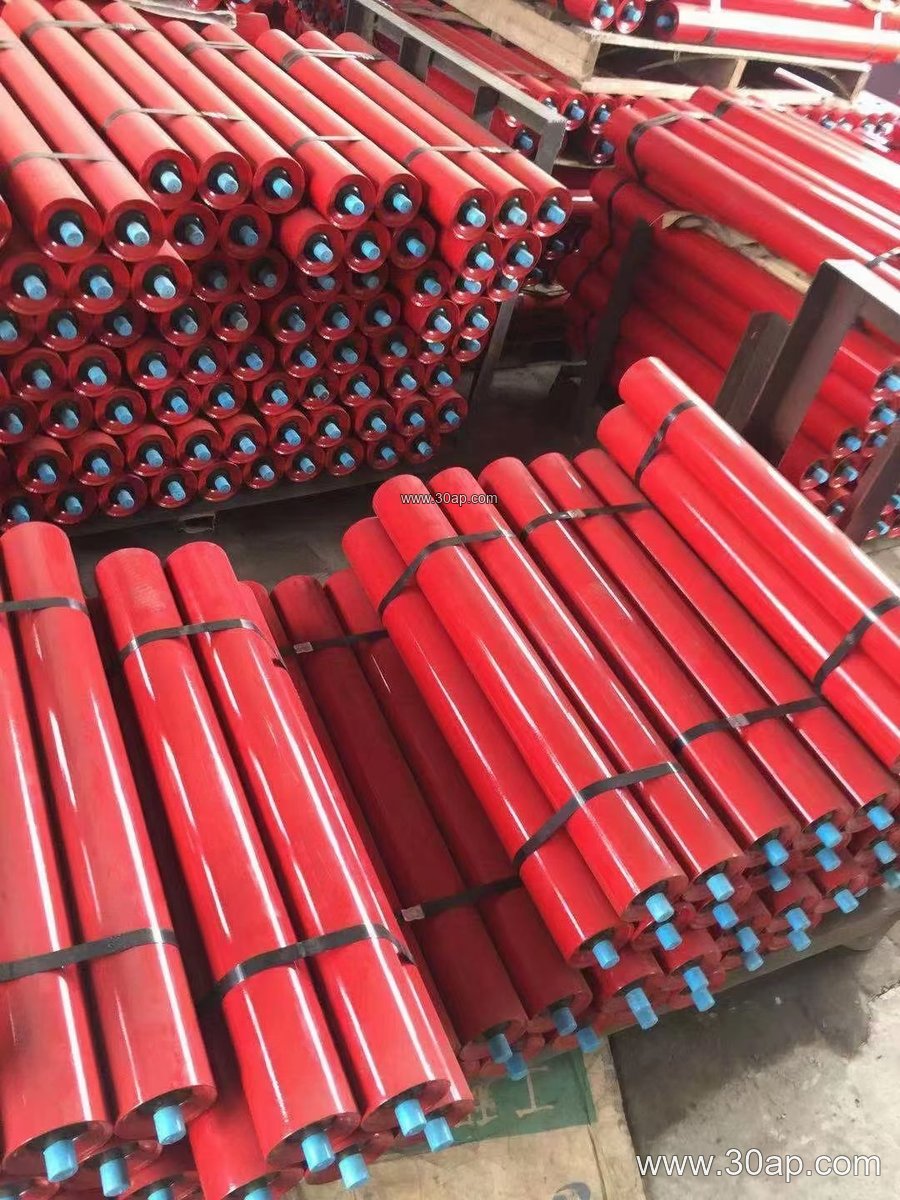
The bearing housing is generally heavier than a standard roller, and the seal is chosen to keep dust out. Typical bearing sizes in this range include 6205, 6305, 6306 and 6308, matched to the shaft and load rather than to belt width alone. A fixed shaft diameter cannot be inferred from belt width; the frame, the idler group and the duty all affect the choice.
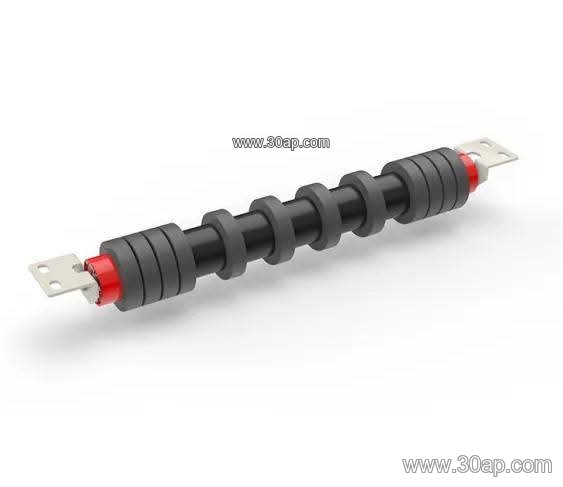
Common construction features
- Steel tube shell with rubber rings or a rubber sleeve
- Reinforced end caps and bearing seats for shock loads
- Labyrinth or multi-stage seals for dusty transfer points
- Mounting dimensions matched to the conveyor bracket and frame
Where It Fits on the Conveyor
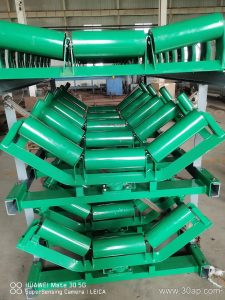
The impact idler sits in the carrying run, usually in a three-roll troughing group, immediately under the chute or hopper. The side rollers and centre roller may all be impact type, or only the centre roll may be cushioned while the wing rolls stay standard. This is a design choice, not a rule.
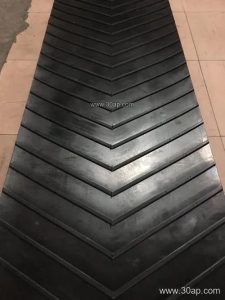
Applications are concentrated where material falls from height. In a coal handling plant, a cement plant or a power plant coal yard, the transfer tower is a typical location. In sand and gravel lines, the area below the primary crusher is another. Ports and ship loading systems also use cushion rollers where the belt receives bulk material from a hopper. The belt itself may be an abrasion resistant conveyor belt, a flame retardant conveyor belt for coal, or a heat resistant conveyor belt near hot clinker; the idler choice follows the belt and the load, not the other way round.
Matching the Idler to Belt Width and Trough Angle
Roller length follows belt width, trough angle and the idler group form. For a three-roll troughing set, common roller lengths are roughly 200 mm for B500, 250 mm for B650, 315 mm for B800, 380 mm for B1000, 465 mm for B1200, 530 mm for B1400, 600 mm for B1600, 670 mm for B1800 and 750 mm for B2000. These are examples only; centre and side rolls can differ, and the final length is set by the frame design.
Diameter is selected from the load and the available space. Common impact idler diameters include Ø76, Ø89, Ø102, Ø108, Ø127, Ø133, Ø159 and Ø178 mm. Trough angles of 20, 30, 35 and 45 degrees are all used, and the angle affects how the load sits and how much the belt is pinched at the edges. A 35 degree trough is common in bulk handling, but a wider belt on a high-tonnage line may use a different angle by design.
| Parameter | Common reference values |
|---|---|
| Roller diameter | Ø76, Ø89, Ø102, Ø108, Ø127, Ø133, Ø159, Ø178 mm |
| Belt width | B500 to B2000 mm, with wider belts by design |
| Trough angle | 20, 30, 35, 45 degrees |
| Bearing sizes | 6205, 6305, 6306, 6308 and similar |
| Surface form | Rubber rings, rubber sleeve, nylon, ceramic |
What a Buyer Should Check
First, confirm the drop height and the lump size at the transfer point. A high drop with large lumps calls for a more compliant roller and possibly a impact bed or cushion bars under the chute. Second, check the idler group: a three-roll troughing set with impact rolls on all three positions behaves differently from one with a single cushioned centre roll.
Third, look at the belt. A heavy-duty mining conveyor belt or a steel cord conveyor belt can tolerate more point load than a thin fabric core belt, but neither should be asked to absorb the full drop energy alone. Fourth, confirm the mounting dimensions against the conveyor bracket and frame, and check that the seal suits the dust level. Fifth, ask for the bearing size and shaft details rather than assuming them from belt width.
Finally, consider maintenance access. Impact rollers at a transfer point are among the first components to wear, so a design that allows replacement without dismantling the chute saves downtime. Spare rings or sleeves are often more economical than replacing the whole roller, provided the shell and bearings remain sound.
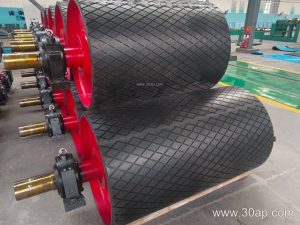
For related conveyor components, buyers often review the conveyor belt, idler roller and conveyor pulley together as one system, because the loading zone performance depends on all three working as a set.