What a Port Conveyor Idler Does
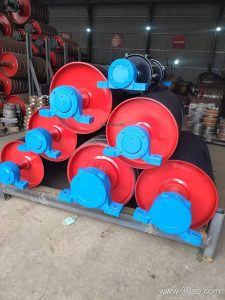
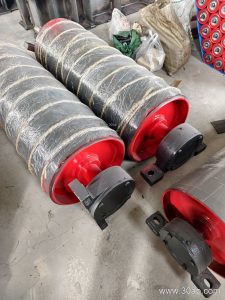
A port conveyor idler is the rotating support that carries the conveyor belt along a ship loading or bulk handling line. In a port, the conveyor often runs a long distance from the stockyard to the berth, and the idler roller must keep the belt stable while salt air, fine dust and heavy tonnage work against the components. The idler is not a pulley: a conveyor pulley drives, tails or bends the belt, while the idler simply supports it. Drive, tail and bend pulleys are separate parts and are not interchangeable with idlers or with each other.
Because port terminals handle a wide mix of cargo, the idler selection follows the belt and the material rather than a single fixed rule. A line carrying iron ore or copper ore concentrate behaves differently from one moving grain, fertilizer or cement clinker.
Construction and Common Forms
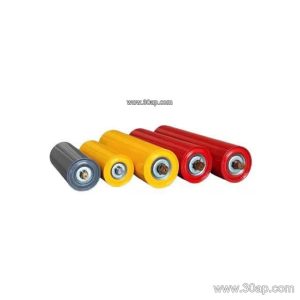
A typical port conveyor idler uses a steel tube shell, a shaft, bearing housings and a sealing arrangement. The shell may be plain steel, nylon coated, ceramic lined or fitted with rubber rings, depending on whether wear, build-up or impact is the main concern. Bearing sizes such as 6204, 6205, 6305, 6306, 6308 and 6310 appear across the range, and the correct bearing is matched to the load and speed by the designer rather than by roller diameter alone.
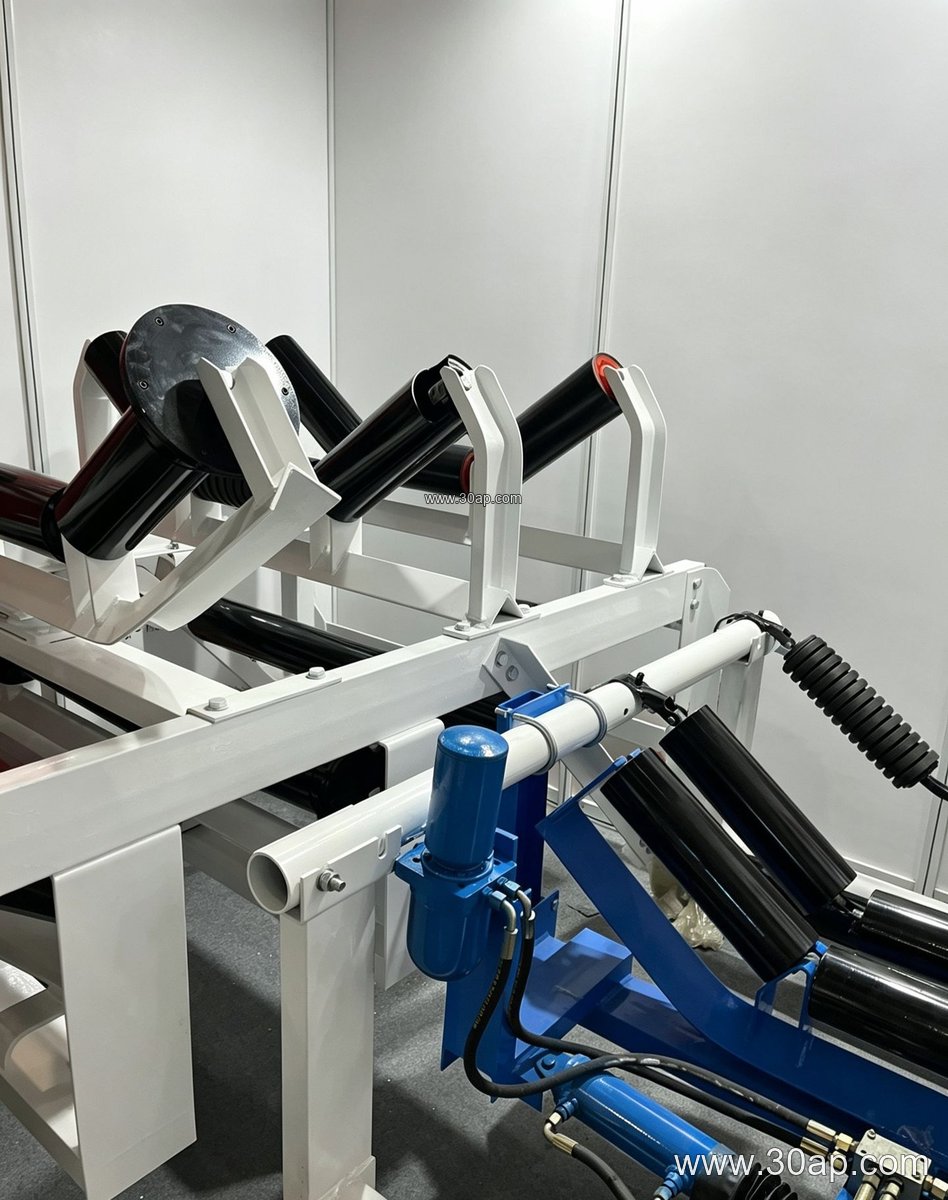
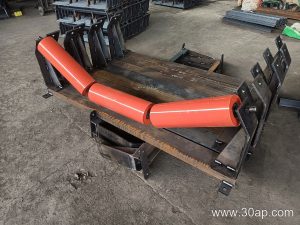
Troughing sets are usually built as single-roll, two-roll or three-roll arrangements. Three-roll troughing is common on high-capacity berth lines, with trough angles of 20, 30, 35 or 45 degrees. A small forward tilt of about 1.5 to 2 degrees is sometimes used on training idlers to help centre the belt.
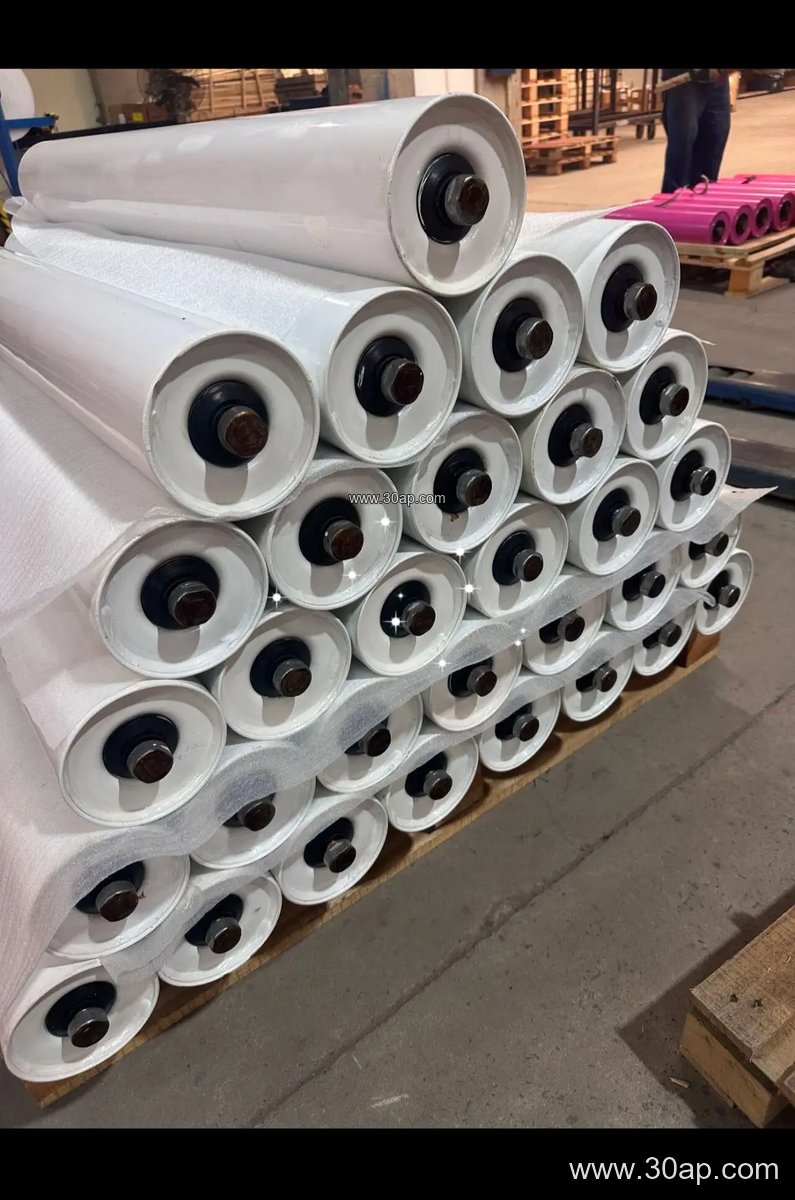
Idler Types Seen on Port Lines
- Troughing idlers on the carrying side, often three-roll
- Transition idlers where the belt changes angle near a pulley
- Flat or V-return idlers on the return strand
- Impact idlers with rubber rings under the loading chute
- Self-aligning idlers, including friction and tapered types, on long runs
- Spiral idlers where sticky material tends to cling
Roller Diameter, Belt Width and Roll Length
Roller diameter is chosen from belt width, belt speed, load and the space available. Common diameters include Ø63, Ø76, Ø89, Ø102, Ø108, Ø127, Ø133, Ø159, Ø178, Ø194 and Ø219 mm. Wider belts generally need larger rollers and heavier bearings, but one belt width does not lock the design to one roller diameter. A B1000 belt, for example, may use different roller sizes on different sections of the same terminal.
Roll length follows belt width, trough angle and the idler arrangement. For three-roll troughing, common reference lengths are roughly 200 mm at B500, 250 mm at B650, 315 mm at B800, 380 mm at B1000, 465 mm at B1200, 530 mm at B1400, 600 mm at B1600, 670 mm at B1800 and 750 mm at B2000. These are examples only; side rolls and centre rolls can differ, and the final length is set by design.
| Reference Item | Common Range | Note |
|---|---|---|
| Roller diameter | Ø63 to Ø219 mm | Selected by load, speed and belt width |
| Belt width | B400 to B2400 | Port lines often run B1200 to B2000 |
| Trough angle | 20, 30, 35, 45 degrees | Higher angle suits higher capacity |
| Bearing | 6204 to 6310 | Matched to duty, not to one roller size |
| Shell surface | Steel, nylon, ceramic, rubber ring | Chosen for wear or build-up |
Where Port Idlers Are Used
Ship loading conveyors, stockyard reclaim lines and train unloading systems all rely on idlers. The same components appear in a power plant coal yard, a cement plant clinker line and a steel plant raw material yard, but the port environment adds salt and humidity. Sealing quality therefore matters as much as shell thickness. A worn idler roller can damage the belt edge and increase power draw, so inspection is part of routine terminal maintenance.
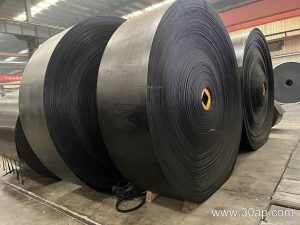
The belt itself sets part of the duty. A heavy-duty mining conveyor belt or a steel cord conveyor belt used on a long berth line transfers high tension, and the idler spacing must suit the sag limit. Where cargo is abrasive, an abrasion resistant conveyor belt reduces wear, but dust still enters the bearing area. For coal and other combustible cargo, a flame retardant conveyor belt is often specified, and the idler must run freely to avoid heat build-up from a seized roller.
Buyer Checklist
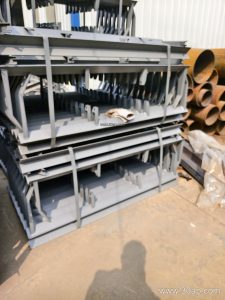
Before ordering, confirm belt width, belt speed, material type, trough angle, roll length, shaft end fixing and the conveyor bracket dimensions. Ask whether the line needs impact idlers under the chute and self-aligning idlers on the long straight sections. Specify the shell surface and sealing level for the local climate. For a port project, it is also worth checking how the idler fits the existing conveyor bracket and whether spare rollers can be swapped without special tools.
For related components, buyers often review the conveyor belt, conveyor pulley and conveyor bracket together with the idler roller, since a mismatch at any point shows up as belt misalignment. More details on idler and belt matching can be found at www.cndongfang.com for port conveyor idler planning.