What a Four-Roll Idler Bracket Does
A four-roll idler bracket is the support frame that carries four idler rollers under the loaded side of a conveyor belt. Instead of the familiar three-roll trough, this bracket spreads the belt across four contact points, which gives the belt a wider, gentler trough profile. In quarry lines, limestone mines and cement plants, the arrangement is often chosen where belt widths and lump sizes put extra stress on the belt edge and on the roller bearings. The bracket itself is a fabricated steel part, so its job is simple but demanding: hold the rollers at the right angles, keep them square to the belt path, and transfer the load into the conveyor stringer.
How the Bracket Is Built
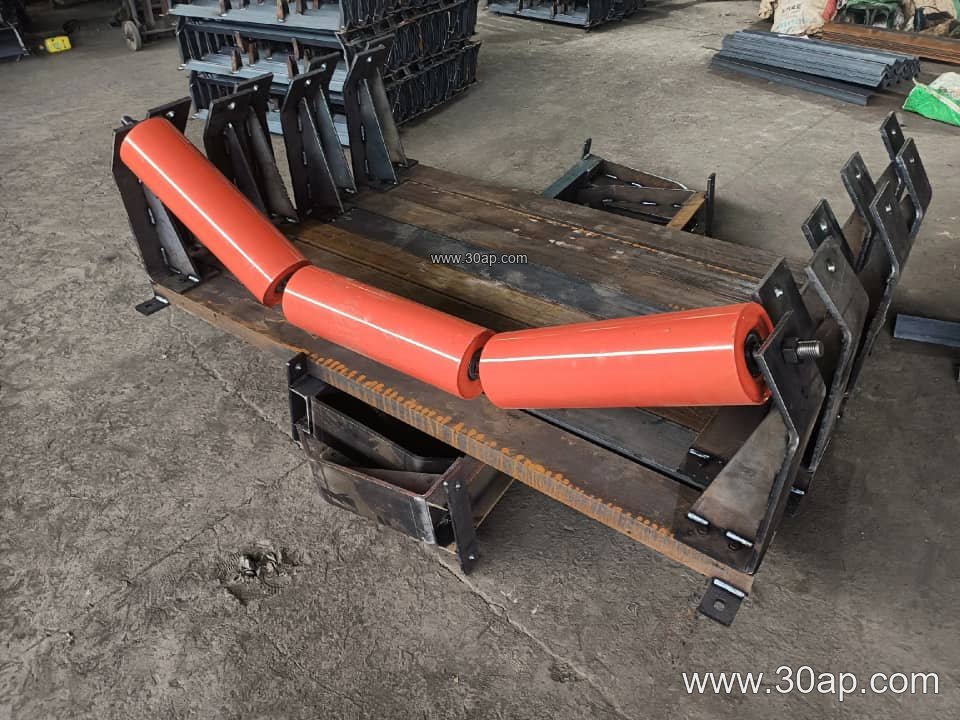
Most four-roll idler brackets are made from angle steel, channel steel or folded steel plate. The two outer arms are set at a steeper angle, while the two inner rolls sit flatter near the centre of the belt. Common trough angles for this family are 20, 30, 35 and 45 degrees, and the outer and inner rolls may use different angles within one bracket. Roller diameters usually follow the conveyor design, with common sizes such as Ø89, Ø108, Ø133, Ø159 and Ø194 mm. The bracket is drilled for mounting to the stringer, and the hole spacing and crossbeam length change with belt width and trough angle rather than staying fixed.
Common reference combinations
The values below are reference examples only. Final dimensions are determined by the conveyor design and the roller supplier.
- B650 with 30 degree trough and Ø89 rollers
- B800 with 35 degree trough and Ø108 rollers
- B1200 with 45 degree trough and Ø133 rollers
- B1400 with 35 degree trough and Ø159 rollers
- B1800 with 45 degree trough and Ø194 rollers
Where It Fits on the Conveyor
The four-roll bracket belongs on the carrying side, usually in the transition zone after the tail pulley or on long spans where belt sag and material spill need tighter control. In a coal handling system at a power plant, or in a sintering plant feeding a blast furnace, the wider support pattern can reduce edge stress on a heavy-duty mining conveyor belt. It also pairs well with impact-resistant conveyor belt in the loading area, where lumps drop onto the belt and the bracket must absorb repeated shock without losing alignment.
It is not a replacement for a bend pulley, a drive pulley or a tail pulley. Those are separate components in the conveyor drive and return system. The four-roll bracket is strictly a roller support, and it works together with the idler roller, the conveyor bracket set and the belt itself. On the return side, a V-return bracket or a flat return bracket is normally used instead.
Installation and Adjustment Points
Alignment matters more than many buyers expect. A four-roll bracket that is twisted or mounted out of square will steer the belt and wear one edge. During installation, check that the bracket centreline is perpendicular to the belt path, that all four rollers turn freely, and that the trough angle matches the drawing. Adjustable brackets allow the angle to be set on site within the design range, which helps where belt tracking needs fine tuning. Fixed brackets are simpler and stiffer, and they suit lines where the profile is already settled.
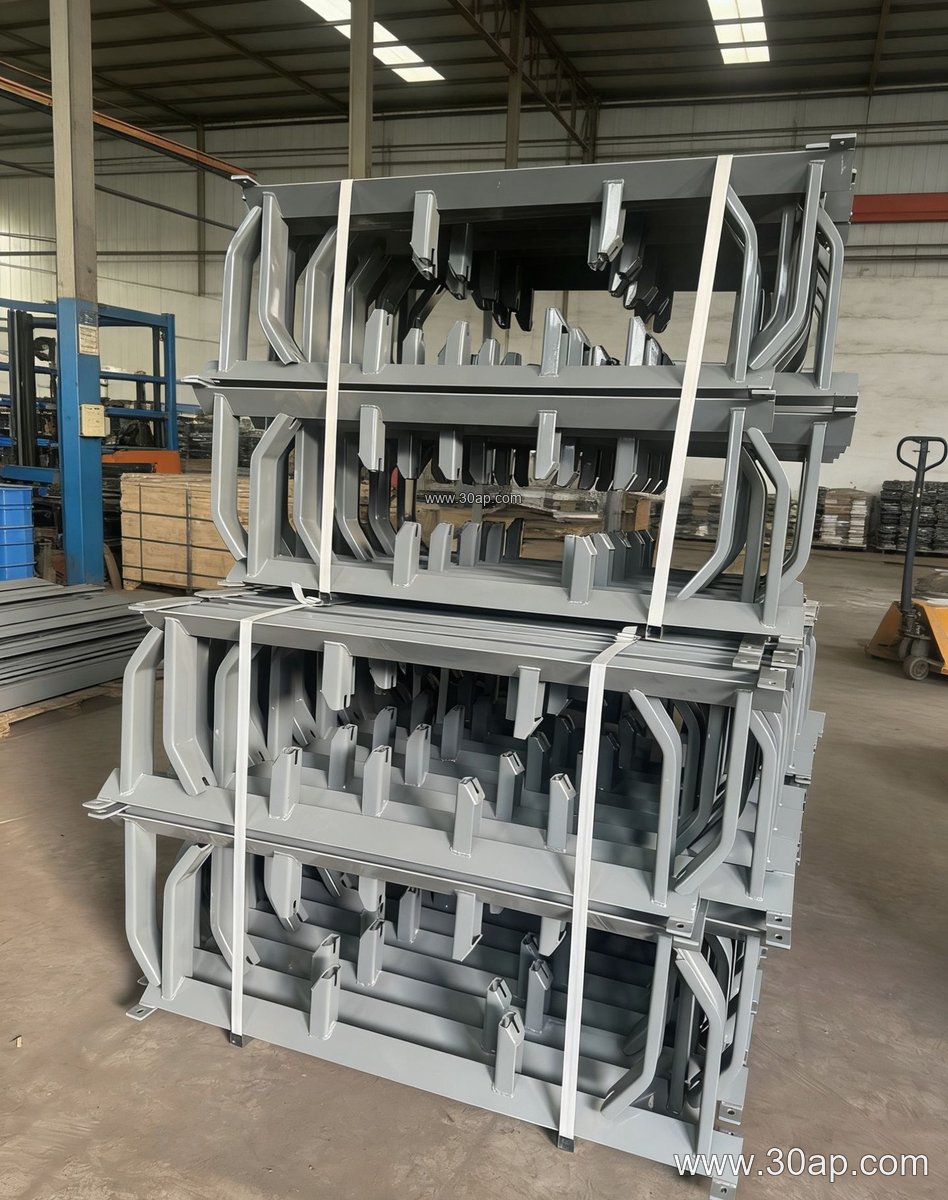
For a belt such as an EP conveyor belt or a steel cord conveyor belt running at high tension, the bracket should be matched to the stringer spacing and to the roller load rating. Do not assume that one belt width locks in one roller diameter; the same width may use different roller sizes depending on load, speed and belt stiffness.
What Buyers Should Check Before Ordering
Start with the belt width, the required trough angle and the roller diameter, then confirm the mounting hole pattern and the crossbeam length against the existing stringer. Ask for the material thickness and the surface treatment, since dusty sites such as a stone crushing line or a bauxite yard will punish thin, poorly coated frames. Confirm whether the bracket is fixed or adjustable, and whether it is designed for a specific roller fixing method. On a fabric core conveyor belt line, a lighter bracket may be enough, while a heavy-duty mining conveyor belt on an ore conveyor belt duty usually needs a stronger frame.
Finally, keep spare brackets and rollers on hand for the loading zone, because that is where most bracket damage begins. A four-roll idler bracket is a small item in the conveyor budget, but it controls belt shape, belt life and spillage over years of service.