What a Self-Aligning Idler Does on a Conveyor
A self-aligning idler is a training idler designed to keep a conveyor belt centered on its path. When a belt begins to drift toward one side, the self-aligning idler responds by pivoting or angling slightly, which produces a gentle steering effect that nudges the belt back toward the centerline. This makes it a practical choice for long overland conveyors, stockyard lines, and transfer points where misalignment can cause edge damage, spillage, and uneven wear. In a quarry, a cement plant, or a coal handling system, a few well-placed self-aligning idlers can reduce downtime caused by belt wandering and improve the service life of the conveyor belt itself.
The product is also known as a self-aligning training idler or self-tracking idler. It should not be confused with a drive pulley, tail pulley, or bend pulley, which are different components with different functions. The self-aligning idler is a rotating roller assembly that supports the belt and corrects its lateral position.
How the Assembly Is Built
A typical self-aligning idler consists of a frame that pivots around a vertical axis, one or more rollers mounted in bearings, and a linkage or friction mechanism that senses belt misalignment. When the belt contacts the roller at an angle, the resulting friction turns the frame slightly. This small rotation changes the direction of the roller relative to the belt, creating a corrective force.
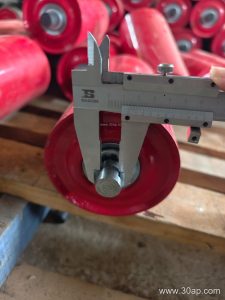
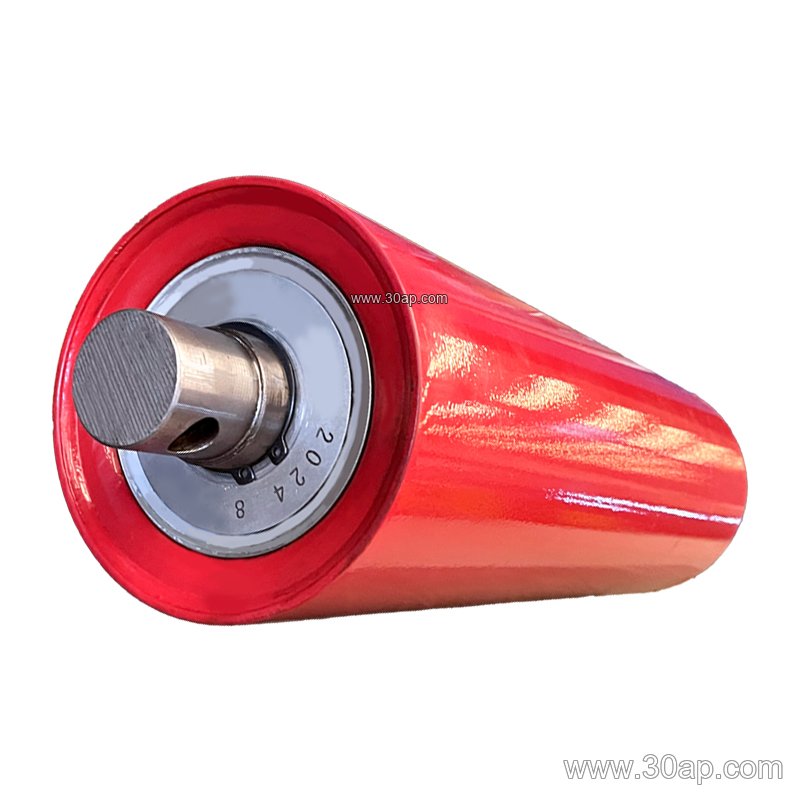
Common designs include friction self-aligning idlers, conical self-aligning idlers, and center-pivot training idlers. Roller diameters often follow the same range as standard carrying idlers, for example Ø89, Ø108, Ø127, Ø133, Ø159, or Ø178, depending on belt width and load. Bearings such as 6204, 6205, 6305, 6306, 6308, or 6310 may be used, but the bearing choice should match the roller diameter and duty cycle rather than being fixed to one size.
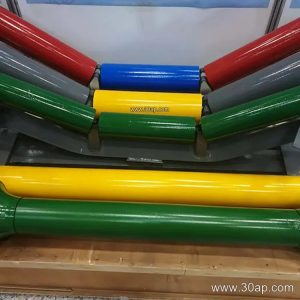
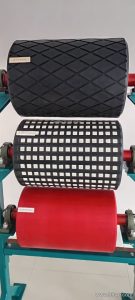
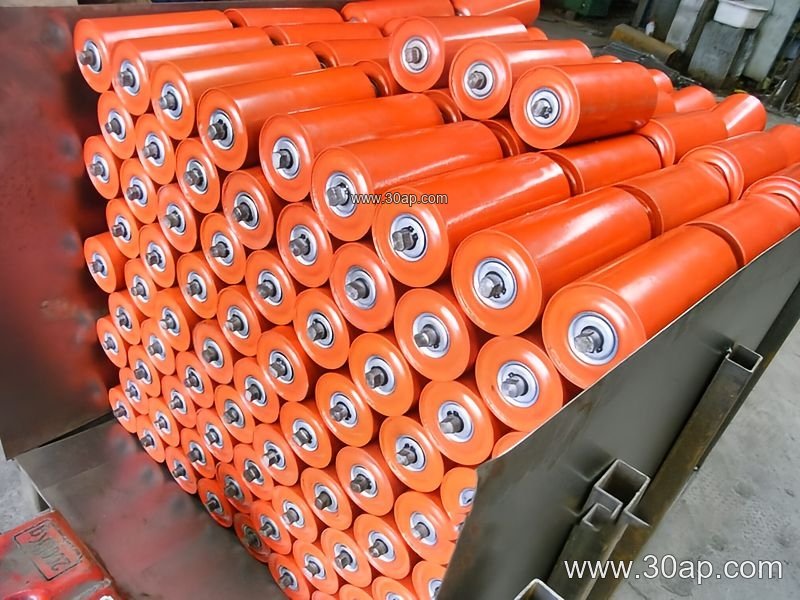
Roller surfaces can be steel tube, nylon, ceramic, or rubber rings. Rubber rings are sometimes used on the training roller to improve grip on the belt edge without excessive wear. The frame is usually made of welded steel and may include a conveyor bracket for mounting to the conveyor stringer. The assembly should be installed square to the belt line with adequate clearance for pivoting.
Where It Fits in a Conveying System
Self-aligning idlers are commonly installed on the carrying side at intervals along the conveyor, especially after curves, at transfer points, and before the tail pulley. They are also used on the return side in some designs. They are not a replacement for a bend pulley or a tail pulley; those pulleys change belt direction and provide tension, while the self-aligning idler only corrects tracking.
Typical applications include limestone quarries, iron ore and copper ore handling, coal preparation plants, cement plants, power plant coal conveying, port ship loading, and aggregate crushing and screening lines. In these settings, the belt may carry abrasive rock, wet ore, or dusty bulk material, so the idler must be selected for the environment. For example, a dusty quarry line may benefit from sealed bearings and a robust frame, while a coal handling system may call for flame retardant conveyor belt and anti-static components in the same conveyor.
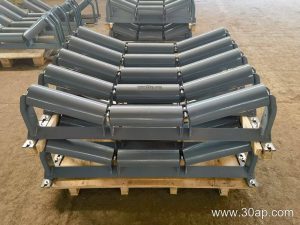
A self-aligning idler works alongside the conveyor belt, idler roller, conveyor pulley, and conveyor bracket. The belt itself may be an EP conveyor belt, a steel cord conveyor belt, or a fabric core conveyor belt depending on tension and distance. In a mine, a heavy-duty mining conveyor belt may run over three-roll troughing idlers, with self-aligning idlers placed at strategic points to control wander.
Common Sizes and Selection Notes
Self-aligning idlers are usually matched to belt width and conveyor duty. The table below shows common reference values; actual dimensions should be confirmed with the conveyor design.
| Belt width | Common roller diameter | Typical idler group |
|---|---|---|
| B500 | Ø63 to Ø89 | Two-roll or three-roll |
| B650 | Ø76 to Ø108 | Three-roll troughing |
| B800 | Ø89 to Ø127 | Three-roll troughing |
| B1000 | Ø108 to Ø133 | Three-roll troughing |
| B1200 | Ø108 to Ø159 | Three-roll troughing |
| B1400 | Ø127 to Ø178 | Three-roll troughing |
| B1600 | Ø133 to Ø194 | Three-roll troughing |
| B1800 | Ø159 to Ø219 | Three-roll troughing |
Trough angles of 20, 30, 35, and 45 degrees are common. For training idlers, a slight forward tilt of about 1.5 to 2 degrees is sometimes used to help center the belt. Roller length varies with belt width, trough angle, and roll arrangement. For example, a three-roll troughing set on B800 may use a center roll around 315 mm and side rolls of different length; these are design examples, not fixed rules.
When specifying a self-aligning idler, consider belt width, belt speed, material lump size, loading conditions, and the available mounting space. Also check whether the conveyor uses a rubber conveyor belt, an abrasion resistant conveyor belt, or a heat resistant conveyor belt, because the idler surface and bearing seals should suit the operating temperature and dust level. For coal mining conveyor belt applications, flame retardant and anti-static properties are often required for the belt, and the idler should be selected to avoid sparking or excessive friction.
Installation and Maintenance Tips
Install self-aligning idlers square to the conveyor centerline and check that the pivot moves freely. Keep the roller surface clean; material buildup on one side can defeat the training action. Inspect bearings for noise, play, or overheating, and replace worn rollers before they damage the belt edge. On a quarry conveyor belt or a cement plant line, routine checks during shutdowns are usually enough to catch misalignment before it becomes a belt tracking problem.
Self-aligning idlers are not a substitute for proper belt tension, pulley alignment, or loading conditions. If a belt persistently wanders, inspect the conveyor pulley alignment, the belt splice, and the loading point before adding more training idlers. Used correctly, a self-aligning idler is a simple and effective way to protect the conveyor belt and keep bulk material moving in mining, cement, power, and aggregate operations.