What a Three-Roll Idler Bracket Does on a Conveyor
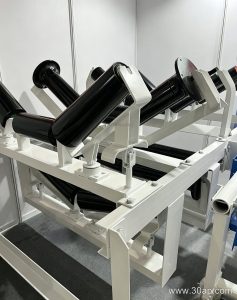
The three-roll idler bracket is the steel support assembly that holds three idler rollers in a trough shape beneath the conveyor belt. Two side rolls angle upward and one center roll sits flat, so the belt forms a cradle that keeps bulk material centered during travel. Without this bracket, the idlers have no fixed geometry, and the belt profile changes from one support station to the next. In a quarry or a cement plant, that inconsistency shows up quickly as spillage and edge wear.
The same assembly is often called a troughing idler bracket or troughing frame. Those names describe the same product: a bracket that positions three rolls at a set trough angle. It should not be confused with a return bracket, which carries the empty belt, or with any pulley type. Drive pulleys, tail pulleys and bend pulleys transmit or redirect belt tension; the three-roll bracket only supports the carrying run.
How the Bracket Is Built
Most brackets are fabricated from angle steel, channel steel or folded steel plate. A cross beam spans the conveyor frame, and two inclined arms carry the side idler mounts. The center roll usually sits in a fixed saddle or a pair of notches. Mounting holes are drilled to match the stringer spacing, and the hole pitch changes with belt width and trough angle rather than following one universal number.
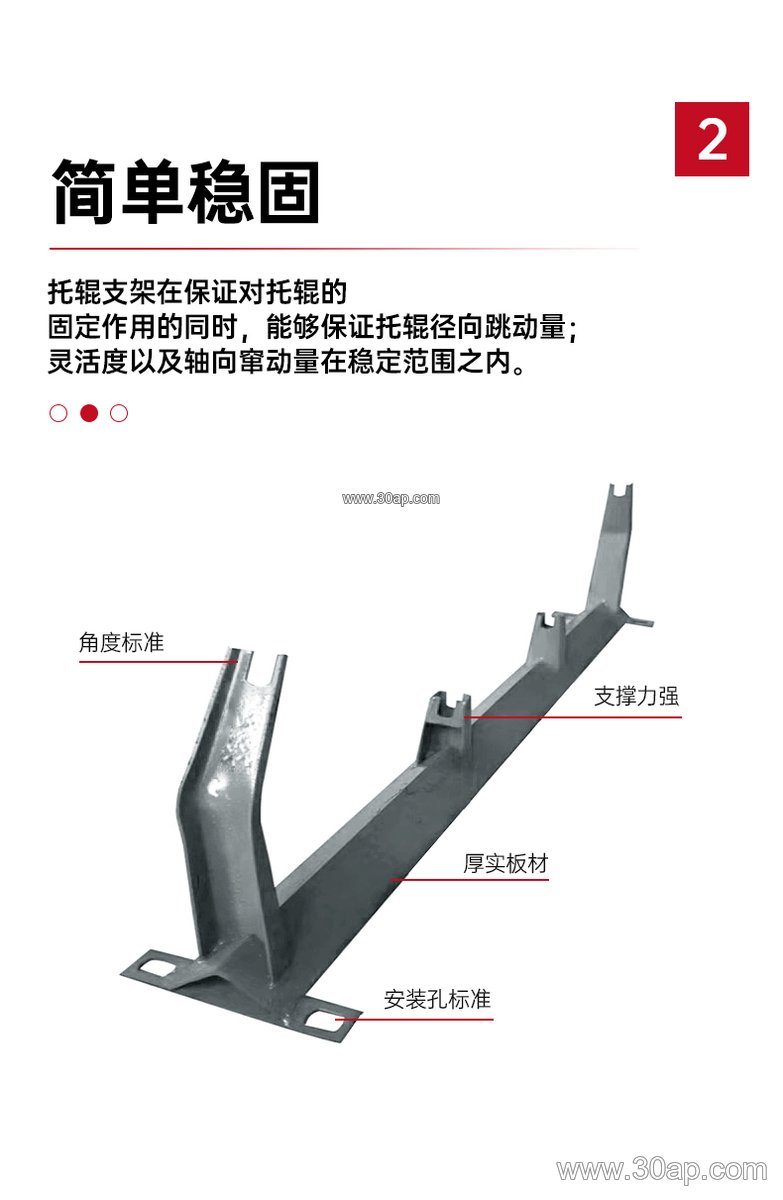
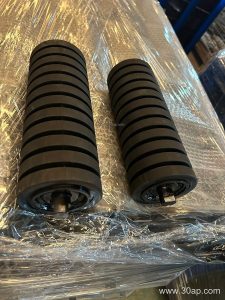
Common materials are painted carbon steel, and galvanized versions appear in wet or dusty service such as a coal washing plant. The bracket must resist vibration, belt load and occasional impact from lump material. At transfer points, a heavier bracket paired with impact idlers is a normal choice, because the standard troughing frame is not designed to absorb falling rock.
Angle, Width and Roll Diameter Work Together
Trough angle and belt width are selected as a set, not as isolated numbers. A 20 or 30 degree trough suits many moderate-capacity lines, while 35 and 45 degrees are common where material must be held more deeply, such as a steeply loaded crusher discharge. Adjustable brackets allow the angle to be changed within a range on site, which helps during commissioning.
The table below lists reference combinations often seen in catalogues and design drawings. They are examples, not fixed rules, and the final choice depends on belt speed, material density and the conveyor designer’s calculation.
| Belt width | Trough angle | Roll diameter | Typical use |
|---|---|---|---|
| B500 | 20 degrees | Ø89 | Small aggregate or sand line |
| B650 | 30 degrees | Ø89 | Light bulk handling |
| B800 | 35 degrees | Ø108 | General quarry duty |
| B1000 | 35 degrees | Ø108 or Ø133 | Cement plant raw material |
| B1200 | 45 degrees | Ø133 | High-capacity coal or ore |
| B1400 | 35 degrees | Ø159 | Power plant coal handling |
| B1600 | 45 degrees | Ø159 or Ø194 | Heavy mineral transport |
A wider belt does not force one angle or one roll size, and a given belt width can be paired with several roll diameters depending on load and idler series. Shaft diameter and bearing size follow the roller selection, so they should be confirmed with the idler supplier rather than guessed from belt width.
Where the Assembly Fits in a Plant
In a crushing and screening circuit, three-roll brackets line the main conveyor between the crusher and the screen deck. In an iron ore or limestone mine, they appear along the long overland carry sections. A power plant coal yard uses them on the belt feeding the bunker, and a fertilizer or grain silo facility uses lighter frames with sealed idlers. The bracket itself is passive hardware, but its alignment determines how well the conveyor belt tracks.
Buyer Checklist Before Ordering
- Confirm belt width, trough angle and required roll diameter as a matched set.
- Check frame stringer spacing and mounting hole pitch against the existing structure.
- Decide between fixed and adjustable brackets, especially where the angle may need tuning.
- Ask for the finish and steel grade if the site is wet, salty or highly abrasive.
- Match the bracket to the idler roller series, since bearing and shaft dimensions must agree.
- For transfer points, specify impact-rated frames rather than standard troughing brackets.
Maintenance is straightforward: inspect for bent arms, loose bolts and worn roll seats, and check alignment after any belt splice or frame repair. A well-chosen three-roll idler bracket keeps the belt profile stable, reduces spillage and extends the service life of both the conveyor belt and the idler rollers it carries.