What a Heavy-Duty Trough Idler Does on a Conveyor
A heavy-duty trough idler is the carrying roller set that supports the loaded conveyor belt and forms it into a trough. In a coal preparation plant or a limestone quarry, the belt may run fully loaded for long shifts, so this component has to hold the belt profile, keep the conveyor belt tracking, and protect the belt from unnecessary wear. The trough shape comes from two or three idler rollers mounted in a frame at a defined trough angle, usually 20, 30, 35 or 45 degrees.
The same product is also called a heavy-duty carrying idler or heavy trough roller set. Those names describe the same assembly, not a different component such as a return idler or a conveyor pulley.
How the Roller Set Is Built
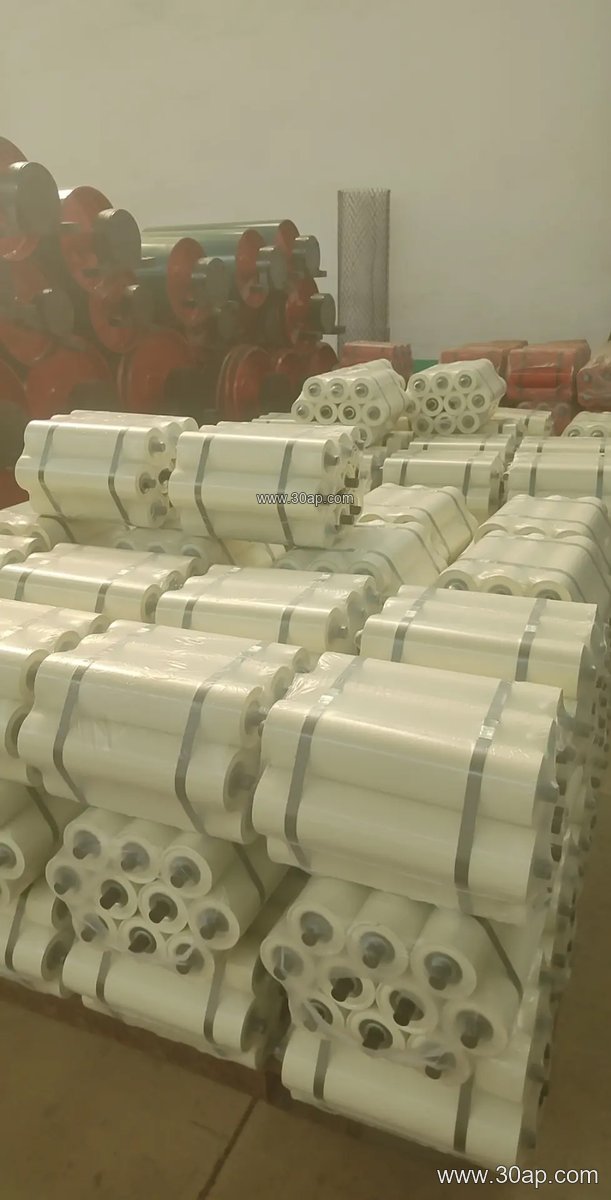
Each idler roller normally consists of a steel tube shell, a shaft, bearing housings and a sealing arrangement. Heavier service calls for thicker tube walls, reinforced end caps and robust bearing seats. Roller surfaces may be plain steel, nylon, ceramic or rubber rings, depending on whether the priority is abrasion resistance, material build-up control or belt grip.
Common bearing sizes in this class include 6204, 6205, 6305, 6306, 6308 and 6310. The bearing is selected together with the shaft and load rating; a given roller diameter does not lock the design to one bearing number. Shaft diameter is also a design decision based on load and frame geometry, not something that can be read from belt width alone.
Where Heavy-Duty Trough Idlers Are Used
These roller sets appear wherever the belt carries abrasive or heavy bulk material. In a cement plant they support clinker and raw meal lines; in a power station coal yard they carry the fuel feed; in an aggregate crushing and screening circuit they handle stone at high tonnage. The trough angle affects how the material sits: a steeper angle gives a deeper trough and better containment for fine, free-flowing loads, while a shallower angle suits wider, flatter material beds.
Frame design also matters. A three-roll trough set is common for wider belts, while two-roll and single-roll arrangements appear where space or belt width is limited. On a transition section near a conveyor pulley, idlers are often arranged in a graduated trough angle so the belt is not forced from flat to full trough in one step. That transition detail protects both the belt edges and the splice.
Common Dimensions and Reference Data
The table below gives typical reference values. They are examples for orientation, not fixed combinations or supply commitments. Final dimensions are confirmed by the conveyor design.
- Roller diameter options: Ø63, Ø76, Ø89, Ø102, Ø108, Ø127, Ø133, Ø159, Ø178, Ø194, Ø219
- Belt width options: B400, B500, B650, B800, B1000, B1200, B1400, B1600, B1800, B2000, B2200, B2400
- Trough angles: 20°, 30°, 35°, 45°
- Forward tilt for training effect: about 1.5° to 2°, used when belt tracking needs help
| Belt width | Typical roller length, three-roll trough | Typical trough angle range |
|---|---|---|
| B500 | about 200 mm | 20° to 35° |
| B650 | about 250 mm | 20° to 35° |
| B800 | about 315 mm | 20° to 35° |
| B1000 | about 380 mm | 30° to 35° |
| B1200 | about 465 mm | 30° to 35° |
| B1400 | about 530 mm | 30° to 45° |
| B1600 | about 600 mm | 35° to 45° |
| B1800 | about 670 mm | 35° to 45° |
| B2000 | about 750 mm | 35° to 45° |
Side rollers and the center roller may differ in length, especially where the trough angle is steep. These figures are common examples, not a rule that ties one belt width to one roller length.
What Buyers Should Check Before Ordering
Start with the belt width, trough angle and the mass of material per meter, because those determine the load on each idler roller. Ask for the roller diameter, shaft diameter, bearing size and seal type together, and confirm that the frame fits the existing conveyor bracket spacing. On a heavy-duty line, the seal design often decides service life: fine dust from a limestone or clinker operation will destroy an unprotected bearing quickly.
Also consider the environment. Wet, sticky material may call for a different surface form than dry, abrasive stone. If belt tracking is a recurring issue, a forward-tilted trough set or a separate training idler may help, but those are separate solutions and should not be confused with the carrying set itself. Drive pulleys, tail pulleys and bend pulleys are entirely different components and cannot substitute for a trough idler.
Finally, ask for a dimensional drawing and confirm roller rotation, mounting hole positions and frame material. A well-matched heavy-duty trough idler keeps the belt stable, reduces spillage and spreads the load evenly along the conveyor line.