What a Five-Roll Idler Bracket Does
A five-roll idler bracket is the support frame that holds five idler rollers under a troughed conveyor belt. Three rolls form the carrying trough, while two additional rolls extend the support toward the outer edges of the belt. This arrangement suits wide belts and high-capacity lines where a conventional three-roll bracket would leave the belt edges under-supported. In a quarry, a cement plant, or a power plant coal yard, the bracket keeps the belt profile stable and spreads the load across more rollers.
Buyers sometimes call this part a five-roll troughing bracket, a five-roll idler frame, or a five-roller support bracket. These names describe the same product. It is not a drive pulley, a tail pulley, or a bend pulley, and it should not be confused with a return bracket or a self-aligning bracket.
How the Bracket Is Built
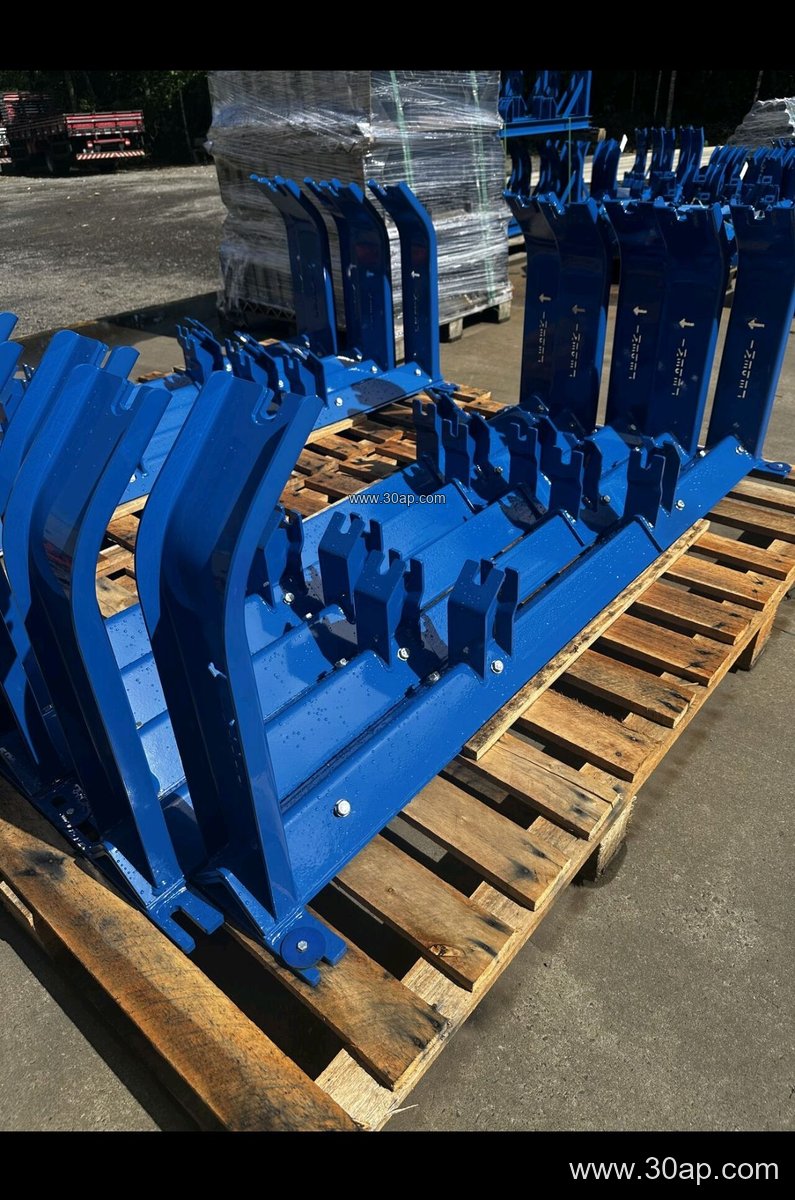
Most five-roll idler brackets are fabricated from angle steel, channel steel, or bent steel plate. The crossbeam carries mounting pads or slots for each roller, and the end sections are angled to create the trough. Because a five-roll layout has more mounting points than a three-roll frame, the bracket needs careful alignment so all five rolls sit at the correct height and angle.
- Crossbeam and end plates carry the roller loads and connect to the conveyor stringers.
- Roller seats set the trough angle and the spacing between rolls.
- Mounting holes suit the stringer spacing, which changes with belt width and trough angle.
- Finish is usually painted or galvanized, depending on the environment.
A common arrangement for a wider line is B1200, 35 degrees, with Ø133 rollers, but the bracket should be confirmed against the actual belt width, trough angle, and roller diameter. A B800 frame with Ø108 rollers is also common on medium-duty lines. Hole spacing and crossbeam length vary with the design and are not fixed numbers.
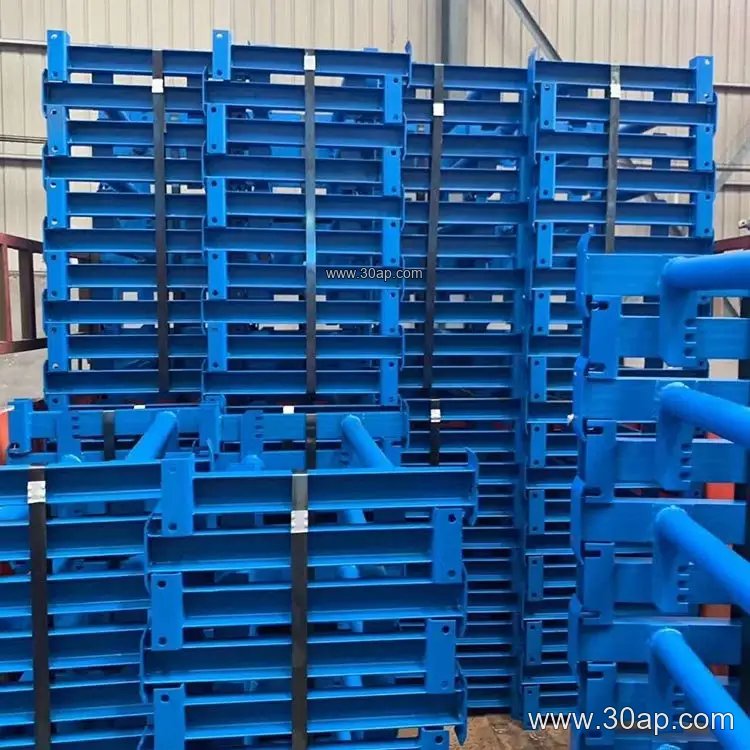
Where Five-Roll Frames Fit
These brackets appear where a wide belt needs extra edge support. One typical site is a limestone quarry feeding a primary crusher, where the belt carries sharp, heavy rock and the edges tend to droop. Another is a coal handling system at a power plant, where a flame retardant conveyor belt runs at high tonnage and the trough must stay stable.
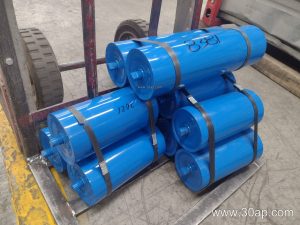
On a long overland line, a five-roll bracket can help when the belt is wide and the material is bulky. The extra rolls reduce the unsupported span at the belt edge and can improve tracking. The same idea applies on a heavy-duty mining conveyor belt or an abrasion resistant conveyor belt carrying ore. The bracket is only one part of the system, so it should be matched with the right idler roller, conveyor pulley, and belt specification.
Belt Width, Trough Angle, and Roller Diameter
The bracket must match the belt and the roller set. Common belt widths range from B500 to B2200, and common trough angles are 20, 30, 35, and 45 degrees. Roller diameters such as Ø89, Ø108, Ø133, Ø159, and Ø194 are used depending on load and belt speed. No single belt width locks in one trough angle or one roller diameter.
| Reference combination | Typical use |
|---|---|
| B650, 30 degrees, Ø89 | Light to medium duty, aggregate lines |
| B800, 35 degrees, Ø108 | General bulk handling |
| B1200, 35 degrees, Ø133 | Wider belts, higher tonnage |
| B1400, 45 degrees, Ø159 | Deep trough, large lump size |
These are reference examples only. The final combination should follow the conveyor design, the belt tension, and the material being carried. A five-roll bracket on a 1200mm or 1500mm wide conveyor belt needs the roller seats and crossbeam length to suit that width.
Fixed and Adjustable Versions
A fixed five-roll bracket holds one trough angle. An adjustable version lets the operator change the trough angle within a range, which can help during commissioning or when the belt load changes. Adjustable frames cost more and need more maintenance attention, but they offer flexibility. A fixed frame is simpler and often preferred where the duty is steady.
For comparison, a three-roll bracket is lighter and common on narrow belts, while a five-roll frame adds support on wide belts. A transition bracket near a conveyor pulley serves a different purpose, so it is not a substitute for the five-roll frame.
Buying Checklist
- Confirm belt width, trough angle, and roller diameter before ordering.
- Check stringer spacing and mounting hole pattern.
- Match the frame material and finish to the site, such as a dusty quarry or a wet coal yard.
- Confirm the roller set fits the bracket seats and that the belt has room for the five-roll trough.
- Ask for a drawing showing crossbeam length and roller positions.
A well-matched five-roll idler bracket keeps the belt profile steady, reduces edge wear, and supports reliable operation on wide, high-capacity conveyors.